Xu Yuepei, He Wen
Department of Psychology, Shanghai Normal University, Shanghai, China.
Front Public Health. 2019 May 22;7:118. doi: 10.3389/fpubh.2019.00118. eCollection 2019.
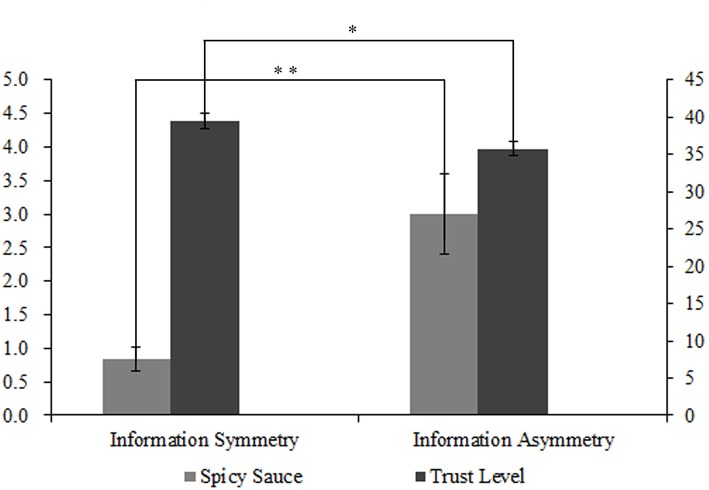
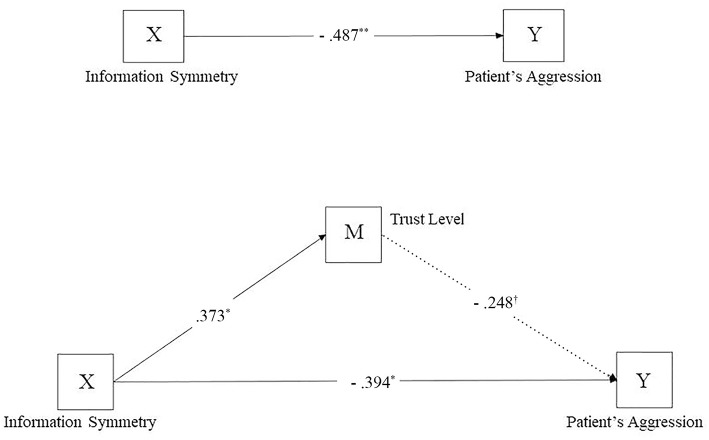
Information asymmetry is a widely studied economic phenomenon. It refers to the situation in which one group in a transaction has more information than the other. Nowadays, information asymmetry has been studied not only as a financial topic but also as a potential reason for essential social problems. To take Chinese doctor-patient relationship as an example and investigate the relationship among information asymmetry, trust level, and aggression behavior using an experimental design. A total of 44 undergraduates (information asymmetry group, = 22, 5 males, 17 females, mean age = 18.95, = 0.18; information symmetry group, = 22, 7 males, 15 females, mean age = 19.27, = 0.18) took part in our experiment. Different slides and guidance were used to create a virtual information asymmetry situation, and we use the Wake Forest Physician Trust Scale (WFPTS) and the hot sauce allocation paradigm to measure their trust level and aggression, respectively. Participants in the information asymmetry group allocated significantly more hot sauce to the doctor ( <.005, = 1.09) and displayed significantly lower trust level ( < 0.05, = -0.78) than the control group. Patients' trust level had a significant mediating effect (95% confidence interval [-1.39, -0.05]). Asymmetric information may arouse patients' aggression and lower their trust in doctors. Patients' trust level is also a significant partial mediator between their aggression and information asymmetry. The current study reinforces the urgent need for information openness in the Chinese medical system.
信息不对称是一种被广泛研究的经济现象。它指的是交易中的一方比另一方拥有更多信息的情况。如今,信息不对称不仅被作为一个金融话题来研究,还被视为一些重大社会问题的潜在原因。以中国医患关系为例,通过实验设计来研究信息不对称、信任水平和攻击行为之间的关系。共有44名本科生(信息不对称组,n = 22,5名男性,17名女性,平均年龄 = 18.95,标准差 = 0.18;信息对称组,n = 22,7名男性,15名女性,平均年龄 = 19.27,标准差 = 0.18)参与了我们的实验。使用不同的幻灯片和指导来营造虚拟的信息不对称情境,我们分别使用维克森林医生信任量表(WFPTS)和辣酱分配范式来测量他们的信任水平和攻击性。信息不对称组的参与者给医生分配的辣酱显著更多(p <.005,Cohen's d = 1.09),并且显示出的信任水平显著低于对照组(p < 0.05,Cohen's d = -0.78)。患者的信任水平具有显著的中介作用(95%置信区间[-1.39, -0.05])。信息不对称可能会引发患者的攻击行为并降低他们对医生的信任。患者的信任水平也是他们的攻击行为和信息不对称之间的一个显著部分中介变量。当前的研究强化了中国医疗系统中信息公开的迫切需求。