Raaj Gowthama, Manimaran Pulliappan, Kumar Chandran Dhinesh, Sadan Duraisamy Sai, Abirami Mathivanan
Department of Prosthodontics and Crown and Bridge, K.S.R Institute of Dental Science and Research, Tiruchengode, Tamil Nadu, India.
Department of Prosthodontics, J.K.K. Nattraja Dental College and Hospital, Komarapalayam, Tamil Nadu, India.
J Pharm Bioallied Sci. 2019 May;11(Suppl 2):S347-S354. doi: 10.4103/JPBS.JPBS_29_19.
Success or failure of dental implants depends on the amount of stress transferred to the surrounding bone. Increased amount of loading to the bone through implant cause failure, whereas decrease in the amount of loading to the bone causes improved success rate of implants. Biomechanical interaction between implant and bone decides the long-term function or prognosis of dental implant system.
The aims of this study were to evaluate the influence of implant length and diameter on stress distribution, to understand the stress distribution around bone-implant interface, and to understand the response of bone under axial and non-axial loading conditions.
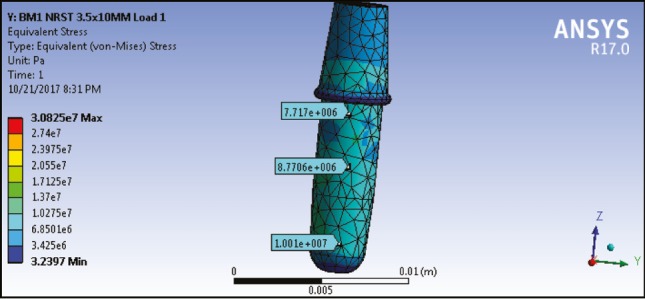
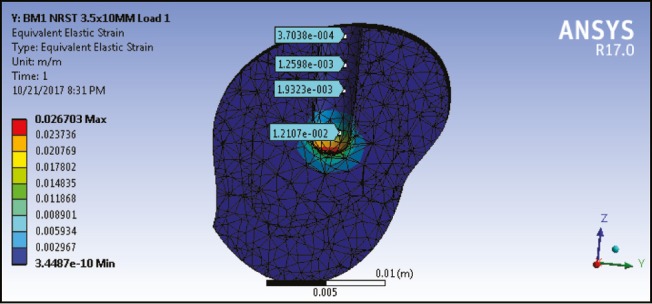
Finite element three-dimensional mandibular model was made using cone beam computed tomography of patient with completely edentulous mandible, and in that model five posterior bone segments were selected. NobelReplace Select Tapered implants with diameters and lengths 3.5 × 10 mm, 4.3 × 10 mm, 3.5 × 11.5 mm, and 4.3 × 11.5 mm, respectively were selected and three dimensionally modeled using Creo 2.0 Parametric Pro/E software. Bone and implant models were assembled as 20 models and finite element analysis was performed using ANSYS Workbench v17.0 under axial and non-axial loads.
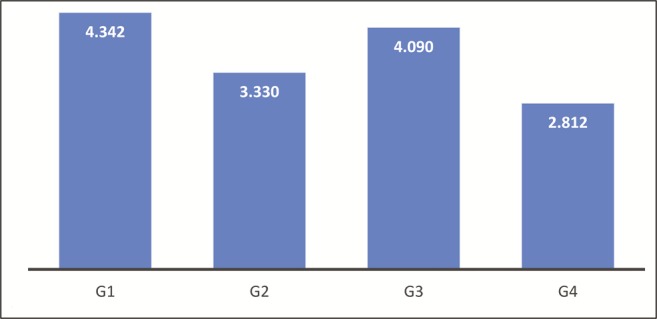
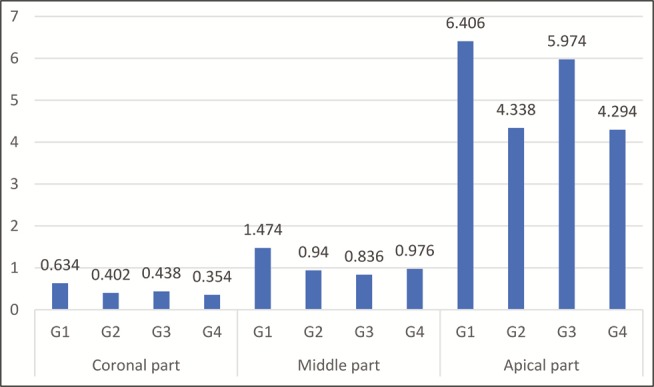
Under axial and non-axial loads, 3.5 × 10 mm implant showed maximum von Mises stress and strain in both cortical and cancellous bone whereas implant with diameter and length 4.3 × 11.5 mm showed minimum von Mises stress and strain in both cortical and cancellous bone.
In axial and non-axial loads, amount of stress distribution around implant-bone interface is influenced by diameter and length of implant in cortical and cancellous bone, respectively. Increased diameter of the implant produces the minimum stress in cortical bone. Increased length of the implant produces the minimum stress in cancellous bone.
牙种植体的成功或失败取决于传递至周围骨组织的应力大小。通过种植体传递至骨组织的负荷增加会导致种植失败,而传递至骨组织的负荷减少则会提高种植成功率。种植体与骨组织之间的生物力学相互作用决定了牙种植系统的长期功能或预后。
本研究的目的是评估种植体长度和直径对应力分布的影响,了解骨-种植体界面周围的应力分布,并了解轴向和非轴向加载条件下骨组织的反应。
使用全口无牙下颌患者的锥形束计算机断层扫描数据制作有限元三维下颌模型,并在该模型中选择五个后牙骨段。分别选取直径和长度为3.5×10mm、4.3×10mm、3.5×11.5mm和4.3×11.5mm的NobelReplace Select锥形种植体,使用Creo 2.0参数化Pro/E软件进行三维建模。将骨模型和种植体模型组装成20个模型,并使用ANSYS Workbench v17.0在轴向和非轴向载荷下进行有限元分析。
在轴向和非轴向载荷下,3.5×10mm种植体在皮质骨和松质骨中均表现出最大的von Mises应力和应变,而直径和长度为4.3×11.5mm的种植体在皮质骨和松质骨中均表现出最小的von Mises应力和应变。
在轴向和非轴向载荷下,种植体-骨界面周围的应力分布量分别受皮质骨和松质骨中种植体直径和长度的影响。种植体直径增加会使皮质骨中的应力最小。种植体长度增加会使松质骨中的应力最小。