Section of Environment and Radiation, International Agency for Research on Cancer (IARC), Lyon, France.
Inorganic Geochemistry, Centre for Environmental Geochemistry, British Geological Survey, Nottingham, UK.
Environ Int. 2019 Sep;130:104721. doi: 10.1016/j.envint.2019.03.069. Epub 2019 Jun 14.
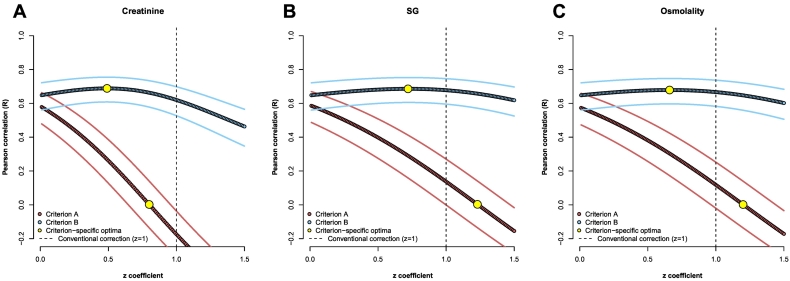
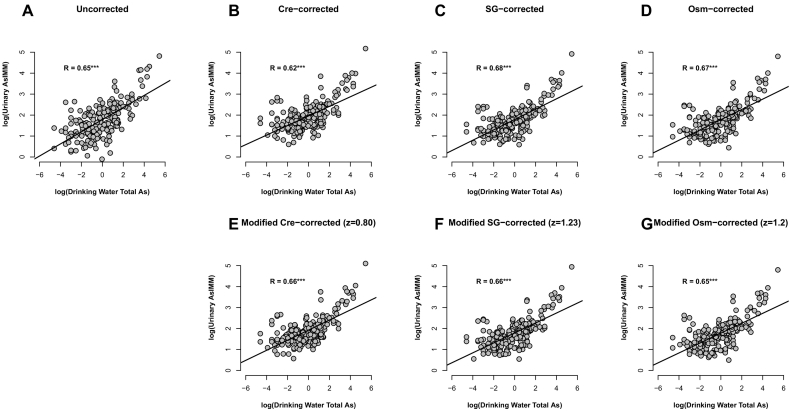
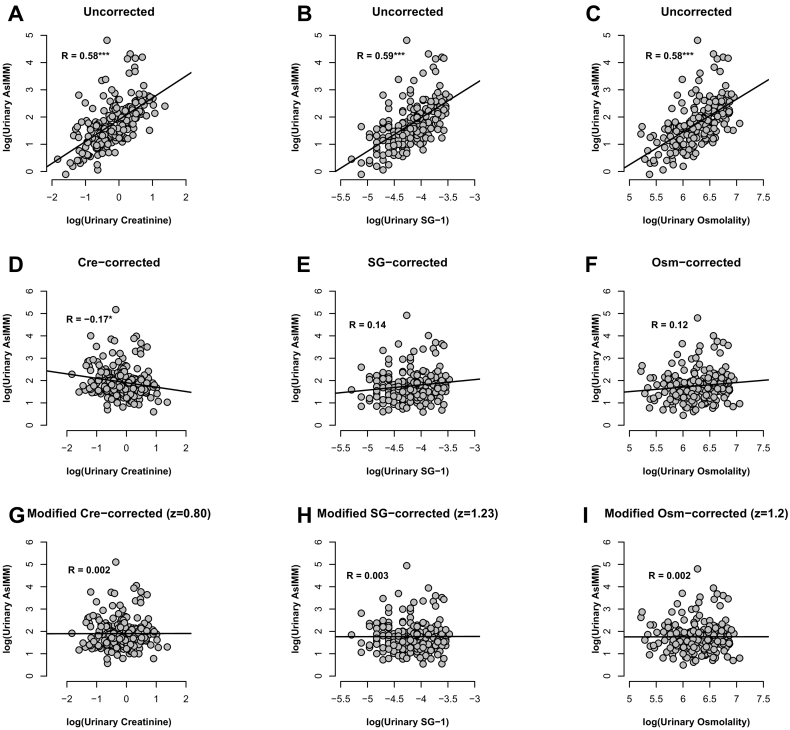
Spot urinary concentrations of environmental exposure biomarkers require correction for dilution. There is no consensus on the most appropriate method, with creatinine used by default despite lacking theoretical robustness. We comparatively assessed the efficacy of creatinine; specific gravity (SG); osmolality and modifications of all three for dilution correcting urinary arsenic. For 202 participants with urinary arsenic, creatinine, osmolality and SG measurements paired to drinking water As, we compared the performance corrections against two independent criteria: primarily, (A) correlations of corrected urinary As and the dilution measurements used to correct them - weak correlations indicating good performance and (B) correlations of corrected urinary As and drinking water As - strong correlations indicating good performance. More than a third of variation in spot urinary As concentrations was attributable to dilution. Conventional SG and osmolality correction removed significant dilution variation from As concentrations, whereas conventional creatinine over-corrected, and modifications of all three removed measurable dilution variation. Modified creatinine and both methods of SG and osmolality generated stronger correlations of urinary and drinking water As concentrations than conventional creatinine, which gave weaker correlations than uncorrected values. A disparity in optima between performance criteria was observed, with much smaller improvements possible for Criterion B relative to A. Conventional corrections - particularly creatinine - limit the utility spot urine samples, whereas a modified technique outlined here may allow substantial improvement and can be readily retrospectively applied to existing datasets. More studies are needed to optimize urinary dilution correction methods. Covariates of urinary dilution measurements still warrant consideration.
尿液中环境暴露生物标志物的浓度需要进行稀释校正。尽管缺乏理论上的稳健性,但默认使用肌酐作为最适方法仍未达成共识。我们比较评估了肌酐、比重(SG)、渗透压以及这三种方法的改良方法在尿液砷稀释校正中的效果。对于 202 名有尿液砷、肌酐、渗透压和 SG 测量值的参与者,我们将这些数据与饮用水砷进行了配对,并比较了校正方法对两种独立标准的性能:首先,(A)校正后尿液砷与用于校正的稀释测量值之间的相关性——弱相关性表明性能良好,(B)校正后尿液砷与饮用水砷之间的相关性——强相关性表明性能良好。超过三分之一的点尿砷浓度的变异归因于稀释。传统的 SG 和渗透压校正可去除砷浓度中的显著稀释变异,而传统的肌酐校正过度,三种方法的改良版本均可去除可测量的稀释变异。改良的肌酐和 SG 及渗透压两种方法生成的尿液和饮用水砷浓度之间的相关性均强于传统肌酐,后者的相关性弱于未校正值。在性能标准之间观察到最佳值的差异,相对于 A 标准,B 标准的改进幅度可能要小得多。传统的校正方法——特别是肌酐——限制了点尿样的实用性,而这里概述的改良技术可能会有显著的改进,并可方便地应用于现有数据集。需要进行更多的研究来优化尿液稀释校正方法。尿液稀释测量的协变量仍值得考虑。