Zhang Xi, Hina Aiman, Song Shiyu, Kong Jiejie, Bhat Javaid Akhter, Zhao Tuanjie
Soybean Research Institution, National Center for Soybean Improvement, Key Laboratory of Biology and Genetics and Breeding for Soybean, Ministry of Agriculture, State Key Laboratory of Crop Genetics and Germplasm Enhancement, Nanjing Agricultural University, Nanjing, 210095, China.
BMC Genomics. 2019 Jun 17;20(1):499. doi: 10.1186/s12864-019-5897-5.
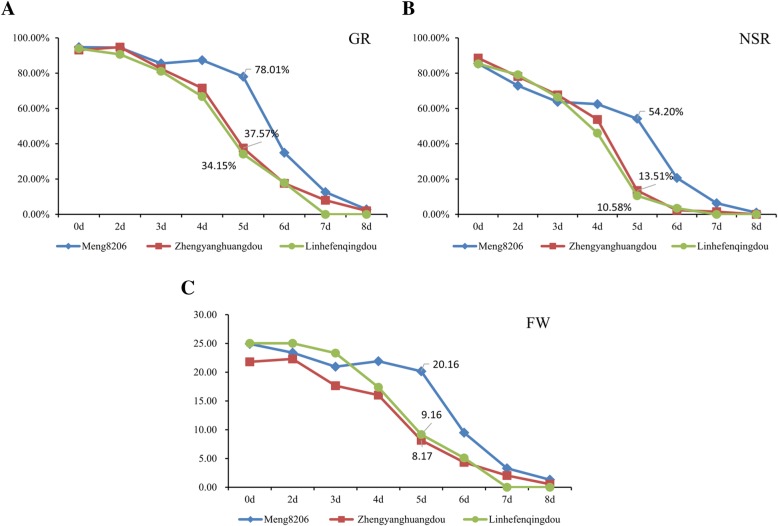
Seed aging in soybean is a serious challenge for agronomic production and germplasm preservation. However, its genetic basis remains largely unclear in soybean. Unraveling the genetic mechanism involved in seed aging, and enhancing seed storability is an imperative goal for soybean breeding. The aim of this study is to identify quantitative trait loci (QTLs) using high-density genetic linkage maps of soybean for seed storability. In this regard, two recombinant inbred line (RIL) populations derived from Zhengyanghuangdou × Meng 8206 (ZM6) and Linhefenqingdou × Meng 8206 (LM6) crosses were evaluated for three seed-germination related traits viz., germination rate (GR), normal seedling length (SL) and normal seedling fresh weight (FW) under natural and artificial aging conditions to map QTLs for seed storability.
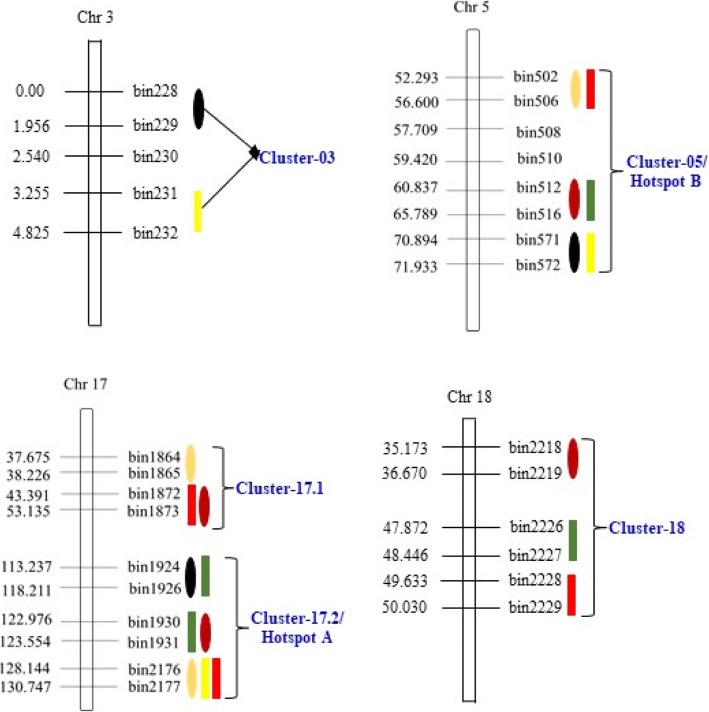
A total of 34 QTLs, including 13 QTLs for GR, 11 QTLs for SL and 10 QTLs for FW, were identified on 11 chromosomes with the phenotypic variation ranged from 7.30 to 23.16% under both aging conditions. All these QTLs were novel, and 21 of these QTLs were clustered in five QTL-rich regions on four different chromosomes viz., Chr3, Chr5, Chr17 &Chr18, among them the highest concentration of seven and six QTLs were found in "QTL hotspot A" (Chr17) and "QTL hotspot B" (Chr5), respectively. Furthermore, QTLs within all the five QTL clusters are linked to at least two studied traits, which is also supported by highly significant correlation between the three germination-related traits. QTLs for seed-germination related traits in "QTL hotspot B" were found in both RIL populations and aging conditions, and also QTLs underlying "QTL hotspot A" are identified in both RIL populations under artificial aging condition. These are the stable genomic regions governing the inheritance of seed storability in soybean, and will be the main focus for soybean breeders.
This study uncovers the genetic basis of seed storability in soybean. The newly identified QTLs provides valuable information, and will be main targets for fine mapping, candidate gene identification and marker-assisted breeding. Hence, the present study is the first report for the comprehensive and detailed investigation of genetic architecture of seed storability in soybean.
大豆种子老化是农业生产和种质保存面临的严峻挑战。然而,大豆种子老化的遗传基础在很大程度上仍不清楚。阐明种子老化的遗传机制并提高种子耐贮性是大豆育种的迫切目标。本研究旨在利用大豆高密度遗传连锁图谱鉴定种子耐贮性的数量性状位点(QTL)。为此,对由正阳黄豆×蒙8206(ZM6)和临河粉青豆×蒙8206(LM6)杂交产生的两个重组自交系(RIL)群体,在自然老化和人工老化条件下,评估了三个与种子萌发相关的性状,即发芽率(GR)、正常幼苗长度(SL)和正常幼苗鲜重(FW),以绘制种子耐贮性的QTL图谱。
在11条染色体上共鉴定出34个QTL,其中包括13个GR的QTL、11个SL的QTL和10个FW的QTL,在两种老化条件下,表型变异范围为7.30%至23.16%。所有这些QTL都是新发现的,其中21个QTL聚集在4条不同染色体(Chr3、Chr5、Chr17和Chr18)上的5个QTL富集区域,其中在“QTL热点A”(Chr17)和“QTL热点B”(Chr5)中分别发现了浓度最高的7个和6个QTL。此外,所有5个QTL簇中的QTL都与至少两个研究性状相关,这也得到了三个与萌发相关性状之间高度显著相关性的支持。在两个RIL群体和老化条件下均发现了“QTL热点B”中与种子萌发相关性状的QTL,并且在人工老化条件下的两个RIL群体中也鉴定出了“QTL热点A”中的QTL。这些是控制大豆种子耐贮性遗传的稳定基因组区域,将是大豆育种者的主要关注重点。
本研究揭示了大豆种子耐贮性的遗传基础。新鉴定的QTL提供了有价值的信息,将成为精细定位、候选基因鉴定和标记辅助育种的主要目标。因此,本研究是首次对大豆种子耐贮性遗传结构进行全面详细研究的报告。