Department of Laboratory Medicine, College of Medicine, Seoul St. Mary's Hospital, Catholic University of Korea, Banpodaero 222, Seocho-gu, Seoul, 06591, South Korea.
BMC Infect Dis. 2019 Jun 17;19(1):531. doi: 10.1186/s12879-019-4141-x.
Clinical microbiology laboratories are asked to process large numbers of urine specimens for culture, but only 20-40% of them are positive. Therefore, a rapid, reliable screening method is necessary to speed up the reporting of a negative result. In this study, we evaluated the iQ200/iChem workstation, which is a combination of digital imaging software and a strip reader to predict negative urine culture.
A total of 1942 urine specimens were processed through both culture and iQ200/ iChem workstation. We analyzed the performance using two definition of positive urine culture; one or two potential uropathogens at a concentration of ≥10 CFU/ml and ≥ 10 CFU/ml. We assessed combinations of parameters (ASP; all small particles, WBC; leukocyte, BACT; bcteria, LE; leukocyte esterase) applying various cut-offs which can achieve the negative predictive value (NPV) ≥97% and culture reduction rate ≥ 50%.
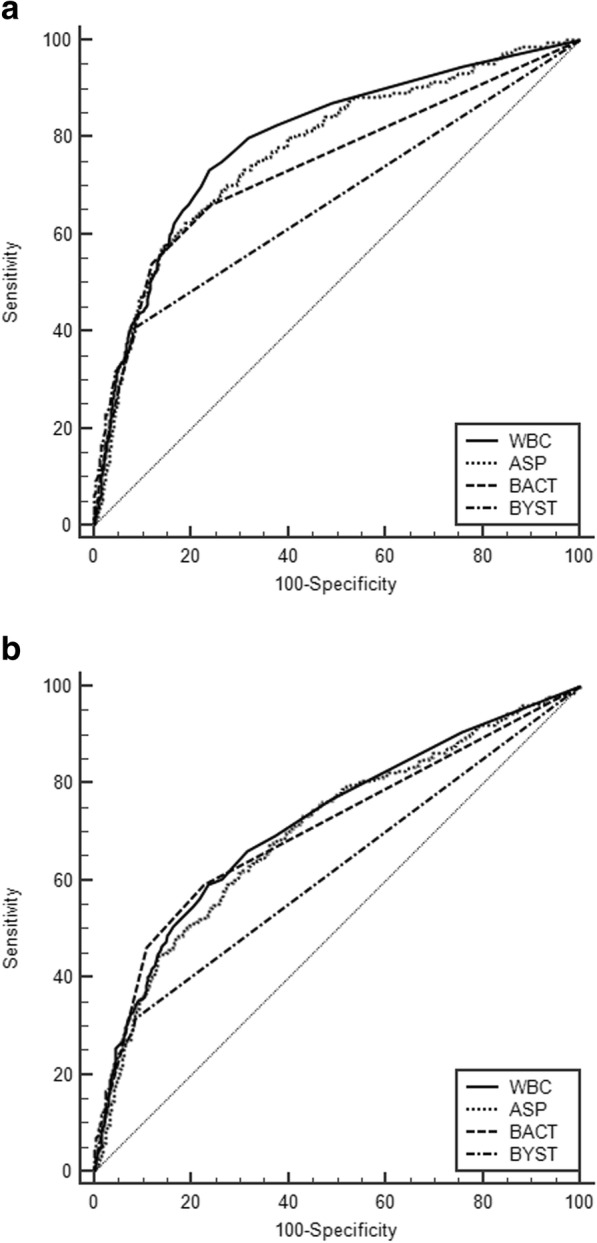
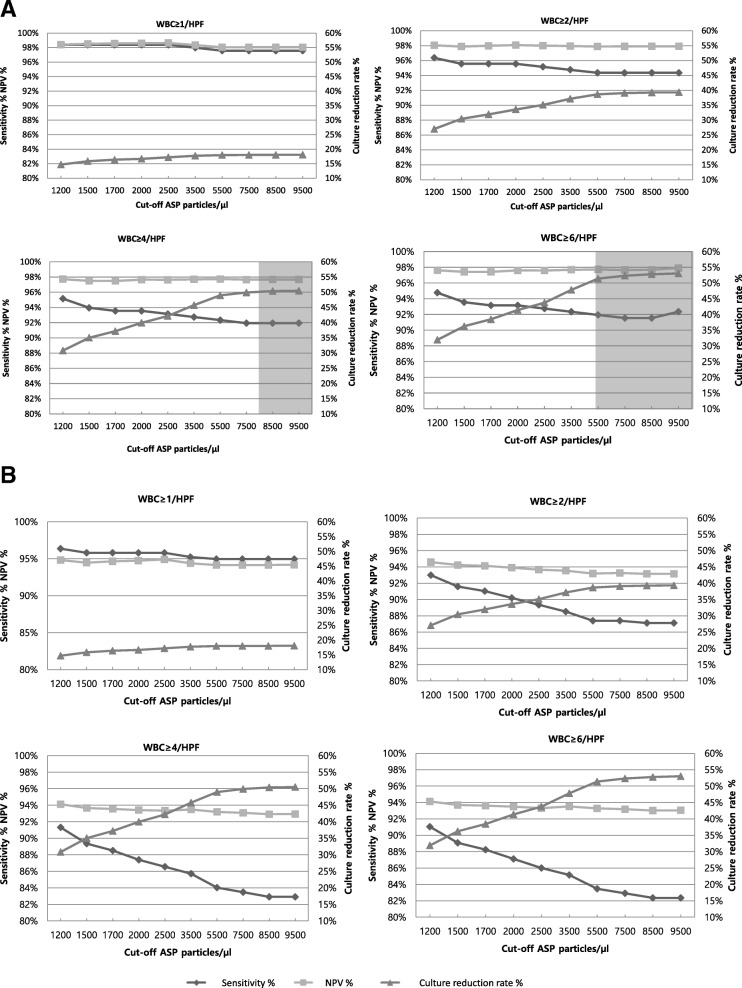
The culture positive rate was 12.8 and 18.4% applying the criteria of ≥10 CFU/ml and ≥ 10 CFU/ml, respectively. The area under the curve (AUC) of each parameter for ≥10 CFU/ml / ≥10 CFU/ml bacteriuria was 795 /0.719 for WBC, 0.722 / 0.701 for ASP and 0.740 /0.704 for bacteria. Therefore, we investigated the combination of the parameters. With the fixed parameter of BACT≥1/HPF and positive LE, the combinations of WBC ≥ 4/HPF and ASP ≥8500/μl or WBC ≥ 6/HPF and ASP≥5500/μl showed good performance for detecting ≥10 CFU/ml uropathogen. The ranges of sensitivity, specificity, negative predictive value and culture reduction rate were 91.5-92.3%, 49.8-52.6%, 97.7-97.9% and 50.4-53.0%, respectively. However, none of the combined setting yielded acceptable range of NPV for detecting ≥10 CFU/ml uropathogen (NPV 92.9-94.9%). Enterococcus spp. was the most common uropathogen causing the false negative results (55.7%), and also the main pathogen among the positive culture of 10 CFU/ml bacteriuria (45%).
iQ200/iChem workstation was excellent in detection of ≥10 CFU/ml uropathogen, but unsatisfactory in detection of 10 CFU/ml uropathogen and Enterococcus spp. It can be useful for screening of urine specimens to reduce bacterial culture. However, notice from clinician will be necessary for specimens from the patients with high risk for UTI, such as pregnant woman, infant, elderly or immune compromised patients.
临床微生物学实验室被要求对大量尿液标本进行培养,但只有 20-40%的标本呈阳性。因此,需要一种快速、可靠的筛选方法来加快阴性结果的报告。在这项研究中,我们评估了 iQ200/iChem 工作站,它是一种结合了数字成像软件和条带阅读器的方法,用于预测阴性尿液培养结果。
总共对 1942 份尿液标本进行了培养和 iQ200/iChem 工作站检测。我们使用两种不同的定义来分析阳性尿液培养的性能:一种或两种潜在的尿路病原体,浓度≥10 CFU/ml 和≥10 CFU/ml。我们评估了各种参数(ASP;所有小颗粒,WBC;白细胞,BACT;细菌,LE;白细胞酯酶)的组合,应用不同的截止值可以达到阴性预测值(NPV)≥97%和培养物减少率≥50%。
应用≥10 CFU/ml 和≥10 CFU/ml 的标准,培养阳性率分别为 12.8%和 18.4%。每个参数的曲线下面积(AUC)对于≥10 CFU/ml/≥10 CFU/ml 菌尿症分别为 WBC 的 0.722/0.719、ASP 的 0.740/0.704 和细菌的 0.722/0.701。因此,我们研究了参数的组合。固定参数为 BACT≥1/HPF 和阳性 LE,WBC≥4/HPF 和 ASP≥8500/μl 或 WBC≥6/HPF 和 ASP≥5500/μl 的组合对检测≥10 CFU/ml 尿路病原体具有良好的性能。灵敏度、特异性、阴性预测值和培养物减少率的范围分别为 91.5-92.3%、49.8-52.6%、97.7-97.9%和 50.4-53.0%。然而,没有任何组合设置能够在检测≥10 CFU/ml 尿路病原体时达到可接受的 NPV 范围(NPV 92.9-94.9%)。肠球菌属是导致假阴性结果的最常见尿路病原体(55.7%),也是阳性培养物中 10 CFU/ml 菌尿症(45%)的主要病原体。
iQ200/iChem 工作站在检测≥10 CFU/ml 尿路病原体方面表现出色,但在检测 10 CFU/ml 尿路病原体和肠球菌属方面表现不佳。它可用于筛选尿液标本以减少细菌培养。然而,对于有尿路感染高风险的患者(如孕妇、婴儿、老年人或免疫功能低下的患者)的标本,临床医生需要注意。