Department of Pediatrics and Child Health Nursing, School of Nursing, College of Medicine and Health Sciences, University of Gondar, P.O. BOX: 196, Gondar, Ethiopia.
BMC Infect Dis. 2019 Jun 17;19(1):534. doi: 10.1186/s12879-019-4156-3.
Late presentation to HIV/AIDS care which is attended by problems like, poor treatment outcomes, early development of opportunistic infections, increased healthcare costs, and mortality is a major problem in Ethiopia. Although evidences are available on the prevalence and associated factors of late presentation to HIV/AIDS care, discrepancies among findings are appreciated. Thus, the country has faced difficulties of having a single estimated data.
This study aimed to estimate the pooled prevalence of late presentation of HIV positive adults to HIV/AIDS care and its predictors in Ethiopia.
We searched all available articles through Google Scholar, PubMed, Web of Sciences, and EMBASE databases. Additionally, we accessed articles from the Ethiopian institutional online research repositories and reference lists of included studies. We included cohort, case- control, and cross-sectional studies in our review. Besides, we utilized the weighted inverse variance random-effects model. The total percentage of variation among studies due to heterogeneity was determined by I statistic. Searching was limited to studies conducted in Ethiopia and published in the English language. Publication bias was checked by Egger's regression test.
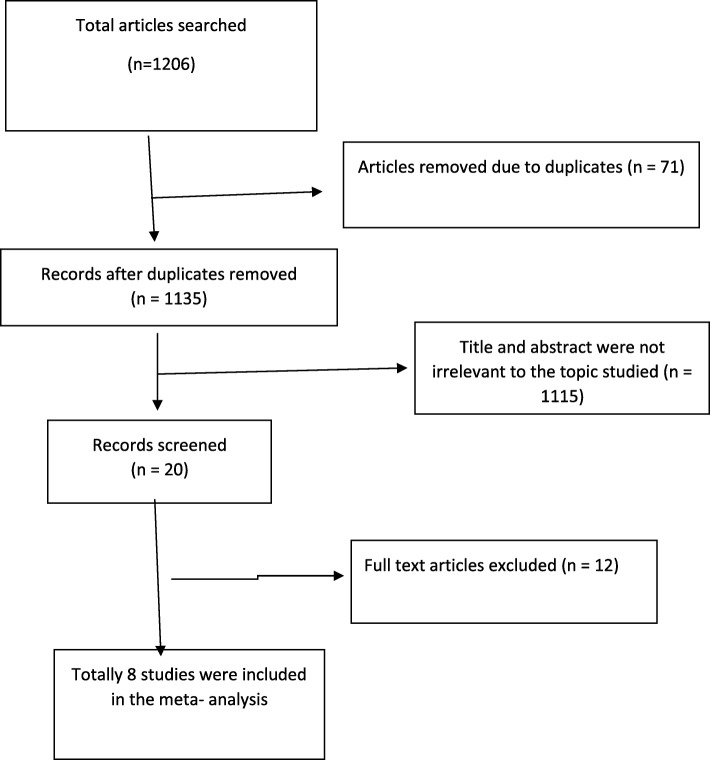
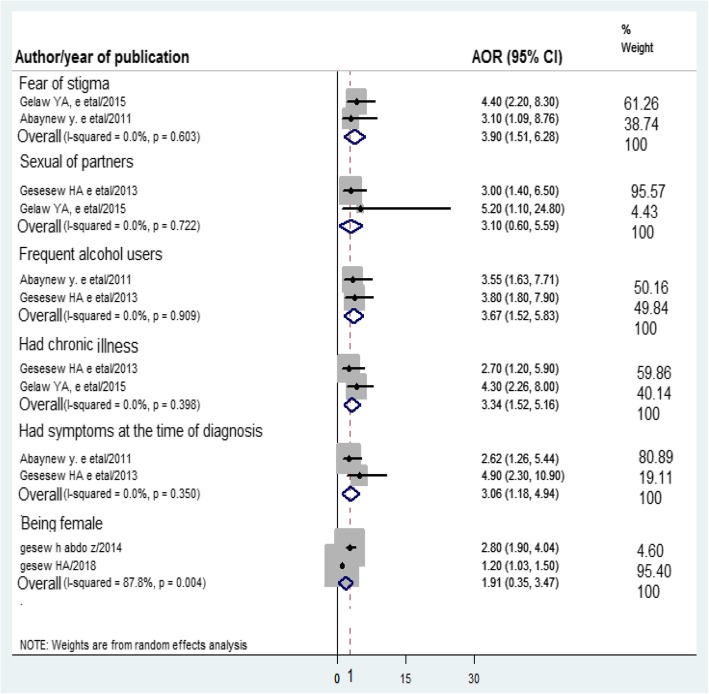
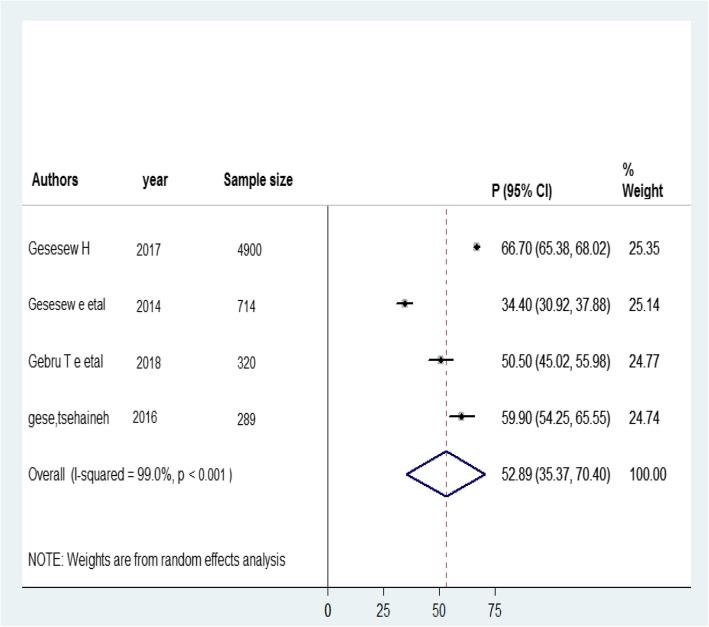
A total of 8 studies with 7, 568 participants were included. The pooled prevalence of late presentation to HIV/AIDS care was 52.89% (95%CI: 35.37, 70.40). The odds of late presentation to HIV/AIDS care of frequent alcohol users [3.67(95% CI = 1.52-5.83)], high fear of stigma [3.90 (95% CI = 1.51-6.28)], chronic illness [3.34(95% CI = 1.52-5.16)], and the presence of symptoms at the time of HIV diagnosis [3.06 (95% CL = 1.18-4.94)] were higher compared to participants who did not experience the preceding.
The prevalence of late presentation of HIV positive adults to HIV/AIDS care was high in Ethiopia. Frequent alcohol use, high fear of stigma, chronic illness, and the presence of symptoms at the time of HIV diagnosis were associated with high odds of late presentation to HIV/AIDS care.
Registered in PROSPERO databases with the registration number of CRD42018081840 .
在埃塞俄比亚,艾滋病毒/艾滋病护理的晚期就诊存在治疗效果不佳、早期机会性感染、医疗保健费用增加和死亡率高等问题。尽管已经有关于艾滋病毒阳性成年人艾滋病毒/艾滋病护理晚期就诊的患病率和相关因素的证据,但研究结果存在差异。因此,该国一直难以获得单一的估计数据。
本研究旨在估计埃塞俄比亚艾滋病毒阳性成年人艾滋病毒/艾滋病护理晚期就诊的综合患病率及其预测因素。
我们通过 Google Scholar、PubMed、Web of Sciences 和 EMBASE 数据库搜索了所有可用的文章。此外,我们还从埃塞俄比亚机构在线研究资源库和纳入研究的参考文献列表中获取了文章。我们在综述中纳入了队列研究、病例对照研究和横断面研究。此外,我们还利用加权倒数方差随机效应模型。研究之间由于异质性而导致的总变异百分比由 I 统计量确定。搜索仅限于在埃塞俄比亚进行的和以英文发表的研究。通过 Egger 回归检验检查发表偏倚。
共有 8 项研究纳入了 7568 名参与者。艾滋病毒/艾滋病护理晚期就诊的综合患病率为 52.89%(95%CI:35.37,70.40)。经常饮酒者[3.67(95%CI=1.52-5.83)]、高度惧怕污名[3.90(95%CI=1.51-6.28)]、慢性疾病[3.34(95%CI=1.52-5.16)]和艾滋病毒诊断时出现症状[3.06(95%CL=1.18-4.94)]的艾滋病毒阳性成年人更有可能延迟就诊。
在埃塞俄比亚,艾滋病毒阳性成年人艾滋病毒/艾滋病护理的晚期就诊率很高。经常饮酒、高度惧怕污名、慢性疾病和艾滋病毒诊断时出现症状与艾滋病毒/艾滋病护理的晚期就诊率较高相关。
在 PROSPERO 数据库中注册,注册号为 CRD42018081840 。