Wang Ning, Qiu Changlu, Chen Minnan, Liu Ting, Wang Ting
School of Food and Bioengineering, Hefei University of Technology, 193 Tun Brook Road, Hefei 230009, Anhui, China.
School of Pharmacy, Anhui Medical University, 81 Plum Hill Road, Hefei 230032, Anhui, China.
Vaccines (Basel). 2019 Jun 17;7(2):52. doi: 10.3390/vaccines7020052.
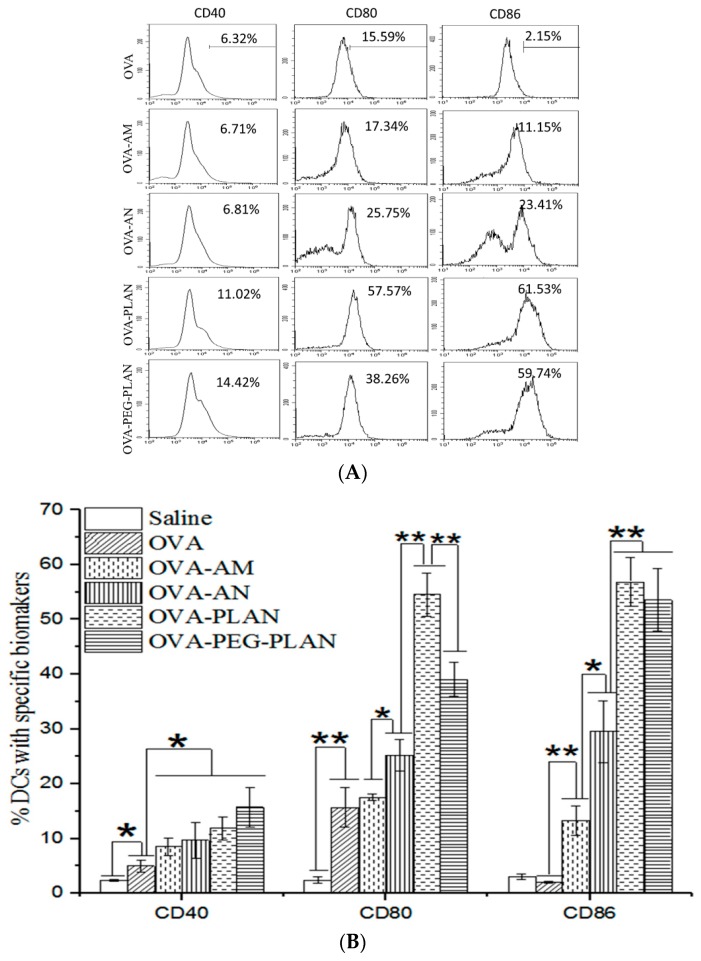
Subunit vaccines have advantages of good safety, minimal reactogenicity, and high specificity. However, subunit vaccines also show a crucial disadvantage of poor immunogenicity and, therefore, are often formulated with an adjuvant carrier to form a vaccine adjuvant-delivery system (VADS) to enhance their efficacies. Alums, the coarse aggregates of the insoluble aluminum salts, are the conventional adjuvants and have been widely used in clinical vaccines for a long time. Unfortunately, alums also show two main drawbacks of low potency in eliciting cellular immunity, and high reactogenicity to cause unwanted inflammations. Therefore, herein the phospholipid bilayer-coated aluminum oxide nanoparticles (PLANs) and the PEGylated PLANs (PEG-PLANs) were engineered as a VADS to overcome the drawbacks of both subunit vaccines and coarse alums, while synergizing their functions. In vitro experiments demonstrated that, unlike the micron-sized alums, the nanosized PLANs and PEG-PLANs loaded with model antigen of ovalbumin (OVA) showed a high safety profile and were able to promote APC (antigen-presenting cell) uptake and engender lysosome escape for enhancing the MHC (major histocompatibility complex)-I-antigen display. Subcutaneously administered to mice, PLANs and, especially, PEG-PLANs smoothly trafficked into the draining lymph nodes, wherein the densely clustered immune cells were activated in substantial numbers, leading to robust immunoresponses and efficient production of the anti-antigen antibodies and CD8+ T cells. Thus, the aluminum-based nanocarriers, especially the PEG-PLANs, are a promising VADS possessing the potential of eliciting strong and comprehensive immunity against pathogens.
亚单位疫苗具有安全性好、反应原性低和特异性高的优点。然而,亚单位疫苗也存在免疫原性差这一关键缺点,因此,它们通常与佐剂载体一起配制,形成疫苗佐剂递送系统(VADS)以提高其效力。明矾是不溶性铝盐的粗聚集体,是传统的佐剂,长期以来已广泛应用于临床疫苗。不幸的是,明矾还存在两个主要缺点:诱导细胞免疫的效力低,以及具有高反应原性,会引发不必要的炎症。因此,本文设计了磷脂双层包覆的氧化铝纳米颗粒(PLANs)和聚乙二醇化的PLANs(PEG-PLANs)作为VADS,以克服亚单位疫苗和粗明矾的缺点,同时协同它们的功能。体外实验表明,与微米级明矾不同,负载卵清蛋白(OVA)模型抗原的纳米级PLANs和PEG-PLANs具有很高的安全性,并且能够促进抗原呈递细胞(APC)摄取并实现溶酶体逃逸,以增强主要组织相容性复合体(MHC)-I抗原呈递。将PLANs,尤其是PEG-PLANs皮下注射给小鼠后,它们顺利进入引流淋巴结,其中大量密集聚集的免疫细胞被激活,导致强烈的免疫反应以及高效产生抗抗原抗体和CD8+ T细胞。因此,基于铝的纳米载体,尤其是PEG-PLANs,是一种很有前景的VADS,具有引发针对病原体的强大而全面免疫的潜力。