Fernández Susana, Boscá Alberto, Pedrós Jorge, Inés Andrea, Fernández Montserrat, Arnedo Israel, González José Pablo, de la Cruz Marina, Sanz David, Molinero Antonio, Singh Fandan Rajveer, Pampillón María Ángela, Calle Fernando, Gandía José Javier, Cárabe Julio, Martínez Javier
CIEMAT, División de Energías Renovables, Avda. Complutense 40, 28040 Madrid, Spain.
Instituto de Sistemas Optoelectrónicos y Microtecnología, Universidad Politécnica de Madrid, Avda. Complutense 30, 28040 Madrid, Spain.
Micromachines (Basel). 2019 Jun 17;10(6):402. doi: 10.3390/mi10060402.
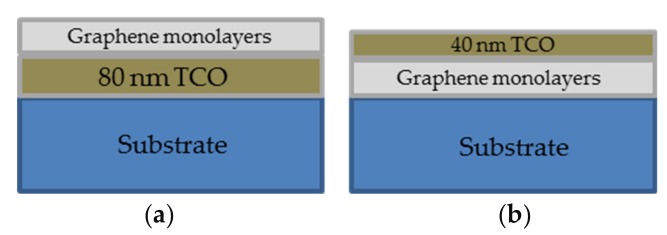
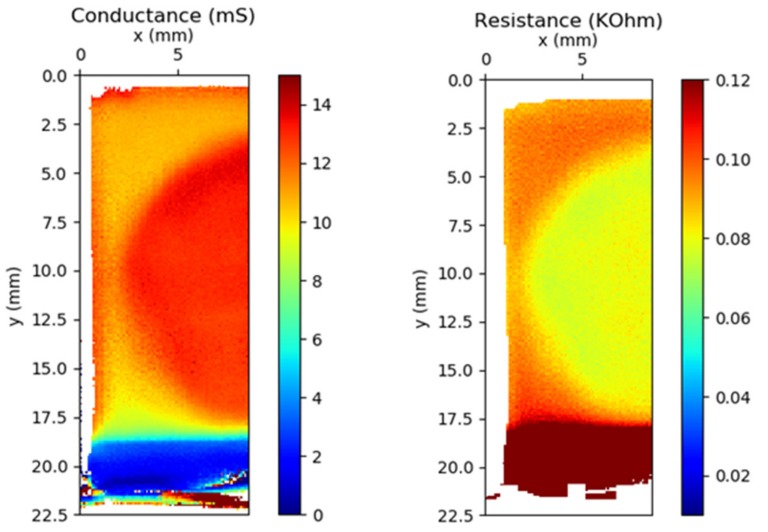
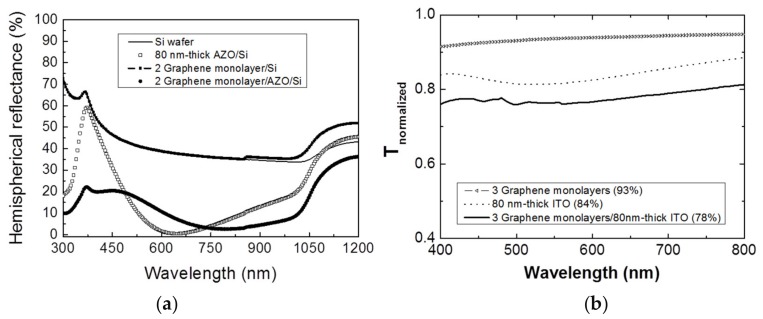
New architectures of transparent conductive electrodes (TCEs) incorporating graphene monolayers in different configurations have been explored with the aim to improve the performance of silicon-heterojunction (SHJ) cell front transparent contacts. In SHJ technology, front electrodes play an important additional role as anti-reflectance (AR) coatings. In this work, different transparent-conductive-oxide (TCO) thin films have been combined with graphene monolayers in different configurations, yielding advanced transparent electrodes specifically designed to minimize surface reflection over a wide range of wavelengths and angles of incidence and to improve electrical performance. A preliminary analysis reveals a strong dependence of the optoelectronic properties of the TCEs on (i) the order in which the different thin films are deposited or the graphene is transferred and (ii) the specific TCO material used. The results shows a clear electrical improvement when three graphene monolayers are placed on top on 80-nm-thick ITO thin film. This optimum TCE presents sheet resistances as low as 55 Ω/sq and an average conductance as high as 13.12 mS. In addition, the spectral reflectance of this TCE also shows an important reduction in its weighted reflectance value of 2-3%. Hence, the work undergone so far clearly suggests the possibility to noticeably improve transparent electrodes with this approach and therefore to further enhance silicon-heterojunction cell performance. These results achieved so far clearly open the possibility to noticeably improve TCEs and therefore to further enhance SHJ contact-technology performance.
为了提高硅异质结(SHJ)电池正面透明接触的性能,人们探索了将石墨烯单层以不同构型整合到透明导电电极(TCE)中的新架构。在SHJ技术中,正面电极作为抗反射(AR)涂层还发挥着重要的额外作用。在这项工作中,不同的透明导电氧化物(TCO)薄膜已与石墨烯单层以不同构型相结合,产生了专门设计的先进透明电极,以在宽波长范围和入射角范围内最小化表面反射并改善电性能。初步分析表明,TCE的光电特性强烈依赖于:(i)不同薄膜的沉积顺序或石墨烯的转移顺序,以及(ii)所使用的特定TCO材料。结果表明,当在80纳米厚的ITO薄膜上放置三层石墨烯单层时,电性能有明显改善。这种最佳TCE的薄层电阻低至55Ω/sq,平均电导率高达13.12mS。此外,该TCE的光谱反射率在其加权反射率值上也有2% - 3%的显著降低。因此,迄今为止所进行的工作清楚地表明,用这种方法显著改善透明电极并进而提高硅异质结电池性能是有可能的。迄今为止所取得的这些结果清楚地开启了显著改善TCE并进而提高SHJ接触技术性能的可能性。