Department of Oncology, The Second Affiliated Hospital, Fujian Medical University, Quanzhou, China.
Institute of Immunotherapy, Fujian Medical University, Fuzhou, 350108, Fujian, China.
BMC Cancer. 2019 Jun 18;19(1):602. doi: 10.1186/s12885-019-5798-7.
Chemo-resistance is one of the major challenges in the therapy of small cell lung cancer (SCLC). Multiple mechanisms are thought to be involved in chemo-resistance during SCLC treatment, but unfortunately, these mechanisms have not been well elucidated. Herein, we investigated the role of miRNA in the resistance of SCLC cells to doxorubicin (Dox).
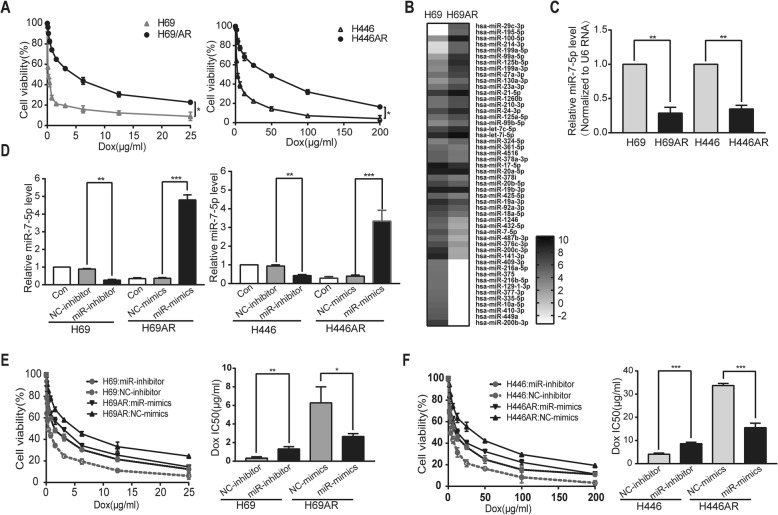
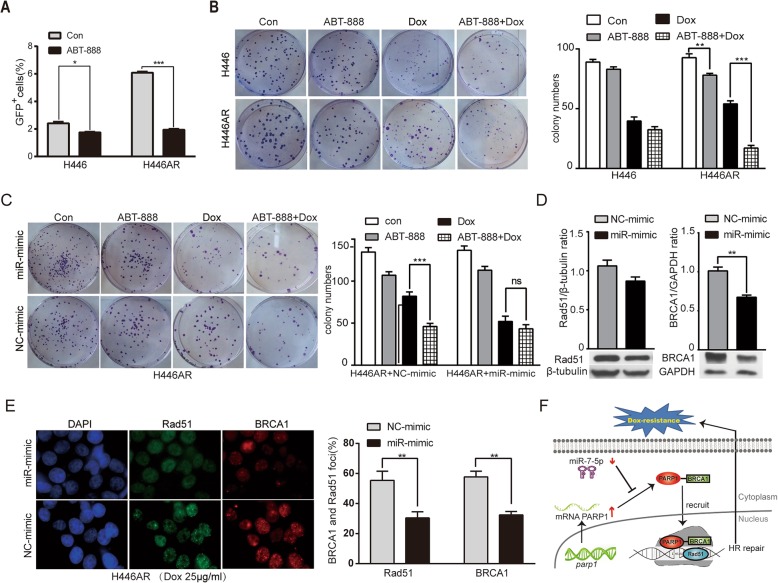
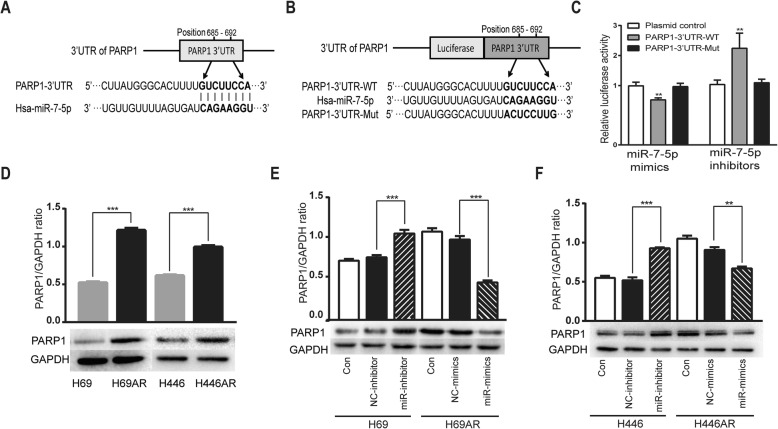
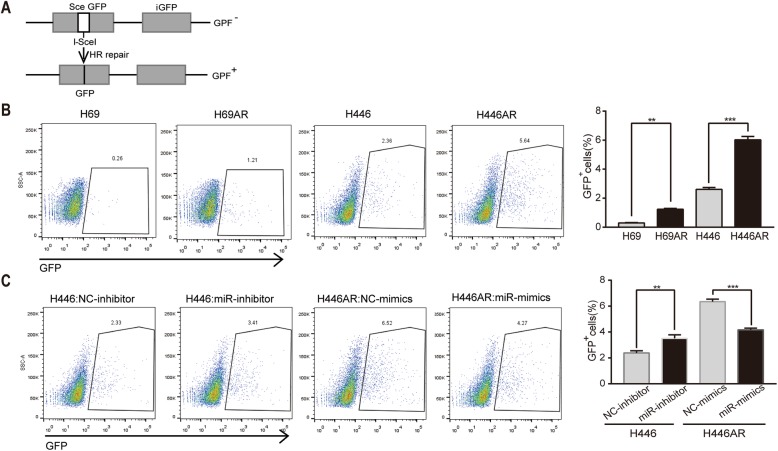
MiRNA microarray analysis revealed that several miRNAs, including miR-7-5p, were specifically decreased in Dox-resistant SCLC cells (H69AR) compared to parental cells (H69). The expression level of miR-7-5p was confirmed by qRT-PCR in Dox-resistant cells (H69AR and H446AR cells) and their parental cells. Bioinformatic analysis indicated that poly ADP-ribose polymerase 1 (PARP1) is a direct target of miR-7-5p. The binding sites of miR-7-5p in the PARP1 3' UTR were verified by luciferase reporter and Western blot assays. To investigate the role of miR-7-5p in the chemo-resistance of SCLC cells to doxorubicin, mimic or inhibitor of miR-7-5p was transfected into SCLC cells, and the effect of miR-7-5p on homologous recombination (HR) repair was analyzed by HR reporter assays. Furthermore, the expression of HR repair factors (Rad51 and BRCA1) induced by doxorubicin was detected by Western blot and immunofluorescent staining in H446AR cells transfected with miR-7-5p mimic.
The expression level of miR-7-5p was remarkably reduced (4-fold) in Dox-resistant SCLC cells (H69AR and H446AR cells) compared with that in parental cells (H69 and H446 cells). Poly ADP-ribose polymerase 1 (PARP1) is a direct target of miR-7-5p, and PARP1 expression was downregulated by miR-7-5p. MiR-7-5p impeded Dox-induced HR repair by inhibiting the expression of HR repair factors (Rad51 and BRCA1) that resulted in resensitizing SCLC cells to doxorubicin.
Our findings provide evidence that miR-7-5p targets PARP1 to exert its suppressive effects on HR repair, indicating that the alteration of the expression of miR-7-5p may be a promising strategy for overcoming chemo-resistance in SCLC therapy.
化疗耐药性是小细胞肺癌(SCLC)治疗中的主要挑战之一。在 SCLC 治疗过程中,人们认为有多种机制参与了化疗耐药性,但不幸的是,这些机制尚未得到很好的阐明。在此,我们研究了 miRNA 在 SCLC 细胞对阿霉素(Dox)耐药性中的作用。
miRNA 微阵列分析显示,与亲本细胞(H69)相比,几种 miRNA,包括 miR-7-5p,在 Dox 耐药的 SCLC 细胞(H69AR)中特异性下调。通过 qRT-PCR 在 Dox 耐药细胞(H69AR 和 H446AR 细胞)及其亲本细胞中证实了 miR-7-5p 的表达水平。生物信息学分析表明,聚 ADP-核糖聚合酶 1(PARP1)是 miR-7-5p 的直接靶标。通过荧光素酶报告和 Western blot 测定验证了 miR-7-5p 在 PARP1 3'UTR 中的结合位点。为了研究 miR-7-5p 在 SCLC 细胞对阿霉素化疗耐药性中的作用,将 miR-7-5p 的模拟物或抑制剂转染到 SCLC 细胞中,通过 HR 报告基因测定分析 miR-7-5p 对同源重组(HR)修复的影响。此外,通过 Western blot 和免疫荧光染色检测 miR-7-5p 模拟物转染的 H446AR 细胞中 doxorubicin 诱导的 HR 修复因子(Rad51 和 BRCA1)的表达。
与亲本细胞(H69 和 H446 细胞)相比,Dox 耐药的 SCLC 细胞(H69AR 和 H446AR 细胞)中 miR-7-5p 的表达水平显著降低(4 倍)。聚 ADP-核糖聚合酶 1(PARP1)是 miR-7-5p 的直接靶标,miR-7-5p 下调 PARP1 的表达。miR-7-5p 通过抑制 HR 修复因子(Rad51 和 BRCA1)的表达来阻碍 Dox 诱导的 HR 修复,从而使 SCLC 细胞对阿霉素重新敏感。
我们的研究结果提供了证据,表明 miR-7-5p 通过靶向 PARP1 发挥其对 HR 修复的抑制作用,表明 miR-7-5p 表达的改变可能是克服 SCLC 治疗中化疗耐药性的一种有前途的策略。