Brady Keri J S, Grant Gabrielle G, Stoddard Frederick J, Meyer Walter J, Romanowski Kathleen S, Chang Philip H, Painting Lynda E, Fowler Laura A, Nelson Judith K, Rivas Perla, Epperson Kathryn, Sheridan Robert L, Murphy Michael, O'Donnell Ellen H, Ceranoglu T Atilla, Sheldrick R Christopher, Ni Pengsheng, Slavin Mary D, Warner Petra, Palmieri Tina L, Schneider Jeffrey C, Kazis Lewis E, Ryan Colleen M
Department of Health Law, Policy, and Management, Boston University School of Public Health, Massachusetts.
Shriners Hospitals for Children-Boston, Massachusetts.
J Burn Care Res. 2020 Jan 30;41(1):84-94. doi: 10.1093/jbcr/irz110.
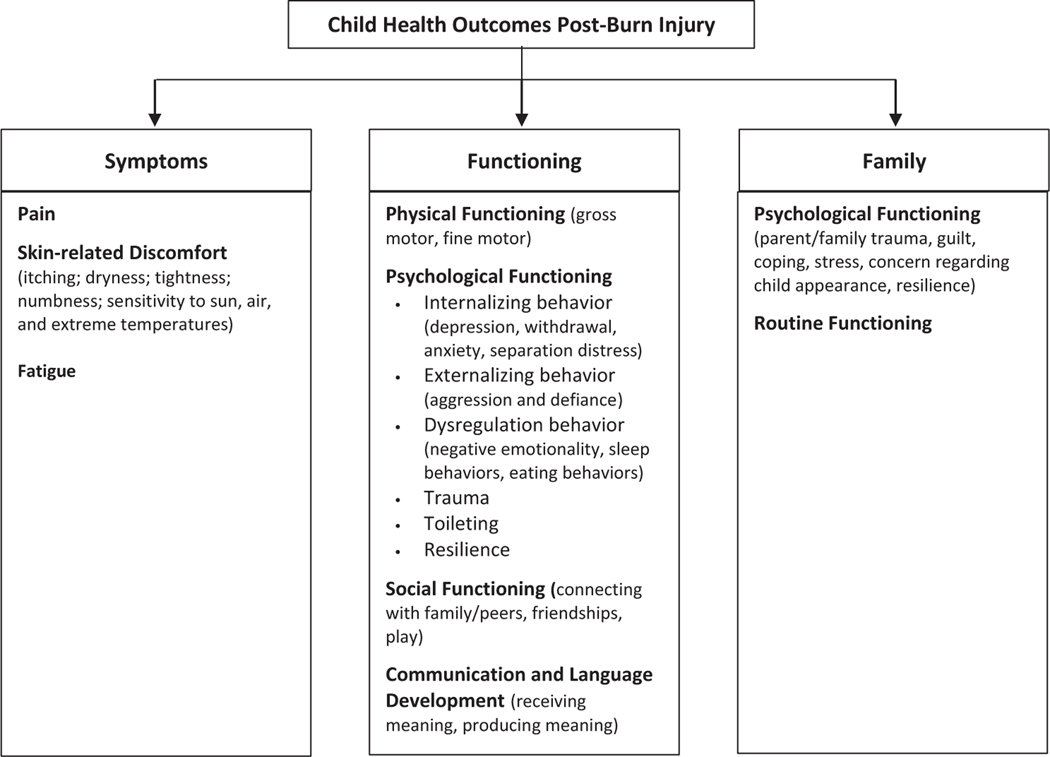
Due to the rapid developmental growth in preschool-aged children, more precise measurement of the effects of burns on child health outcomes is needed. Expanding upon the Shriners Hospitals for Children/American Burn Association Burn Outcome Questionnaire 0 to 5 (BOQ0-5), we developed a conceptual framework describing domains important in assessing recovery from burn injury among preschool-aged children (1-5 years). We developed a working conceptual framework based on the BOQ0-5, the National Research Council and Institute of Medicine's Model of Child Health, and the World Health Organization's International Classification of Functioning, Disability, and Health for Children and Youth. We iteratively refined our framework based on a literature review, focus groups, interviews, and expert consensus meetings. Data were qualitatively analyzed using methods informed by grounded theory. We reviewed 95 pediatric assessments, conducted two clinician focus groups and six parent interviews, and consulted with 23 clinician experts. Three child health outcome domains emerged from our analysis: symptoms, functioning, and family. The symptoms domain describes parents' perceptions of their child's pain, skin-related discomfort, and fatigue. The functioning domain describes children's physical functioning (gross and fine motor function), psychological functioning (internalizing, externalizing, and dysregulation behavior; trauma; toileting; resilience), communication and language development (receiving and producing meaning), and social functioning (connecting with family/peers, friendships, and play). The family domain describes family psychological and routine functioning outcomes.
由于学龄前儿童发育迅速,需要更精确地衡量烧伤对儿童健康结果的影响。在史瑞纳儿童医院/美国烧伤协会烧伤结果问卷0至5(BOQ0 - 5)的基础上,我们制定了一个概念框架,描述了评估1至5岁学龄前儿童烧伤恢复情况时重要的领域。我们基于BOQ0 - 5、美国国家研究委员会和医学研究所的儿童健康模型以及世界卫生组织的《儿童和青少年功能、残疾与健康国际分类》,制定了一个实用的概念框架。我们根据文献综述、焦点小组、访谈和专家共识会议,反复完善我们的框架。使用扎根理论指导的方法对数据进行定性分析。我们审查了95份儿科评估报告,进行了两个临床医生焦点小组讨论和六次家长访谈,并咨询了23位临床专家。我们的分析得出了三个儿童健康结果领域:症状、功能和家庭。症状领域描述了父母对孩子疼痛、皮肤相关不适和疲劳的感知。功能领域描述了儿童的身体功能(大肌肉和精细运动功能)、心理功能(内化、外化和行为失调;创伤;如厕;恢复力)、沟通和语言发展(接收和产生意义)以及社会功能(与家人/同伴建立联系、友谊和玩耍)。家庭领域描述了家庭心理和日常功能结果。