Duke University, Durham, NC, USA.
Emory University, Atlanta, GA, USA.
Cult Med Psychiatry. 2020 Mar;44(1):110-134. doi: 10.1007/s11013-019-09640-x.
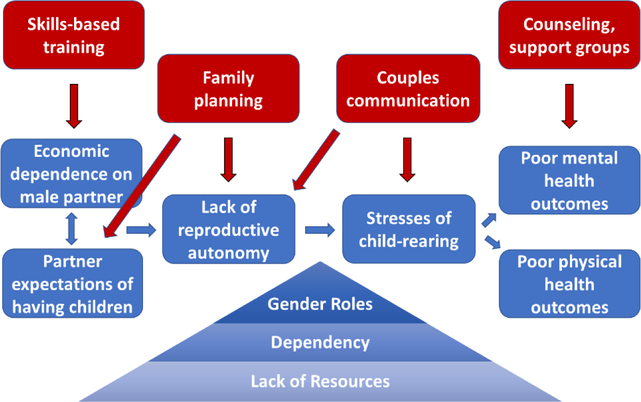
Mental healthcare is largely unavailable throughout Haiti, particularly in rural areas. The aim of the current study is to explore perceived feasibility, acceptability, and effectiveness of potential culturally adapted interventions to improve mental health among Haitian women. The study used focus group discussions (n = 12) to explore five potential interventions to promote mental health: individual counseling, income-generating skills training, peer support groups, reproductive health education, and couples' communication training. Findings indicate that individual counseling, support group, and skills training components were generally anticipated to be effective, acceptable, and feasible by both male and female participants. That being said, participants expressed doubts regarding the acceptability of the couples' communication training and reproductive health education due to: a perceived lack of male interest, traditional male and female gender roles, lack of female autonomy, and misconceptions about family planning. Additionally, the feasibility, effectiveness, and acceptability of the components were described as dependent on cost, proximity to participants, and inclusion of a female health promoter that is known in the community. Given the lack of research on intervention approaches in Haiti, particularly those targeting mental health, this study provides a foundation for developing prevention and treatment approaches for mental distress among Haitian women.
海地的精神卫生服务基本上无法普及,尤其是在农村地区。本研究旨在探索潜在的文化适应性干预措施在改善海地妇女精神健康方面的感知可行性、可接受性和有效性。该研究使用焦点小组讨论(n=12)探讨了五种可能的促进精神健康的干预措施:个体咨询、创收技能培训、同伴支持小组、生殖健康教育和夫妻沟通培训。研究结果表明,个体咨询、支持小组和技能培训部分普遍被男性和女性参与者认为是有效、可接受和可行的。尽管如此,由于参与者认为男性缺乏兴趣、传统的男女角色、女性缺乏自主权以及对计划生育的误解,他们对夫妻沟通培训和生殖健康教育的可接受性表示怀疑。此外,这些组成部分的可行性、有效性和可接受性被描述为取决于成本、与参与者的距离以及包括在社区中广为人知的女性健康促进者。鉴于海地在干预措施方面的研究,特别是针对精神健康的研究很少,本研究为制定海地妇女精神困扰的预防和治疗方法提供了基础。