PPGBCM, Center of Biotechnology, Federal University of Rio Grande do Sul, 9500, Porto Alegre, RS 91501-970, Brazil.
Laboratory of Experimental Hepatology and Gastroenterology, Hospital de Clínicas de Porto Alegre (HCPA), 2350, Porto Alegre, RS 90035-903, Brazil.
Int J Mol Sci. 2019 Jun 25;20(12):3099. doi: 10.3390/ijms20123099.
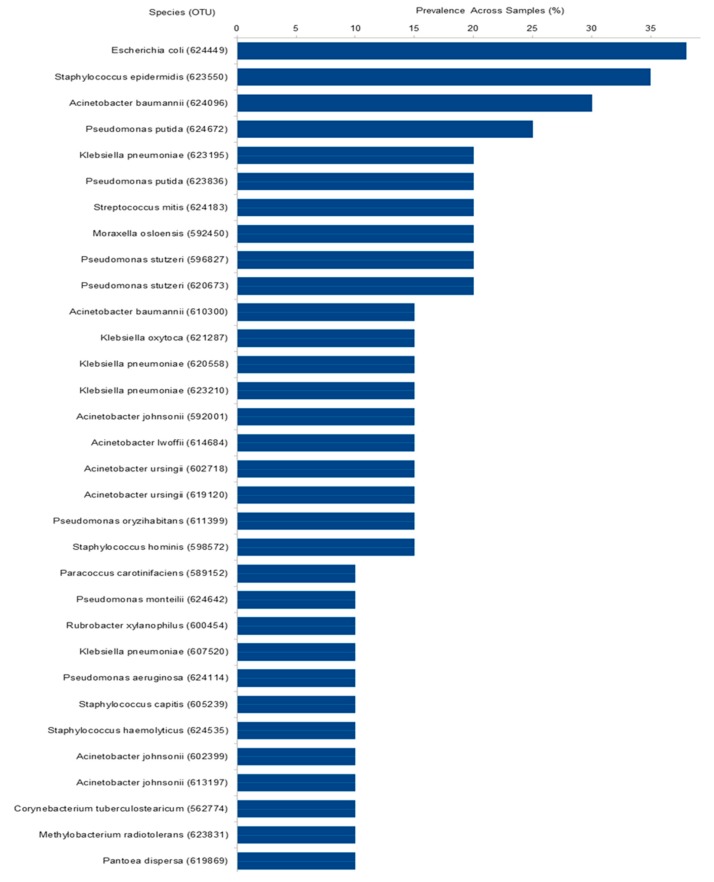
The aim of this work was to analyze and compare the bacterial communities of 663 samples from a Brazilian hospital by using high-throughput sequencing of the 16S rRNA gene. To increase taxonomic profiling and specificity of 16S-based identification, a strict sequence quality filtering process was applied for the accurate identification of clinically relevant bacterial taxa. Our results indicate that the hospital environment is predominantly inhabited by closely related species. A massive dominance of a few taxa in all taxonomic levels down to the genera was observed, where the ten most abundant genera in each facility represented 64.4% of all observed taxa, with a major predominance of and . The presence of several nosocomial pathogens was revealed. Co-occurrence analysis indicated that the present hospital microbial network had low connectedness, forming a clustered topology, but not structured among groups of nodes (i.e., modules). Furthermore, we were able to detect ecologically relevant relationships between specific microbial taxa, in particular, potential competition between pathogens and non-pathogens. Overall, these results provide new insight into different aspects of a hospital microbiome and indicate that 16S rRNA sequencing may serve as a robust one-step tool for microbiological identification and characterization of a wide range of clinically relevant bacterial taxa in hospital settings with a high resolution.
本研究旨在通过高通量 16S rRNA 基因测序分析和比较巴西某医院 663 份样本的细菌群落。为了提高基于 16S 的鉴定的分类学分析和特异性,我们应用了严格的序列质量过滤过程,以准确鉴定临床相关的细菌分类群。我们的结果表明,医院环境主要由密切相关的物种栖息。在所有分类水平(甚至到属)都观察到少数几个分类群的大量优势,每个设施中最丰富的 10 个属代表了所有观察到的分类群的 64.4%,其中 和 占据主导地位。还揭示了一些医院病原体的存在。共生分析表明,目前医院微生物网络的连通性较低,形成了聚类拓扑结构,但没有在节点组(即模块)之间形成结构。此外,我们能够检测到特定微生物分类群之间具有生态相关性的关系,特别是病原体和非病原体之间的潜在竞争。总体而言,这些结果提供了对医院微生物组不同方面的新见解,并表明 16S rRNA 测序可以作为一种强大的一步法工具,用于对医院环境中广泛的临床相关细菌分类群进行微生物学鉴定和特征分析,具有高分辨率。