Department of Biomolecular Chemistry, School of Medicine and Public Health, University of Wisconsin-Madison, Madison, Wisconsin, United States of America.
Department of Medical Microbiology and Immunology, School of Medicine and Public Health, University of Wisconsin-Madison, Madison, Wisconsin, United States of America.
PLoS Pathog. 2019 Jun 27;15(6):e1007777. doi: 10.1371/journal.ppat.1007777. eCollection 2019 Jun.
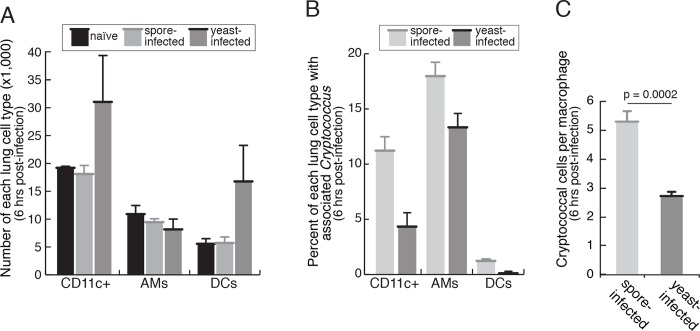
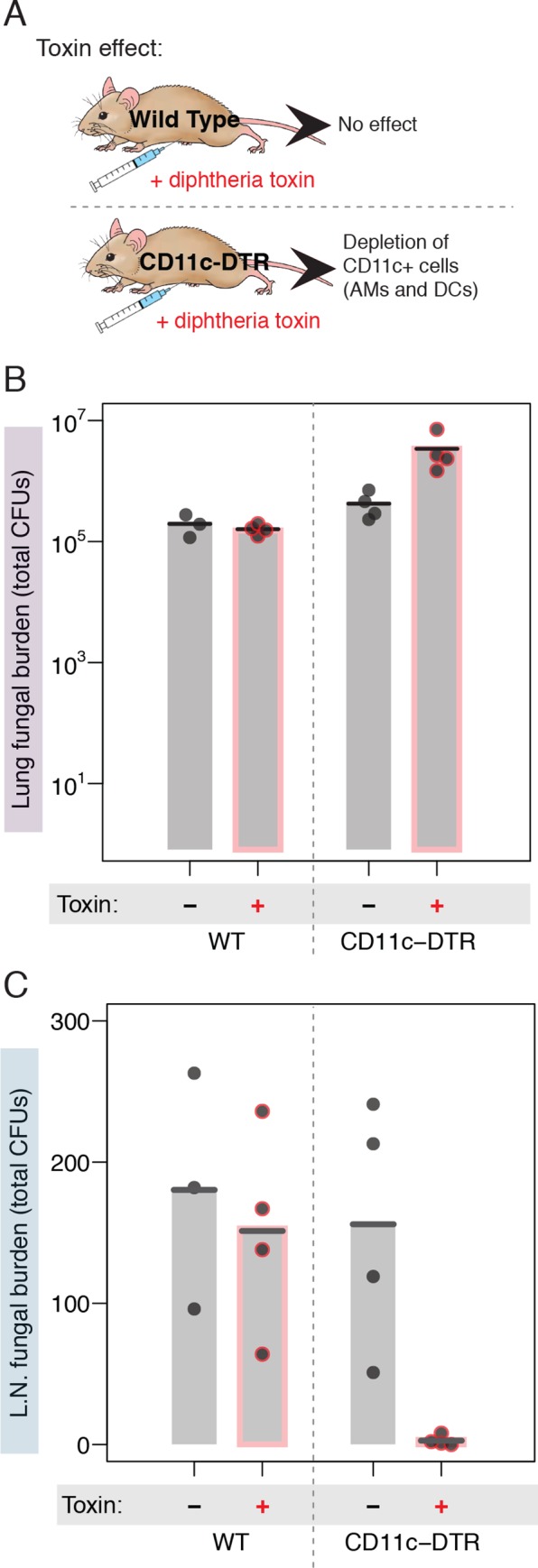
The majority of invasive human fungal pathogens gain access to their human hosts via the inhalation of spores from the environment into the lung, but relatively little is known about this infectious process. Among human fungal pathogens the most frequent cause of inhaled fatal fungal disease is Cryptococcus, which can disseminate from the lungs to other tissues, including the brain, where it causes meningoencephalitis. To determine the mechanisms by which distinct infectious particles of Cryptococcus cause disseminated disease, we evaluated two developmental cell types (spores and yeast) in mouse models of infection. We discovered that while both yeast and spores from several strains cause fatal disease, there was a consistently higher fungal burden in the brains of spore-infected mice. To determine the basis for this difference, we compared the pathogenesis of avirulent yeast strains with their spore progeny derived from sexual crosses. Strikingly, we discovered that spores produced by avirulent yeast caused uniformly fatal disease in the murine inhalation model of infection. We determined that this difference in outcome is associated with the preferential dissemination of spores to the lymph system. Specifically, mice infected with spores harbored Cryptococcus in their lung draining lymph nodes as early as one day after infection, whereas mice infected with yeast did not. Furthermore, phagocyte depletion experiments revealed this dissemination to the lymph nodes to be dependent on CD11c+ phagocytes, indicating a critical role for host immune cells in preferential spore trafficking. Taken together, these data support a model in which spores capitalize on phagocytosis by immune cells to escape the lung and gain access to other tissues, such as the central nervous system, to cause fatal disease. These previously unrealized insights into early interactions between pathogenic fungal spores and lung phagocytes provide new opportunities for understanding cryptococcosis and other spore-mediated fungal diseases.
大多数侵袭性人类真菌病原体通过吸入环境中的孢子进入肺部而进入其人类宿主,但对这一感染过程知之甚少。在人类真菌病原体中,吸入性致命真菌感染最常见的病原体是隐球菌,它可以从肺部传播到其他组织,包括大脑,从而引起脑膜脑炎。为了确定不同的隐球菌感染颗粒引起播散性疾病的机制,我们在感染的小鼠模型中评估了两种发育中的细胞类型(孢子和酵母)。我们发现,虽然来自几种菌株的酵母和孢子都可引起致命疾病,但感染孢子的小鼠的大脑中的真菌负担始终更高。为了确定这种差异的基础,我们比较了无毒酵母株与其通过有性杂交产生的孢子后代的发病机制。令人惊讶的是,我们发现,来自无毒酵母的孢子在感染的小鼠吸入模型中引起一致的致命疾病。我们确定,这种结果差异与孢子向淋巴系统的优先传播有关。具体来说,感染了孢子的小鼠在感染后仅一天就在肺部引流的淋巴结中就存在隐球菌,而感染了酵母的小鼠则没有。此外,吞噬细胞耗竭实验表明,这种向淋巴结的传播依赖于 CD11c+吞噬细胞,表明宿主免疫细胞在孢子优先转移中起着关键作用。综上所述,这些数据支持了一种模型,即孢子利用免疫细胞的吞噬作用从肺部逃脱并进入其他组织(如中枢神经系统)引起致命疾病。这些对致病性真菌孢子与肺部吞噬细胞之间早期相互作用的新认识,为理解隐球菌病和其他孢子介导的真菌病提供了新的机会。