• 文献检索
  • 文档翻译
  • 深度研究
  • 学术资讯
  • Suppr Zotero 插件Zotero 插件
  • 邀请有礼
  • 套餐&价格
  • 历史记录
应用&插件
Suppr Zotero 插件Zotero 插件浏览器插件Mac 客户端Windows 客户端微信小程序
定价
高级版会员购买积分包购买API积分包
服务
文献检索文档翻译深度研究API 文档MCP 服务
关于我们
关于 Suppr公司介绍联系我们用户协议隐私条款
关注我们

Suppr 超能文献

核心技术专利:CN118964589B侵权必究
粤ICP备2023148730 号-1Suppr @ 2026

文献检索

告别复杂PubMed语法,用中文像聊天一样搜索,搜遍4000万医学文献。AI智能推荐,让科研检索更轻松。

立即免费搜索

文件翻译

保留排版,准确专业,支持PDF/Word/PPT等文件格式,支持 12+语言互译。

免费翻译文档

深度研究

AI帮你快速写综述,25分钟生成高质量综述,智能提取关键信息,辅助科研写作。

立即免费体验

在西班牙语推文中检测抑郁症迹象:行为与语言分析

Detecting Signs of Depression in Tweets in Spanish: Behavioral and Linguistic Analysis.

作者信息

Leis Angela, Ronzano Francesco, Mayer Miguel A, Furlong Laura I, Sanz Ferran

机构信息

Research Programme on Biomedical Informatics, Hospital del Mar Medical Research Institute, Department of Experimental and Health Sciences, Universitat Pompeu Fabra, Barcelona, Spain.

出版信息

J Med Internet Res. 2019 Jun 27;21(6):e14199. doi: 10.2196/14199.

DOI:10.2196/14199
PMID:31250832
原文链接:https://pmc.ncbi.nlm.nih.gov/articles/PMC6620890/
Abstract

BACKGROUND

Mental disorders have become a major concern in public health, and they are one of the main causes of the overall disease burden worldwide. Social media platforms allow us to observe the activities, thoughts, and feelings of people's daily lives, including those of patients suffering from mental disorders. There are studies that have analyzed the influence of mental disorders, including depression, in the behavior of social media users, but they have been usually focused on messages written in English.

OBJECTIVE

The study aimed to identify the linguistic features of tweets in Spanish and the behavioral patterns of Twitter users who generate them, which could suggest signs of depression.

METHODS

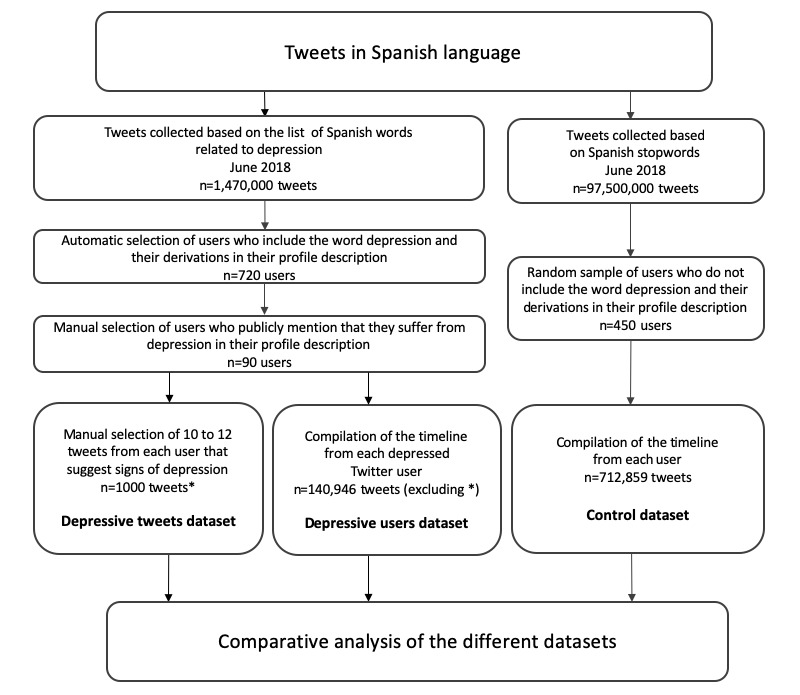
This study was developed in 2 steps. In the first step, the selection of users and the compilation of tweets were performed. A total of 3 datasets of tweets were created, a depressive users dataset (made up of the timeline of 90 users who explicitly mentioned that they suffer from depression), a depressive tweets dataset (a manual selection of tweets from the previous users, which included expressions indicative of depression), and a control dataset (made up of the timeline of 450 randomly selected users). In the second step, the comparison and analysis of the 3 datasets of tweets were carried out.

RESULTS

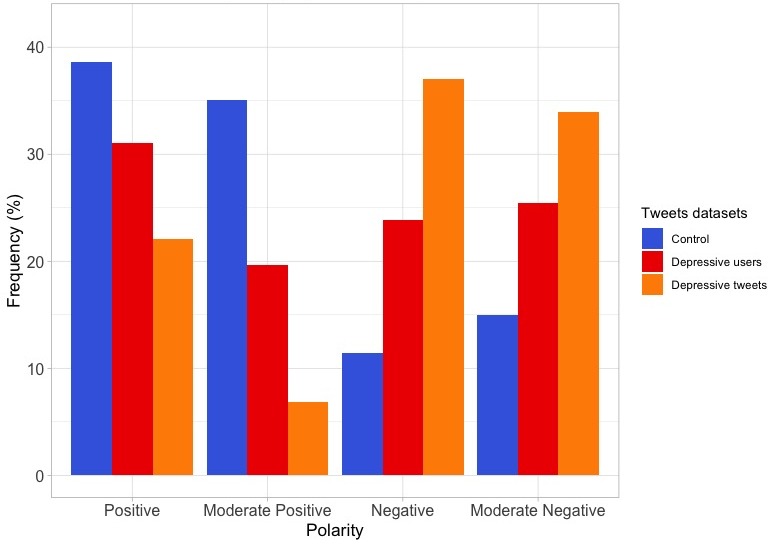
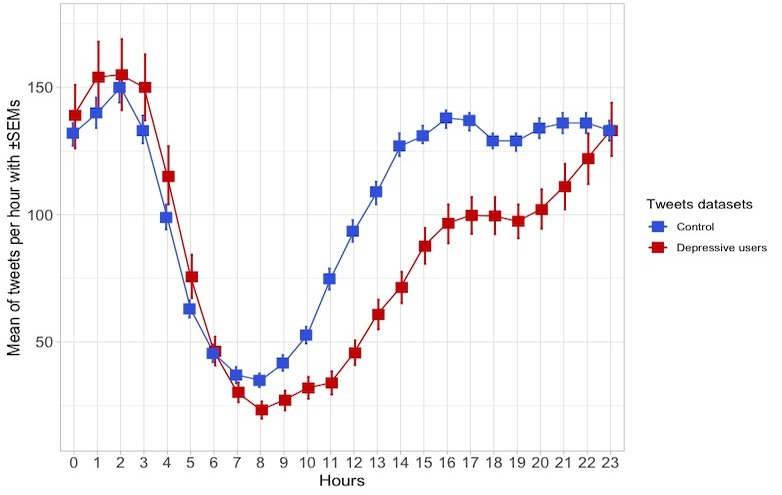
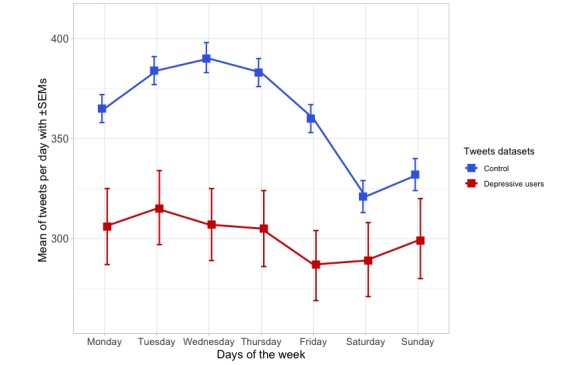
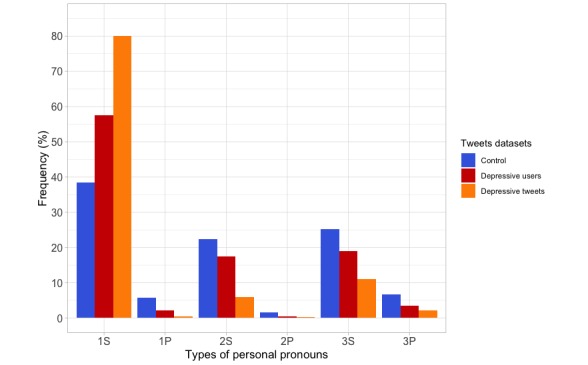
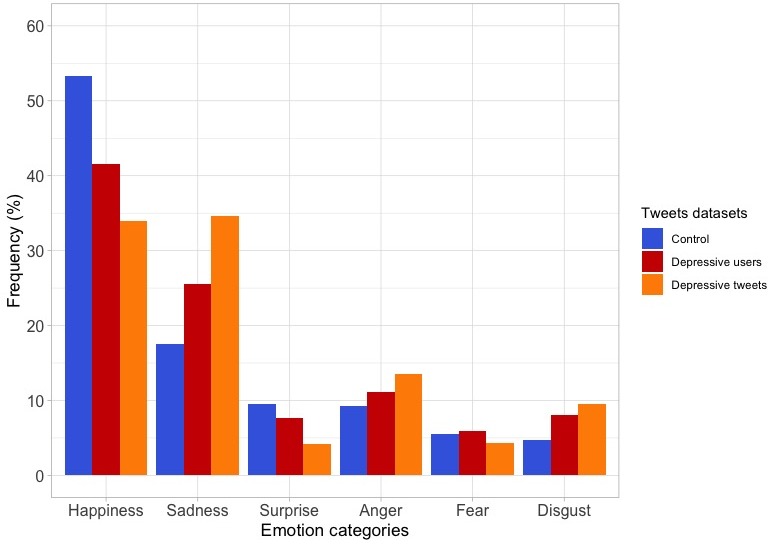
In comparison with the control dataset, the depressive users are less active in posting tweets, doing it more frequently between 23:00 and 6:00 (P<.001). The percentage of nouns used by the control dataset almost doubles that of the depressive users (P<.001). By contrast, the use of verbs is more common in the depressive users dataset (P<.001). The first-person singular pronoun was by far the most used in the depressive users dataset (80%), and the first- and the second-person plural pronouns were the least frequent (0.4% in both cases), this distribution being different from that of the control dataset (P<.001). Emotions related to sadness, anger, and disgust were more common in the depressive users and depressive tweets datasets, with significant differences when comparing these datasets with the control dataset (P<.001). As for negation words, they were detected in 34% and 46% of tweets in among depressive users and in depressive tweets, respectively, which are significantly different from the control dataset (P<.001). Negative polarity was more frequent in the depressive users (54%) and depressive tweets (65%) datasets than in the control dataset (43.5%; P<.001).

CONCLUSIONS

Twitter users who are potentially suffering from depression modify the general characteristics of their language and the way they interact on social media. On the basis of these changes, these users can be monitored and supported, thus introducing new opportunities for studying depression and providing additional health care services to people with this disorder.
https://cdn.ncbi.nlm.nih.gov/pmc/blobs/2295/6620890/01042258ed03/jmir_v21i6e14199_fig6.jpg
https://cdn.ncbi.nlm.nih.gov/pmc/blobs/2295/6620890/d11cc2eaf53f/jmir_v21i6e14199_fig1.jpg
https://cdn.ncbi.nlm.nih.gov/pmc/blobs/2295/6620890/6dc51041e598/jmir_v21i6e14199_fig2.jpg
https://cdn.ncbi.nlm.nih.gov/pmc/blobs/2295/6620890/181810589ab0/jmir_v21i6e14199_fig3.jpg
https://cdn.ncbi.nlm.nih.gov/pmc/blobs/2295/6620890/36b716ecdcbc/jmir_v21i6e14199_fig4.jpg
https://cdn.ncbi.nlm.nih.gov/pmc/blobs/2295/6620890/a28bac149a3d/jmir_v21i6e14199_fig5.jpg
https://cdn.ncbi.nlm.nih.gov/pmc/blobs/2295/6620890/01042258ed03/jmir_v21i6e14199_fig6.jpg
https://cdn.ncbi.nlm.nih.gov/pmc/blobs/2295/6620890/d11cc2eaf53f/jmir_v21i6e14199_fig1.jpg
https://cdn.ncbi.nlm.nih.gov/pmc/blobs/2295/6620890/6dc51041e598/jmir_v21i6e14199_fig2.jpg
https://cdn.ncbi.nlm.nih.gov/pmc/blobs/2295/6620890/181810589ab0/jmir_v21i6e14199_fig3.jpg
https://cdn.ncbi.nlm.nih.gov/pmc/blobs/2295/6620890/36b716ecdcbc/jmir_v21i6e14199_fig4.jpg
https://cdn.ncbi.nlm.nih.gov/pmc/blobs/2295/6620890/a28bac149a3d/jmir_v21i6e14199_fig5.jpg
https://cdn.ncbi.nlm.nih.gov/pmc/blobs/2295/6620890/01042258ed03/jmir_v21i6e14199_fig6.jpg
摘要

背景

精神障碍已成为公共卫生领域的主要关注点,是全球疾病总负担的主要原因之一。社交媒体平台使我们能够观察人们日常生活中的活动、思想和感受,包括患有精神障碍的患者。已有研究分析了包括抑郁症在内的精神障碍对社交媒体用户行为的影响,但这些研究通常集中在英文撰写的信息上。

目的

本研究旨在识别西班牙语推文中的语言特征以及发布推文的推特用户的行为模式,这些特征可能暗示抑郁迹象。

方法

本研究分两步进行。第一步,进行用户选择和推文汇编。共创建了3个推文数据集,一个抑郁用户数据集(由90名明确表示患有抑郁症的用户的时间线组成),一个抑郁推文数据集(从先前用户的推文中手动挑选,包括表明抑郁的表达),以及一个对照数据集(由450名随机选择的用户的时间线组成)。第二步,对3个推文数据集进行比较和分析。

结果

与对照数据集相比,抑郁用户发布推文的活跃度较低,在23:00至6:00之间发布更为频繁(P<0.001)。对照数据集使用名词的百分比几乎是抑郁用户的两倍(P<0.001)。相比之下,动词在抑郁用户数据集中的使用更为常见(P<0.001)。第一人称单数代词在抑郁用户数据集中的使用最为频繁(80%),第一和第二人称复数代词使用最少(两者均为0.4%),这种分布与对照数据集不同(P<0.001)。与悲伤、愤怒和厌恶相关的情绪在抑郁用户和抑郁推文数据集中更为常见,将这些数据集与对照数据集进行比较时存在显著差异(P<0.001)。至于否定词,在抑郁用户和抑郁推文中分别有34%和46%的推文中检测到,这与对照数据集有显著差异(P<0.001)。抑郁用户(54%)和抑郁推文(65%)数据集中的负极性比对照数据集(43.5%)更频繁(P<0.001)。

结论

可能患有抑郁症的推特用户会改变其语言的一般特征以及他们在社交媒体上的互动方式。基于这些变化,可以对这些用户进行监测和支持,从而为研究抑郁症带来新的机会,并为患有这种疾病的人提供额外的医疗服务。

相似文献

1
Detecting Signs of Depression in Tweets in Spanish: Behavioral and Linguistic Analysis.在西班牙语推文中检测抑郁症迹象:行为与语言分析
J Med Internet Res. 2019 Jun 27;21(6):e14199. doi: 10.2196/14199.
2
Evaluating Behavioral and Linguistic Changes During Drug Treatment for Depression Using Tweets in Spanish: Pairwise Comparison Study.使用西班牙语推文评估抑郁症药物治疗期间的行为和语言变化:成对比较研究。
J Med Internet Res. 2020 Dec 18;22(12):e20920. doi: 10.2196/20920.
3
Exploring the Behavior of Users With Attention-Deficit/Hyperactivity Disorder on Twitter: Comparative Analysis of Tweet Content and User Interactions.探索 Twitter 上注意力缺陷多动障碍用户的行为:推文内容和用户互动的比较分析。
J Med Internet Res. 2023 May 17;25:e43439. doi: 10.2196/43439.
4
Depression detection for twitter users using sentiment analysis in English and Arabic tweets.使用英语和阿拉伯语推文的情感分析检测 Twitter 用户的抑郁情绪。
Artif Intell Med. 2024 Jan;147:102716. doi: 10.1016/j.artmed.2023.102716. Epub 2023 Nov 19.
5
Social media mining for birth defects research: A rule-based, bootstrapping approach to collecting data for rare health-related events on Twitter.社交媒体挖掘在出生缺陷研究中的应用:一种基于规则和自举的方法,用于在 Twitter 上收集罕见健康相关事件的数据。
J Biomed Inform. 2018 Nov;87:68-78. doi: 10.1016/j.jbi.2018.10.001. Epub 2018 Oct 4.
6
A Systematic review of the validity of screening depression through Facebook, Twitter, Instagram, and Snapchat.通过 Facebook、Twitter、Instagram 和 Snapchat 筛查抑郁的有效性的系统评价
J Affect Disord. 2021 May 1;286:360-369. doi: 10.1016/j.jad.2020.08.091. Epub 2021 Feb 8.
7
Investigating Health and Well-Being Challenges Faced by an Aging Workforce in the Construction and Nursing Industries: Computational Linguistic Analysis of Twitter Data.调查建筑和护理行业中老龄化劳动力面临的健康和福利挑战:对 Twitter 数据的计算语言学分析。
J Med Internet Res. 2024 Jun 5;26:e49450. doi: 10.2196/49450.
8
Studying expressions of loneliness in individuals using twitter: an observational study.利用推特研究个体的孤独感表达:一项观察性研究。
BMJ Open. 2019 Nov 4;9(11):e030355. doi: 10.1136/bmjopen-2019-030355.
9
Understanding Depressive Symptoms and Psychosocial Stressors on Twitter: A Corpus-Based Study.基于语料库研究推特上的抑郁症状与心理社会压力源
J Med Internet Res. 2017 Feb 28;19(2):e48. doi: 10.2196/jmir.6895.
10
Stroke Survivors on Twitter: Sentiment and Topic Analysis From a Gender Perspective.推特上的中风幸存者:基于性别视角的情感与话题分析
J Med Internet Res. 2019 Aug 26;21(8):e14077. doi: 10.2196/14077.

引用本文的文献

1
Detecting ADHD through natural language processing and stylometric analysis of adolescent narratives.通过自然语言处理和青少年叙事的文体分析来检测注意力缺陷多动障碍。
Front Child Adolesc Psychiatry. 2025 May 9;4:1519753. doi: 10.3389/frcha.2025.1519753. eCollection 2025.
2
Understanding social media discourse on antidepressants: unsupervised and sentiment analysis using X.理解社交媒体上关于抗抑郁药的话语:使用X进行无监督和情感分析。
Eur Psychiatry. 2025 Mar 5;68(1):e51. doi: 10.1192/j.eurpsy.2025.10.
3
Detection of differences in physical symptoms between depressed and undepressed patients with breast cancer: a study using K-medoids clustering.

本文引用的文献

1
Increasing Interest of Mass Communication Media and the General Public in the Distribution of Tweets About Mental Disorders: Observational Study.大众传播媒体和公众对有关精神障碍推文传播的兴趣日益增加:观察性研究。
J Med Internet Res. 2018 May 28;20(5):e205. doi: 10.2196/jmir.9582.
2
Predicting Depression From Language-Based Emotion Dynamics: Longitudinal Analysis of Facebook and Twitter Status Updates.基于语言的情绪动态预测抑郁症:对脸书和推特状态更新的纵向分析。
J Med Internet Res. 2018 May 8;20(5):e168. doi: 10.2196/jmir.9267.
3
Changes in Problematic Anger, Shame, and Disgust in Anxious and Depressed Adults Undergoing Treatment for Emotion Dysregulation.
乳腺癌抑郁患者与非抑郁患者身体症状差异的检测:一项使用K-中心点聚类的研究
BMC Cancer. 2025 Jan 7;25(1):23. doi: 10.1186/s12885-024-13387-z.
4
Detecting and tracking depression through temporal topic modeling of tweets: insights from a 180-day study.通过推文的时间主题建模检测和追踪抑郁症:一项为期180天研究的见解
Npj Ment Health Res. 2024 Dec 6;3(1):62. doi: 10.1038/s44184-024-00107-5.
5
Federated learning for privacy-preserving depression detection with multilingual language models in social media posts.用于社交媒体帖子中基于多语言语言模型进行隐私保护抑郁症检测的联邦学习。
Patterns (N Y). 2024 May 13;5(7):100990. doi: 10.1016/j.patter.2024.100990. eCollection 2024 Jul 12.
6
Fine grain emotion analysis in Spanish using linguistic features and transformers.利用语言特征和变压器进行西班牙语细粒度情感分析。
PeerJ Comput Sci. 2024 Apr 30;10:e1992. doi: 10.7717/peerj-cs.1992. eCollection 2024.
7
Affective norms for 501 Chinese words from three emotional dimensions rated by depressive disorder patients.抑郁症患者从三个情感维度对501个中文词汇进行的情感规范评定。
Front Psychiatry. 2024 Feb 26;15:1309501. doi: 10.3389/fpsyt.2024.1309501. eCollection 2024.
8
Syntactic Errors in Older Adults with Depression.老年人抑郁中的句法错误。
Medicina (Kaunas). 2023 Dec 7;59(12):2133. doi: 10.3390/medicina59122133.
9
Detecting Community Depression Dynamics Due to COVID-19 Pandemic in Australia.在澳大利亚检测因新冠疫情引发的社区抑郁动态变化。
IEEE Trans Comput Soc Syst. 2021 Jan 15;8(4):982-991. doi: 10.1109/TCSS.2020.3047604. eCollection 2021 Aug.
10
Words for the hearts: a corpus study of metaphors in online depression communities.心灵之语:在线抑郁症社区隐喻的语料库研究
Front Psychol. 2023 Aug 30;14:1227123. doi: 10.3389/fpsyg.2023.1227123. eCollection 2023.
情绪失调的焦虑和抑郁成年人在接受治疗过程中问题性愤怒、羞耻和厌恶的变化。
Behav Ther. 2018 May;49(3):344-359. doi: 10.1016/j.beth.2017.10.004. Epub 2017 Oct 27.
4
Linguistic analysis of patients with mood and anxiety disorders during cognitive behavioral therapy.心境和焦虑障碍患者在认知行为治疗中的语言分析。
Cogn Behav Ther. 2018 Jul;47(4):315-327. doi: 10.1080/16506073.2017.1419505. Epub 2018 Jan 18.
5
Discovering Shifts to Suicidal Ideation from Mental Health Content in Social Media.从社交媒体上的心理健康内容中发现向自杀意念的转变。
Proc SIGCHI Conf Hum Factor Comput Syst. 2016 May;2016:2098-2110. doi: 10.1145/2858036.2858207.
6
Exploring opportunities to support mental health care using social media: A survey of social media users with mental illness.利用社交媒体探索支持心理健康护理的机会:一项针对患有精神疾病的社交媒体用户的调查。
Early Interv Psychiatry. 2019 Jun;13(3):405-413. doi: 10.1111/eip.12496. Epub 2017 Oct 20.
7
Forecasting the onset and course of mental illness with Twitter data.利用 Twitter 数据预测精神疾病的发病和病程。
Sci Rep. 2017 Oct 11;7(1):13006. doi: 10.1038/s41598-017-12961-9.
8
A Collaborative Approach to Identifying Social Media Markers of Schizophrenia by Employing Machine Learning and Clinical Appraisals.一种通过机器学习和临床评估来识别精神分裂症社交媒体标记物的协作方法。
J Med Internet Res. 2017 Aug 14;19(8):e289. doi: 10.2196/jmir.7956.
9
Researching Mental Health Disorders in the Era of Social Media: Systematic Review.社交媒体时代的心理健康障碍研究:系统综述
J Med Internet Res. 2017 Jun 29;19(6):e228. doi: 10.2196/jmir.7215.
10
Zika in Twitter: Temporal Variations of Locations, Actors, and Concepts.推特上的寨卡病毒:地点、行为主体及概念的时间变化
JMIR Public Health Surveill. 2017 Apr 20;3(2):e22. doi: 10.2196/publichealth.6925.