Department of Family and Community Medicine, Division of Integrative Medicine, University of Cincinnati College of Medicine, Cincinnati, Ohio.
Department of Pediatrics, University of Cincinnati College of Medicine, Cincinnati, Ohio.
Early Interv Psychiatry. 2020 Apr;14(2):211-219. doi: 10.1111/eip.12848. Epub 2019 Jul 2.
Previous studies suggest that Mindfulness-Based Cognitive Therapy for Children (MBCT-C) is feasible and may improve anxiety and emotion regulation in youth with anxiety disorders at-risk for bipolar disorder. However, controlled studies are warranted to replicate and extend these findings.
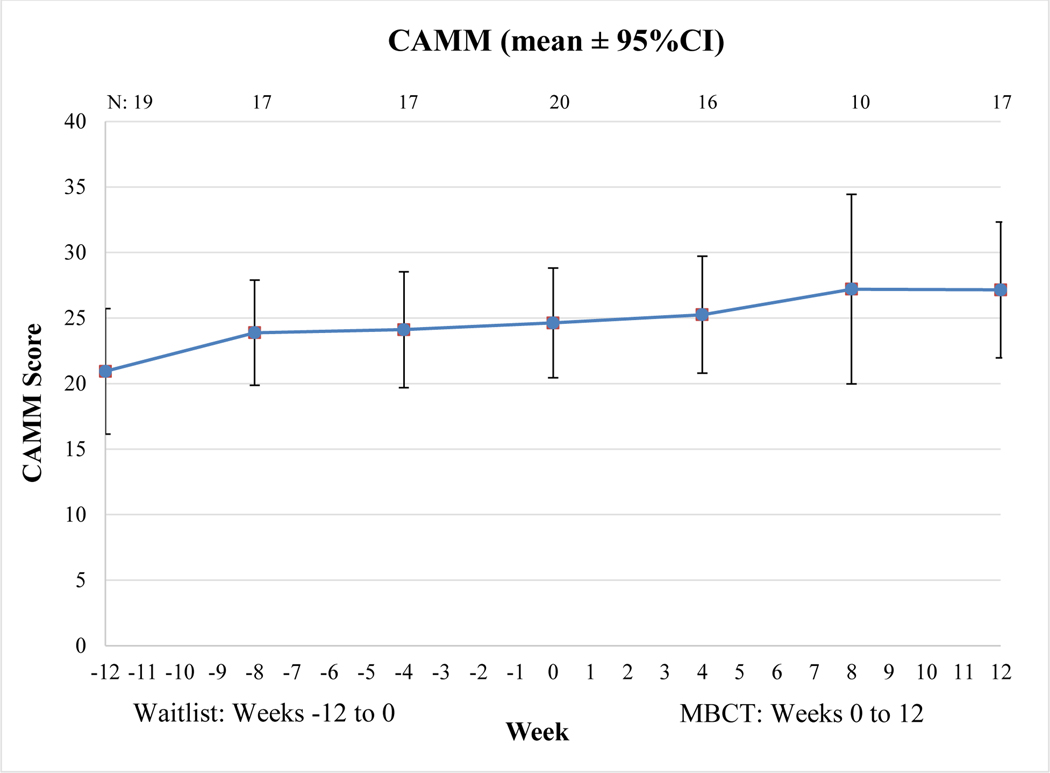
In the current study, 24 youth with anxiety disorders who have at least one parent with bipolar disorder participated in a MBCT-C treatment period (n = 24; M = 13.6, 75% girls, 79% White) with a subset also participating in a prior psychoeducation waitlist control period (n = 19 M = 13.8, 68% girls, 84% White). Participants in both the waitlist and MBCT-C periods completed independently-rated symptom scales at each time point. Participants in the waitlist period received educational materials 12 weeks prior to the beginning of MBCT-C.
There were significantly greater improvements in overall clinical severity in the MBCT-C period compared to the waitlist period, but not in clinician- and child-rated anxiety, emotion regulation or mindfulness. However, increases in mindfulness were associated with improvements in anxiety and emotion regulation in the MBCT-C period, but not the waitlist period.
Findings suggest that MBCT-C may be effective for improving overall clinical severity in youth with anxiety disorders who are at-risk for bipolar disorder. However, waitlist controlled designs may inflate effect sizes so interpret with caution. Larger studies utilizing prospective randomized controlled designs are warranted.
先前的研究表明,儿童正念认知疗法(MBCT-C)是可行的,可能改善双相障碍风险的焦虑障碍青年的焦虑和情绪调节。然而,需要进行对照研究来复制和扩展这些发现。
在当前研究中,24 名患有焦虑障碍且至少有一位父母患有双相障碍的青年参加了 MBCT-C 治疗期(n=24;M=13.6,75%为女孩,79%为白人),其中一部分也参加了之前的心理教育候补名单对照期(n=19;M=13.8,68%为女孩,84%为白人)。候补名单和 MBCT-C 期间的参与者在每个时间点都完成了独立评定的症状量表。候补名单期间的参与者在 MBCT-C 开始前 12 周收到了教育材料。
MBCT-C 期的总体临床严重程度较候补名单期有显著改善,但在临床医生和儿童评定的焦虑、情绪调节或正念方面没有改善。然而,正念的增加与 MBCT-C 期的焦虑和情绪调节改善相关,但与候补名单期无关。
研究结果表明,MBCT-C 可能对改善双相障碍风险的焦虑障碍青年的总体临床严重程度有效。然而,候补名单对照设计可能会夸大效应大小,因此谨慎解释。需要更大规模的前瞻性随机对照设计研究。