Kranstauber Bart
1Department of Evolutionary Biology and Environmental Studies, University of Zurich, Winterthurerstrasse 190, Zurich, CH-8057 Switzerland.
2Kalahari Meerkat Project, Kuruman River Reserve, P.O. Box 64, Van Zylsrus, 8467 Northern Cape South Africa.
Mov Ecol. 2019 Jun 25;7:22. doi: 10.1186/s40462-019-0167-3. eCollection 2019.
The ability to observe animal movement and possible correlates has increased strongly over the past decades. Methods to analyze trajectories have developed in parallel, but many tools fail to make an immediate connection between a movement model, covariates of the movement, and animal space use.
Here I develop a novel method based on the Brownian Bridge Movement Model that facilitates investigating and testing covariates of movement. The model makes it possible to flexibly investigate different covariates including, for example, periodic movement patterns.
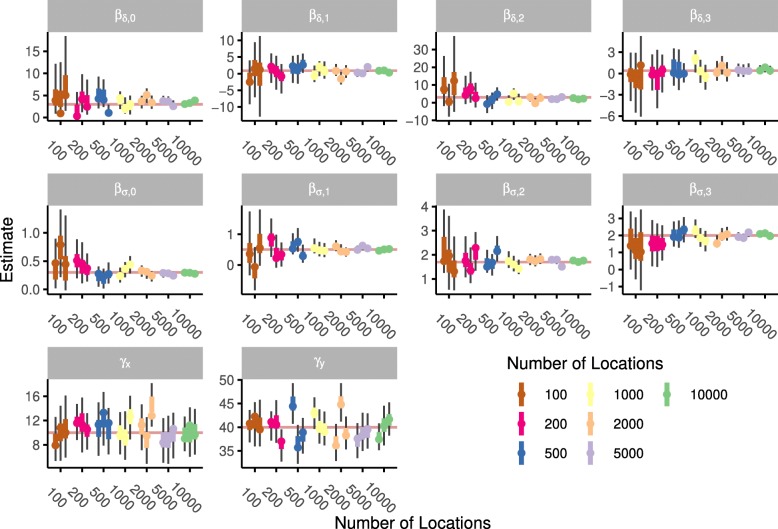
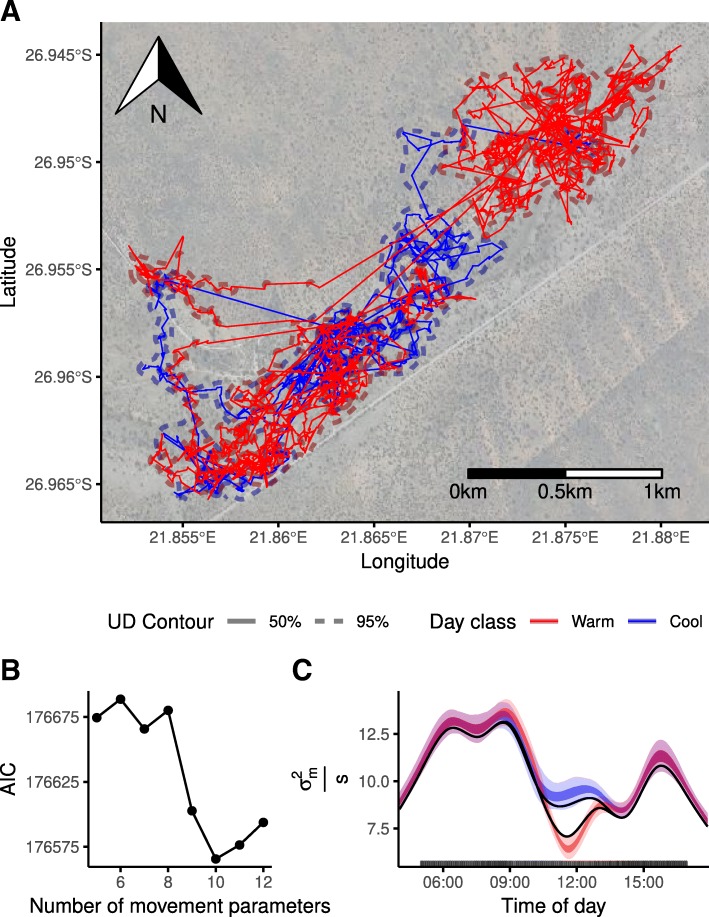
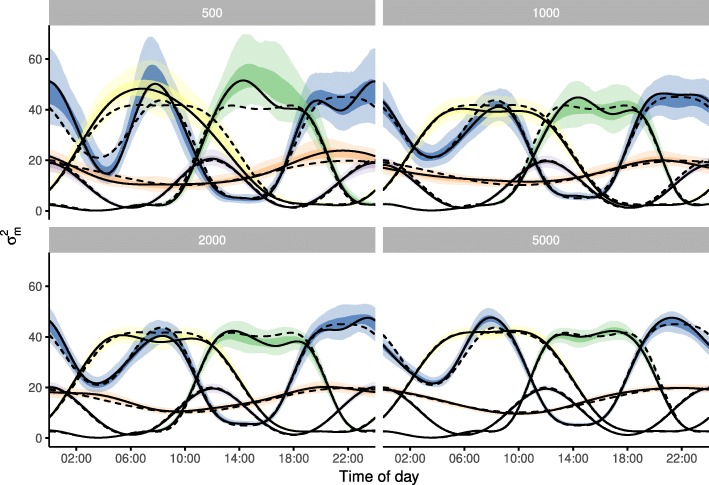
I applied the Brownian Bridge Covariates Model (BBCM) to simulated trajectories demonstrating its ability to reproduce the parameters used for the simulation. I also applied the model to a GPS trajectory of a meerkat, showing its application to empirical data. The value of the model was shown by testing the interaction between maximal daily temperature and the daily movement pattern.
This model produces accurate parameter estimates for covariates of the movements and location error in simulated trajectories. Application to the meerkat trajectory also produced plausible parameter estimates. This new method opens the possibility to directly test hypotheses about the influence of covariates on animal movement while linking these to space-use estimates.
在过去几十年中,观察动物运动及其可能相关因素的能力有了显著提升。分析轨迹的方法也在同步发展,但许多工具未能在运动模型、运动协变量和动物空间利用之间建立直接联系。
在此,我基于布朗桥运动模型开发了一种新方法,便于研究和测试运动协变量。该模型能够灵活地研究不同的协变量,例如周期性运动模式。
我将布朗桥协变量模型(BBCM)应用于模拟轨迹,证明了其再现模拟所用参数的能力。我还将该模型应用于狐獴的GPS轨迹,展示了其在实证数据中的应用。通过测试每日最高温度与每日运动模式之间的相互作用,显示了该模型的价值。
该模型能为模拟轨迹中的运动协变量和位置误差产生准确的参数估计。应用于狐獴轨迹也产生了合理的参数估计。这种新方法为直接检验关于协变量对动物运动影响的假设开辟了可能性,同时将这些假设与空间利用估计联系起来。