Tran Thao T D, Tran Phuong H L
Department for Management of Science and Technology Development, Ton Duc Thang University, Ho Chi Minh City, Vietnam.
Faculty of Pharmacy, Ton Duc Thang University, Ho Chi Minh City, Vietnam.
Pharmaceutics. 2019 Jul 10;11(7):325. doi: 10.3390/pharmaceutics11070325.
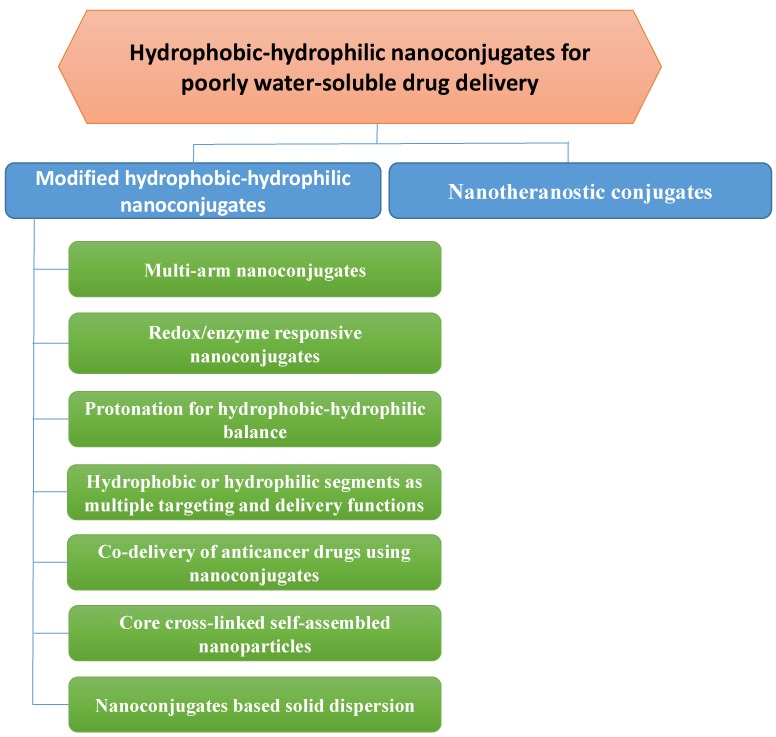
Nanoconjugations have been demonstrated to be a dominant strategy for drug delivery and biomedical applications. In this review, we intend to describe several strategies for drug formulation, especially to improve the bioavailability of poorly water-soluble molecules for future application in the therapy of numerous diseases. The context of current studies will give readers an overview of the conjugation strategies for fabricating nanoparticles, which have expanded from conjugated materials to the surface conjugation of nanovehicles. Moreover, nanoconjugates for theranostics are also discussed and highlighted. Overall, these state-of-the-art conjugation methods and these techniques and applications for nanoparticulate systems of poorly water-soluble drugs will inspire scientists to explore and discover more productive techniques and methodologies for drug development.
纳米缀合物已被证明是药物递送和生物医学应用的主要策略。在本综述中,我们打算描述几种药物制剂策略,特别是为了提高难溶性分子的生物利用度,以便未来应用于多种疾病的治疗。当前研究的背景将使读者对制备纳米颗粒的缀合策略有一个概述,这些策略已从缀合材料扩展到纳米载体的表面缀合。此外,还讨论并强调了用于治疗诊断的纳米缀合物。总体而言,这些最先进的缀合方法以及这些用于难溶性药物纳米颗粒系统的技术和应用将激励科学家探索和发现更多用于药物开发的高效技术和方法。