Jaderson Mukhtar, Park Ju-Hyeong
Health Effects Laboratory Division, National Institute for Occupational Safety and Health, Morgantown, WV, USA.
Respiratory Health Division, National Institute for Occupational Safety and Health, Morgantown, WV, USA.
Saf Health Work. 2019 Jun;10(2):196-204. doi: 10.1016/j.shaw.2018.12.004. Epub 2018 Dec 21.
Liquid chromatography-tandem mass spectrometry (LC-MSMS) for simultaneous analysis of multiple microbial secondary metabolites (MSMs) is potentially subject to interference by matrix components.
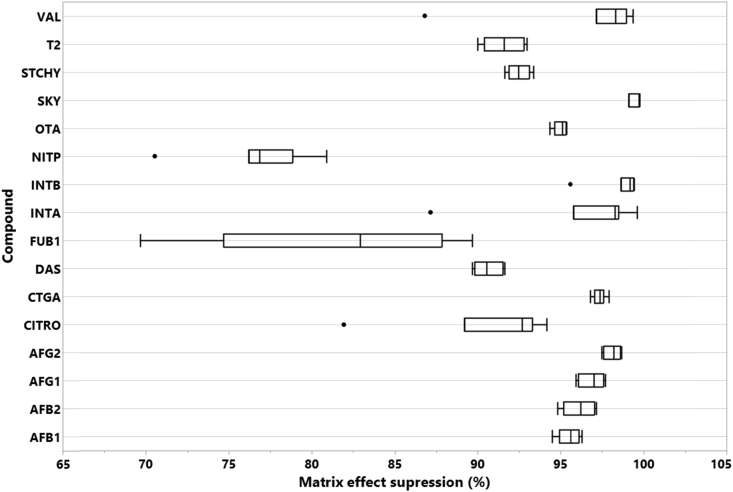
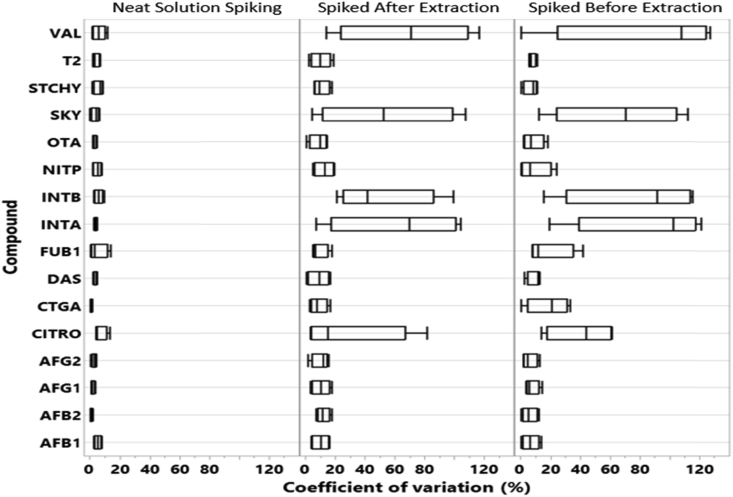
We examined potential matrix effects (MEs) in analyses of 31 MSMs using ultraperformance LC-MSMS. Twenty-one dust aliquots from three buildings (seven aliquots/building) were spiked with seven concentrations of each of the MSMs (6.2 pg/μl-900 pg/μl) and then extracted. Another set of 21 aliquots were first extracted and then, the extract was spiked with the same concentrations. We added deepoxy-deoxynivalenol (DOM) to all aliquots as a universal internal standard. Ten microliters of the extract was injected into the ultraperformance LC-MSMS. ME was calculated by subtracting the percentage of the response of analyte in spiked extract to that in neat standard from 100. Spiked extract results were used to create a matrix-matched calibration (MMC) curve for estimating MSM concentration in dust spiked before extraction.
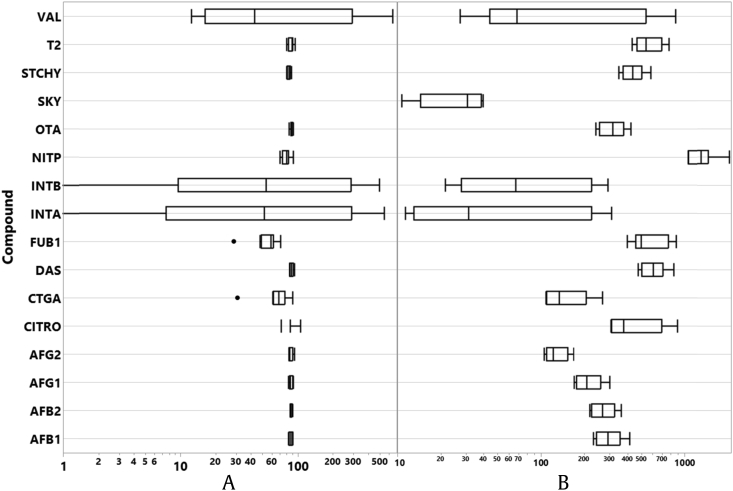
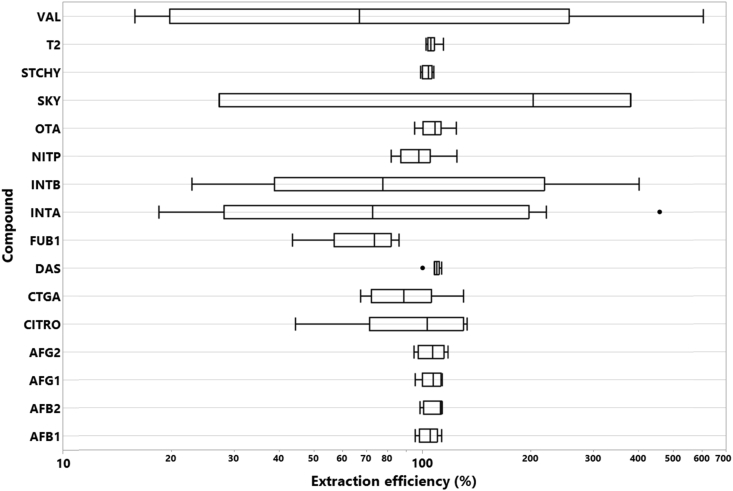
Analysis of variance was used to examine effects of compound (MSM), building and concentration on response. MEs (range: 63.4%-99.97%) significantly differed by MSM ( < 0.01) and building ( < 0.05). Mean percent recoveries adjusted with DOM and the MMC method were 246.3% (SD = 226.0) and 86.3% (SD = 70.7), respectively.
We found that dust MEs resulted in substantial underestimation in quantifying MSMs and that DOM was not an optimal universal internal standard for the adjustment but that the MMC method resulted in more accurate and precise recovery compared with DOM. More research on adjustment methods for dust MEs in the simultaneous analyses of multiple MSMs using LC-MSMS is warranted.
液相色谱-串联质谱法(LC-MSMS)用于同时分析多种微生物次级代谢产物(MSMs)时,可能会受到基质成分的干扰。
我们使用超高效液相色谱-串联质谱法研究了31种MSMs分析中的潜在基质效应(MEs)。从三栋建筑物采集了21份灰尘等分试样(每栋建筑物7份),每份分别添加7种浓度的每种MSM(6.2 pg/μl - 900 pg/μl),然后进行提取。另一组21份等分试样先进行提取,然后向提取物中添加相同浓度的MSM。我们向所有等分试样中添加了去环氧脱氧雪腐镰刀菌烯醇(DOM)作为通用内标。将10微升提取物注入超高效液相色谱-串联质谱仪。通过从100中减去加标提取物中分析物响应与纯标准品中响应的百分比来计算基质效应。加标提取物的结果用于创建基质匹配校准(MMC)曲线,以估计提取前加标灰尘中MSM的浓度。
采用方差分析来检验化合物(MSM)、建筑物和浓度对响应的影响。基质效应(范围:63.4% - 99.97%)在不同MSM(< 0.01)和不同建筑物(< 0.05)之间存在显著差异。用DOM和MMC方法调整后的平均回收率分别为246.3%(标准差 = 226.0)和86.3%(标准差 = 70.7)。
我们发现灰尘基质效应导致在定量MSMs时严重低估,并且DOM不是用于校正的最佳通用内标,但与DOM相比,MMC方法能实现更准确和精确的回收率。有必要对使用LC-MSMS同时分析多种MSMs时灰尘基质效应的校正方法进行更多研究。