Department of Applied Mathematics and Theoretical Physics, University of Cambridge, Cambridge, United Kingdom.
Institute of Theoretical Physics, Faculty of Physics, University of Warsaw, Warsaw, Poland.
Elife. 2019 Jul 16;8:e44907. doi: 10.7554/eLife.44907.
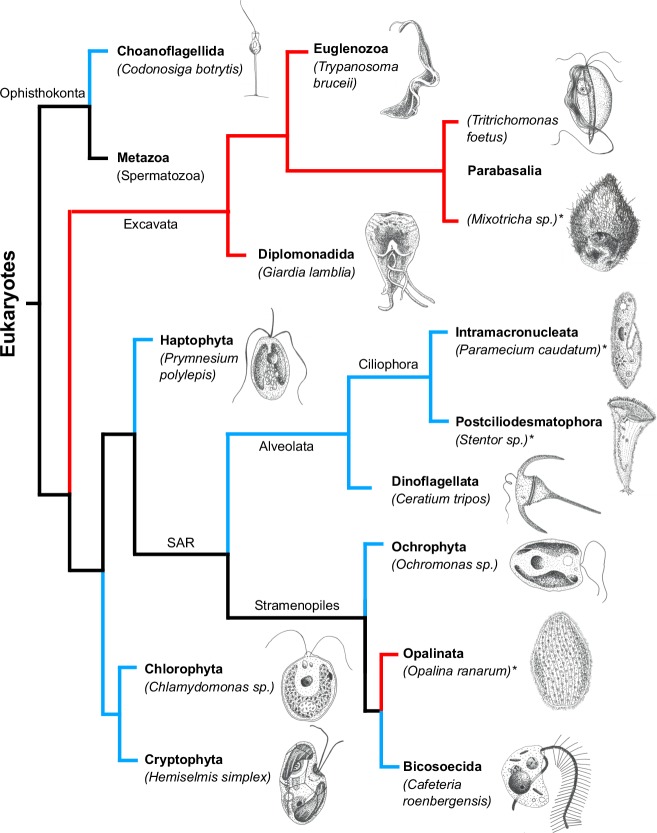
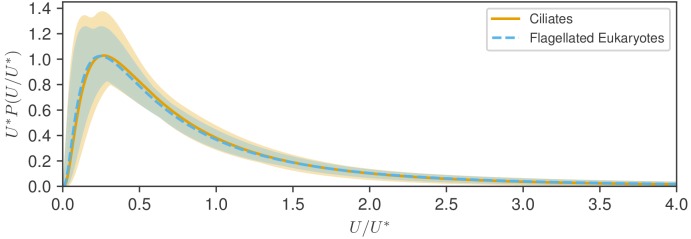
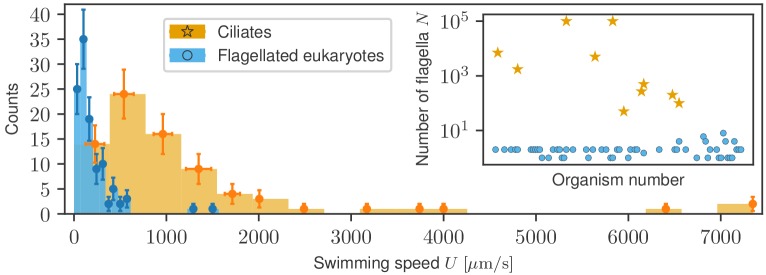
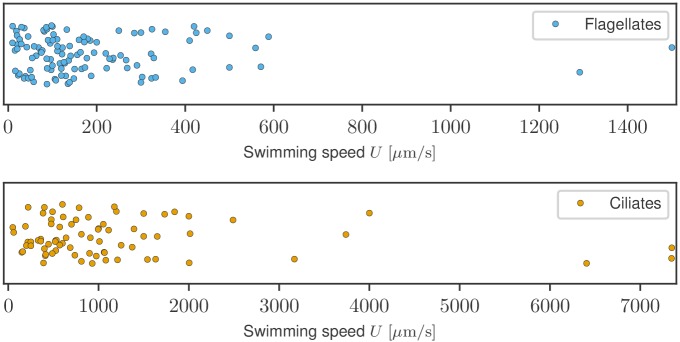
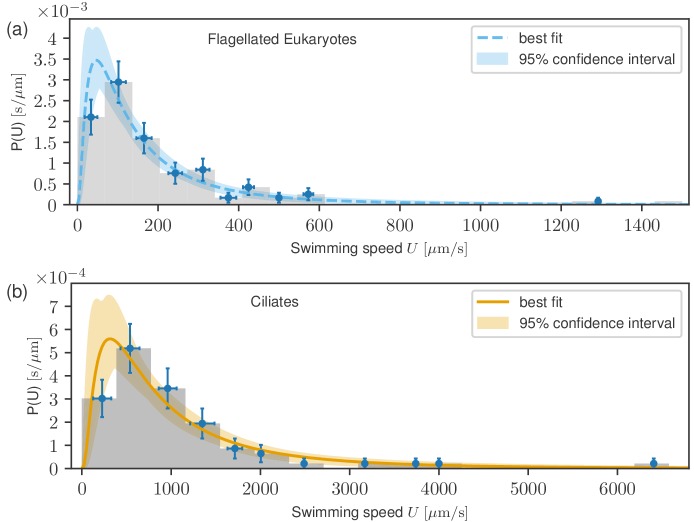
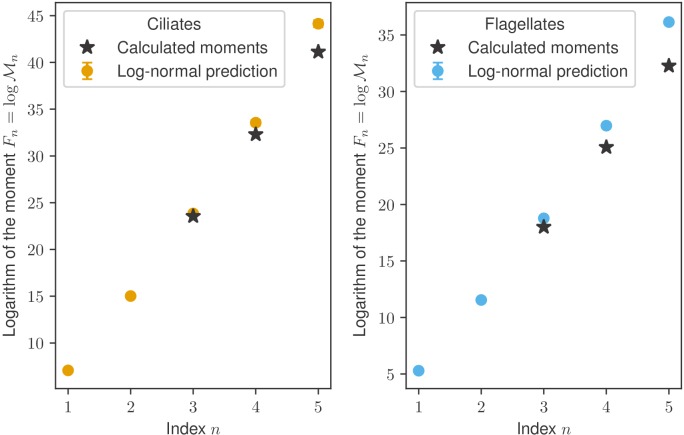
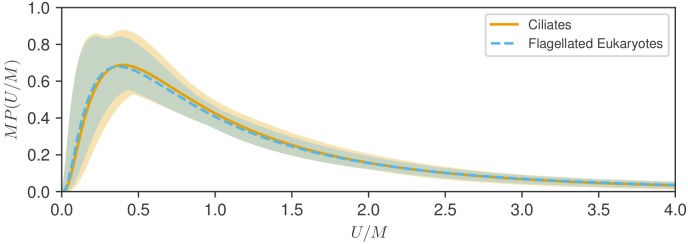
One approach to quantifying biological diversity consists of characterizing the statistical distribution of specific properties of a taxonomic group or habitat. Microorganisms living in fluid environments, and for whom motility is key, exploit propulsion resulting from a rich variety of shapes, forms, and swimming strategies. Here, we explore the variability of swimming speed for unicellular eukaryotes based on published data. The data naturally partitions into that from flagellates (with a small number of flagella) and from ciliates (with tens or more). Despite the morphological and size differences between these groups, each of the two probability distributions of swimming speed are accurately represented by log-normal distributions, with good agreement holding even to fourth moments. Scaling of the distributions by a characteristic speed for each data set leads to a collapse onto an apparently universal distribution. These results suggest a universal way for ecological niches to be populated by abundant microorganisms.
一种量化生物多样性的方法包括描述分类群或栖息地特定属性的统计分布。生活在流体环境中的微生物,其运动能力是关键,它们利用丰富多样的形状、形态和游动策略来产生推进力。在这里,我们根据已发表的数据探索了单细胞真核生物游动速度的可变性。这些数据自然分为鞭毛虫(数量较少的鞭毛)和纤毛虫(数量超过数十个)。尽管这些群体在形态和大小上存在差异,但游动速度的两个概率分布都可以通过对数正态分布准确地表示,即使到第四阶矩也能很好地吻合。通过每个数据集的特征速度对分布进行缩放,可以得到一个明显的通用分布。这些结果表明,丰富的微生物可以通过一种通用的方式占据生态位。