Raja Iruthayapandi Selestin, Kim Chuntae, Song Su-Jin, Shin Yong Cheol, Kang Moon Sung, Hyon Suong-Hyu, Oh Jin-Woo, Han Dong-Wook
Monocrystalline Bank Research Institute, Pusan National University, Busan 46241, Korea.
Department of Nanofusion Technology, College of Nanoscience & Nanotechnology, Pusan National University, Busan 46241, Korea.
Nanomaterials (Basel). 2019 Jul 15;9(7):1014. doi: 10.3390/nano9071014.
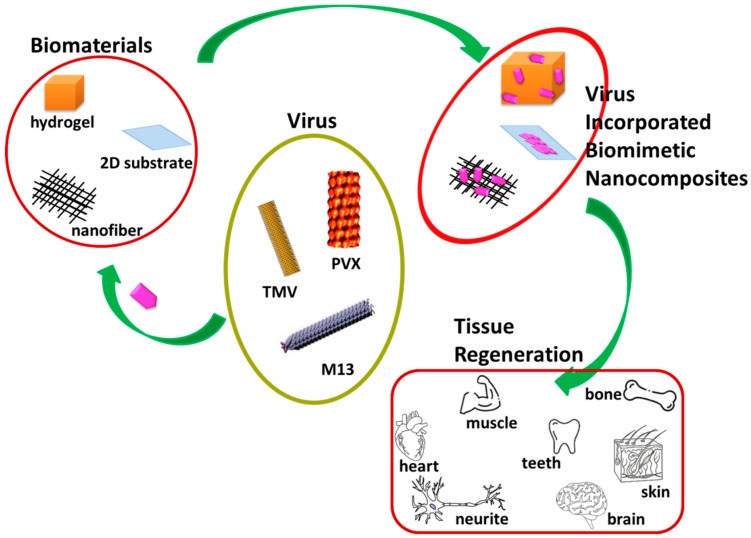
Owing to the astonishing properties of non-harmful viruses, tissue regeneration using virus-based biomimetic materials has been an emerging trend recently. The selective peptide expression and enrichment of the desired peptide on the surface, monodispersion, self-assembly, and ease of genetic and chemical modification properties have allowed viruses to take a long stride in biomedical applications. Researchers have published many reviews so far describing unusual properties of virus-based nanoparticles, phage display, modification, and possible biomedical applications, including biosensors, bioimaging, tissue regeneration, and drug delivery, however the integration of the virus into different biomaterials for the application of tissue regeneration is not yet discussed in detail. This review will focus on various morphologies of virus-incorporated biomimetic nanocomposites in tissue regeneration and highlight the progress, challenges, and future directions in this area.
由于无害病毒具有惊人的特性,利用基于病毒的仿生材料进行组织再生最近已成为一种新兴趋势。病毒在表面具有选择性肽表达和所需肽的富集、单分散性、自组装以及易于进行基因和化学修饰等特性,这使得病毒在生物医学应用中取得了长足进展。到目前为止,研究人员已经发表了许多综述,描述了基于病毒的纳米颗粒的异常特性、噬菌体展示、修饰以及可能的生物医学应用,包括生物传感器、生物成像、组织再生和药物递送,然而,尚未详细讨论将病毒整合到不同生物材料中用于组织再生的应用。本综述将重点关注用于组织再生的病毒掺入仿生纳米复合材料的各种形态,并突出该领域的进展、挑战和未来方向。