Infection and Immunity, Murdoch Children's Research Institute, Royal Children's Hospital, Parkville, Victoria, Australia.
Department of Paediatrics, The University of Melbourne, Parkville, Victoria, Australia.
Microbiome. 2019 Jul 16;7(1):106. doi: 10.1186/s40168-019-0716-4.
Streptococcus pneumoniae is a significant global pathogen that colonises the nasopharynx of healthy children. Pneumococcal conjugate vaccines, which reduce nasopharyngeal colonisation of vaccine-type S. pneumoniae, may have broader effects on the nasopharyngeal microbiota; however, data are limited. In Fiji, nasopharyngeal carriage prevalence of S. pneumoniae and other colonising species differ between the two main ethnic groups. Here, we examined the association between the 7-valent pneumococcal conjugate vaccine (PCV7) and the nasopharyngeal microbiota of children in Fiji, including for each of the two main ethnic groups-indigenous Fijians (iTaukei) and Fijians of Indian descent (FID).
The nasopharyngeal microbiota of 132 Fijian children was examined using nasopharyngeal swabs collected from 12-month-old iTaukei and FID children who were vaccinated (3 doses PCV7) or unvaccinated in infancy as part of a phase II randomised controlled trial. Microbiota composition was determined by sequencing the V4 region of the 16S rRNA gene. Species-specific carriage of S. pneumoniae, Haemophilus influenzae, Moraxella catarrhalis and Staphylococcus aureus was determined using real-time quantitative PCR. Associations between microbiota composition and other host and environmental factors were considered in the analysis.
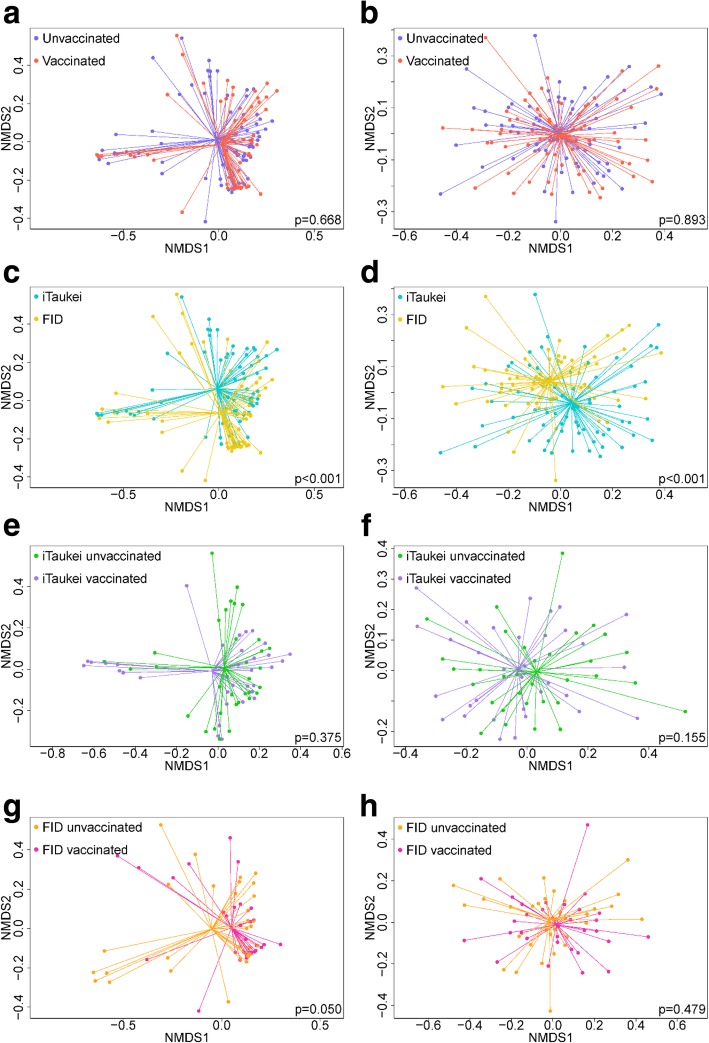
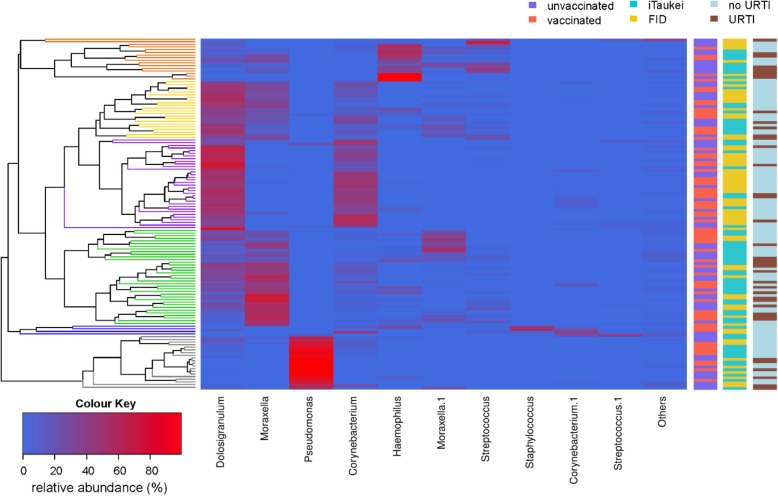
PCV7 had no overall impact on microbial diversity or composition. However, ethnic differences were observed in both diversity and composition with iTaukei children having higher relative abundance of Moraxella (p = 0.004) and Haemophilus (p = 0.004) and lower relative abundance of Staphylococcus (p = 0.026), Dolosigranulum (p = 0.004) and Corynebacterium (p = 0.003) compared with FID children. Further, when we stratified by ethnicity, associations with PCV7 could be detected: vaccinated iTaukei children had a lower relative abundance of Streptococcus and Haemophilus compared with unvaccinated iTaukei children (p = 0.022 and p = 0.043, respectively); and vaccinated FID children had a higher relative abundance of Dolosigranulum compared with unvaccinated FID children (p = 0.037). Children with symptoms of an upper respiratory tract infection (URTI) had a significantly different microbiota composition to children without symptoms. The microbiota composition of iTaukei children without URTI symptoms was most similar to the microbiota composition of FID children with URTI symptoms.
Associations between PCV7 and nasopharyngeal microbiota differed within each ethnic group. This study highlights the influence that ethnicity and URTIs have on nasopharyngeal microbiota.
肺炎链球菌是一种重要的全球病原体,定植于健康儿童的鼻咽部。肺炎球菌结合疫苗可降低疫苗型肺炎链球菌在鼻咽部的定植,可能对鼻咽部微生物群产生更广泛的影响;然而,数据有限。在斐济,两种主要族裔(本土斐济人[iTaukei]和斐济印度裔[FID])之间,肺炎链球菌和其他定植物种的鼻咽部携带率存在差异。在这里,我们研究了 7 价肺炎球菌结合疫苗(PCV7)与斐济儿童鼻咽部微生物群之间的关联,包括对这两个主要族裔(本土斐济人[iTaukei]和斐济印度裔[FID])的 12 个月大的接种(3 剂 PCV7)和未接种婴儿进行研究。使用鼻咽拭子从接种或未接种婴儿中采集鼻咽部微生物群样本,通过对 16S rRNA 基因 V4 区进行测序来确定微生物群组成。使用实时定量 PCR 确定肺炎链球菌、流感嗜血杆菌、卡他莫拉菌和金黄色葡萄球菌的特异性携带情况。在分析中考虑了微生物群组成与其他宿主和环境因素之间的关联。
PCV7 对微生物多样性或组成没有总体影响。然而,在多样性和组成方面观察到了族裔差异,iTaukei 儿童的莫拉菌(p=0.004)和流感嗜血杆菌(p=0.004)相对丰度较高,而金黄色葡萄球菌(p=0.026)、Dolosigranulum(p=0.004)和棒状杆菌(p=0.003)的相对丰度较低,与 FID 儿童相比。此外,当我们按族裔分层时,可以检测到与 PCV7 的关联:与未接种的 iTaukei 儿童相比,接种的 iTaukei 儿童的链球菌和流感嗜血杆菌相对丰度较低(p=0.022 和 p=0.043);与未接种的 FID 儿童相比,接种的 FID 儿童的Dolosigranulum 相对丰度较高(p=0.037)。有上呼吸道感染(URTI)症状的儿童与无症状儿童的微生物群组成有显著差异。没有 URTI 症状的 iTaukei 儿童的微生物群组成与有 URTI 症状的 FID 儿童的微生物群组成最相似。
PCV7 与鼻咽部微生物群之间的关联在每个族裔内有所不同。本研究强调了族裔和 URTIs 对鼻咽部微生物群的影响。