Department of Nutritional Sciences and New Jersey Institute for Food, Nutrition, and Health, Rutgers University, New Brunswick, NJ, 08901, United States.
Oregon Institute for Occupational Health Sciences, Department of Molecular and Medical Genetics, Oregon Health & Sciences University, Portland, Oregon, 97239, United States.
DNA Repair (Amst). 2019 Sep;81:102667. doi: 10.1016/j.dnarep.2019.102667. Epub 2019 Jul 8.
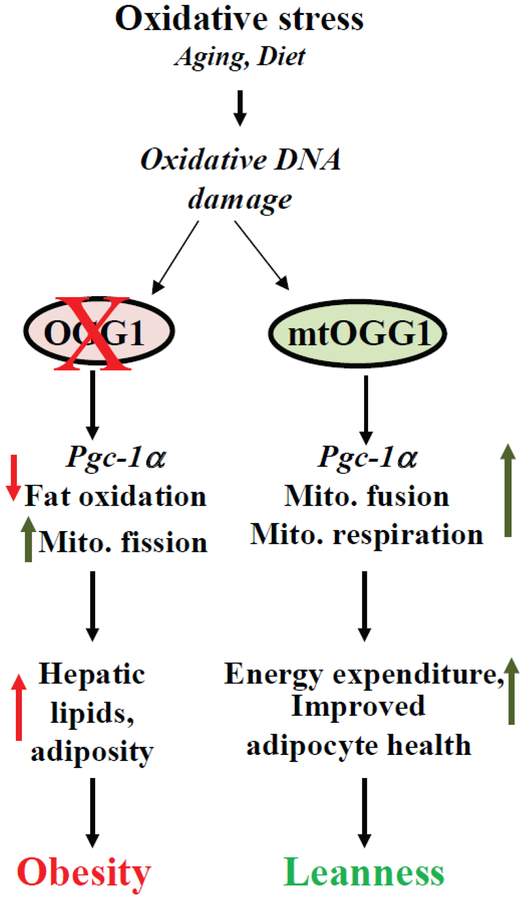
Cellular damage produced by conditions generating oxidative stress have far-reaching implications in human disease that encompass, but are not restricted to aging, cardiovascular disease, type 2 diabetes, airway inflammation/asthma, cancer, and metabolic syndrome including visceral obesity, insulin resistance, fatty liver disease, and dyslipidemia. Although there are numerous sources and cellular targets of oxidative stress, this review will highlight literature that has investigated downstream consequences of oxidatively-induced DNA damage in both nuclear and mitochondrial genomes. The presence of such damage can in turn, directly and indirectly modulate cellular transcriptional and repair responses to such stressors. As such, the persistence of base damage can serve as a key regulator in coordinated gene-response cascades. Conversely, repair of these DNA lesions serves as both a suppressor of mutagenesis and by inference carcinogenesis, and as a signal for the cessation of ongoing oxidative stress. A key enzyme in all these processes is 8-oxoguanine DNA glycosylase (OGG1), which, via non-catalytic binding to oxidatively-induced DNA damage in promoter regions, serves as a nucleation site around which changes in large-scale regulation of inflammation-associated gene expression can occur. Further, the catalytic function of OGG1 can alter the three-dimensional structure of specialized DNA sequences, leading to changes in transcriptional profiles. This review will concentrate on adverse deleterious health effects that are associated with both the diminution of OGG1 activity via population-specific polymorphic variants and the complete loss of OGG1 in murine models. This mouse model displays diet- and age-related induction of metabolic syndrome, highlighting a key role for OGG1 in protecting against these phenotypes. Conversely, recent investigations using murine models having enhanced global expression of a mitochondrial-targeted OGG1 demonstrate that they are highly resistant to diet-induced disease. These data suggest strategies through which therapeutic interventions could be designed for reducing or limiting adverse human health consequences to these ubiquitous stressors.
由产生氧化应激条件引起的细胞损伤对人类疾病有深远的影响,这些疾病不仅包括衰老、心血管疾病、2 型糖尿病、气道炎症/哮喘、癌症和代谢综合征(包括内脏肥胖、胰岛素抵抗、脂肪肝疾病和血脂异常)。尽管氧化应激有许多来源和细胞靶点,但本综述将重点介绍研究氧化诱导的核和线粒体基因组中 DNA 损伤下游后果的文献。这种损伤的存在反过来又可以直接和间接地调节细胞对这些应激源的转录和修复反应。因此,碱基损伤的持续存在可以作为协调基因反应级联的关键调节剂。相反,这些 DNA 损伤的修复既是突变和致癌作用的抑制剂,也是氧化应激持续的信号。所有这些过程中的关键酶是 8-氧鸟嘌呤 DNA 糖苷酶(OGG1),它通过非催化结合到启动子区域的氧化诱导的 DNA 损伤,作为一个核化位点,围绕这个位点可以发生与炎症相关基因表达的大规模调节变化。此外,OGG1 的催化功能可以改变特殊 DNA 序列的三维结构,导致转录谱的变化。本综述将集中讨论与 OGG1 活性降低相关的不良有害健康影响,这种降低是由于人群特异性多态性变体,以及在鼠模型中完全丧失 OGG1 引起的。这种鼠模型显示出与饮食和年龄相关的代谢综合征诱导,突出了 OGG1 在保护免受这些表型中的关键作用。相反,最近使用具有增强的线粒体靶向 OGG1 全局表达的鼠模型进行的研究表明,它们对饮食诱导的疾病具有高度抗性。这些数据表明,可以通过设计治疗干预措施来减少或限制这些普遍应激源对人类健康的不良影响。