Evolution, Genomes, Behavior and Ecology, CNRS, Univ Paris-Sud, IRD (UMR 9191), 1 avenue de la Terrasse, Gif-sur-Yvette, 91198, France.
Sci Rep. 2019 Jul 16;9(1):10313. doi: 10.1038/s41598-019-46482-4.
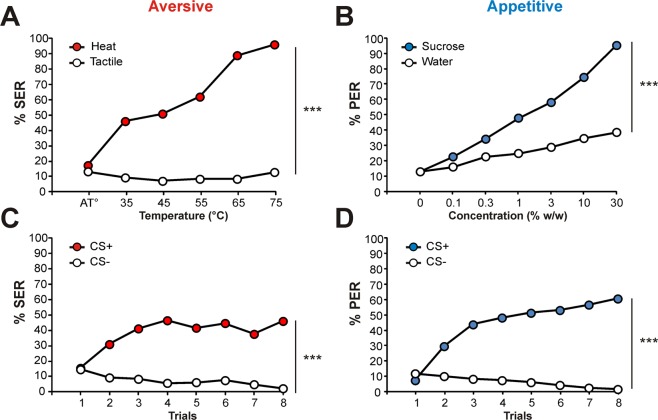
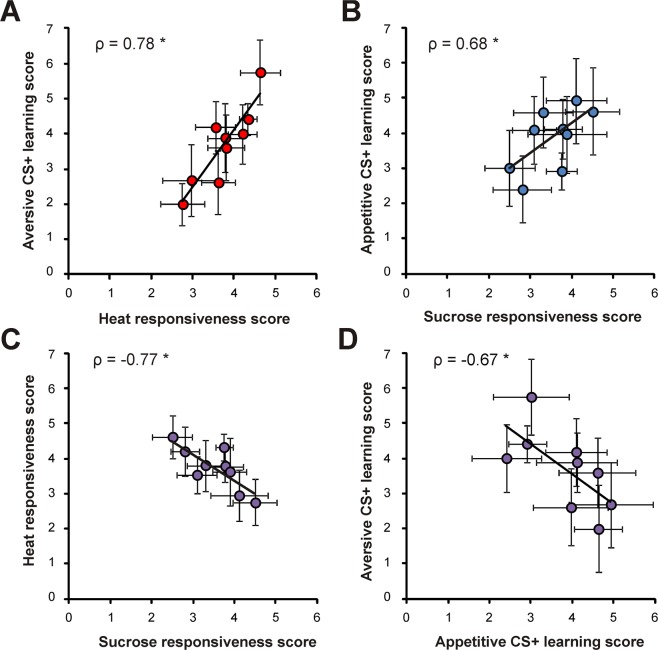
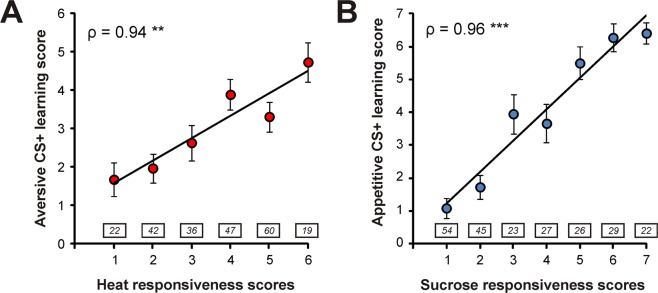
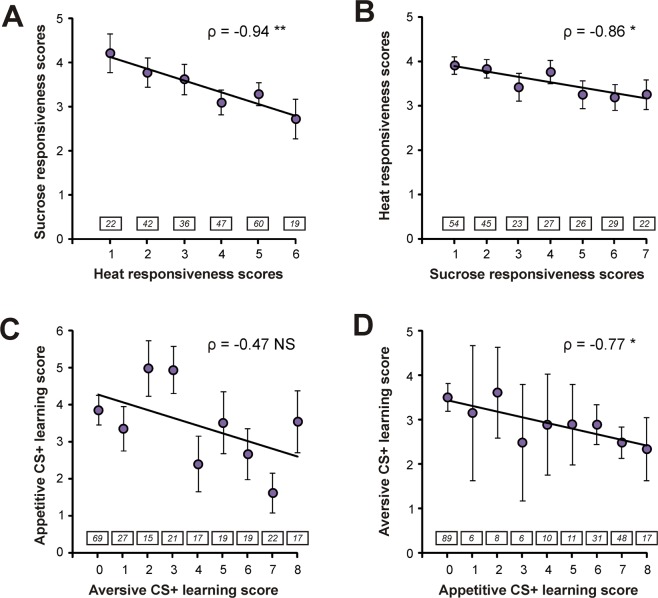
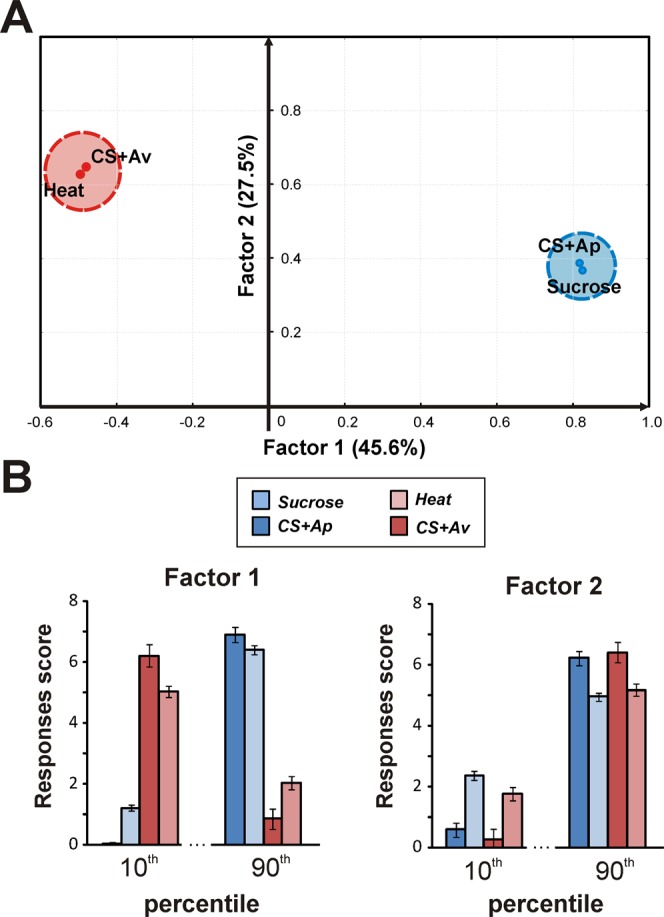
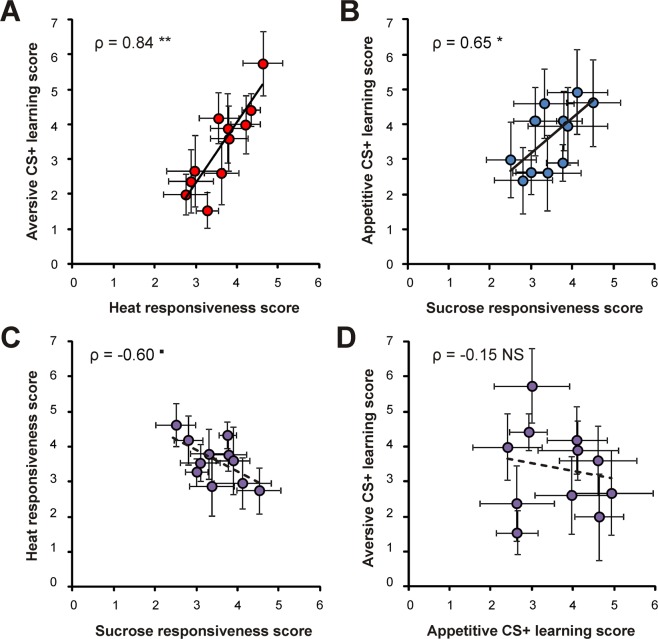
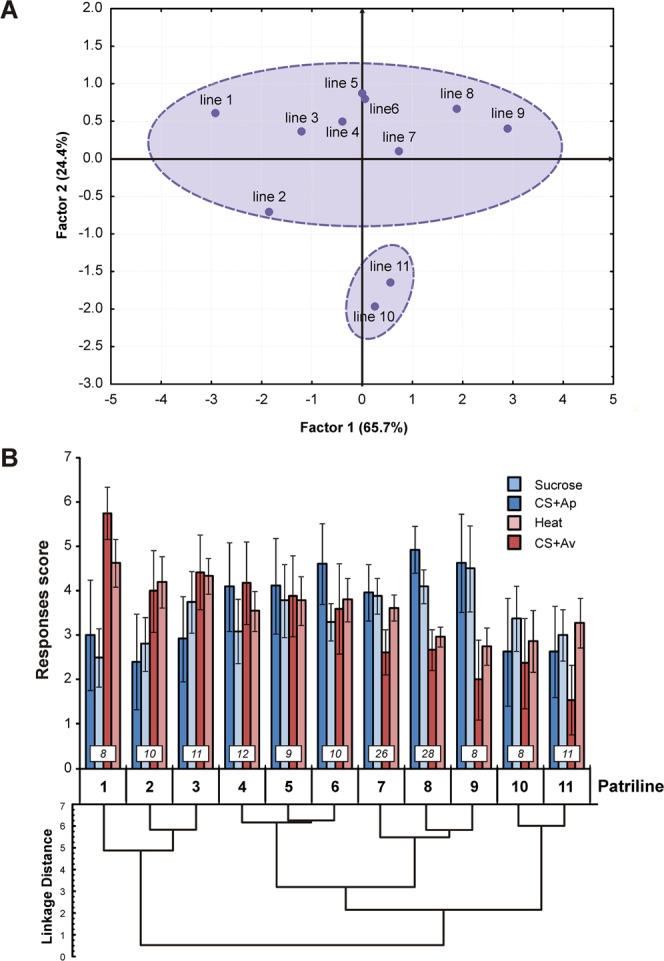
Honey bees can learn both appetitive and aversive associations, using two olfactory conditioning protocols. Appetitive conditioning of the proboscis extension response (PER) involves associating an odor, the conditioned stimulus (CS) with a sucrose solution, the unconditioned stimulus (US). Conversely, aversive conditioning of the sting extension response (SER) involves associating the odor CS with an electric or thermal shock US. Here, we investigated the relationship between bees' appetitive and aversive learning capacities at the individual level and the influence of bees' genotype. As learning performance was shown to depend on an individuals' sensitivity to the US, we systematically measured four different traits in each individual bee: sensitivity to sucrose, PER learning performance with a sucrose US, sensitivity to temperature, SER learning with a temperature US. First, we confirmed for both conditioning types that learning performance correlates with US responsiveness. Second, we found a trade-off between appetitive and aversive learning performances: bees that were better appetitive learners (and had a lower sucrose US threshold) learned less efficiently in the aversive conditioning (and had a higher temperature US threshold). Because the honey bee queen typically mates with 15-20 males, the workers from a honey bee hive belong to as many different patrilines, allowing for the search of the genetic determinism of cognitive abilities. Using microsatellite analysis, we show that a genetic determinism underlies the trade-off between appetitive and aversive capacities, with appetitively vs aversively biased patrilines. The honey bee hive thus appears as a genetically structured cognitive community.
蜜蜂可以通过两种嗅觉条件作用协议来学习食欲和厌恶联想。味觉延伸反应(PER)的条件作用涉及将气味(条件刺激,CS)与蔗糖溶液(非条件刺激,US)联系起来。相反,蜇刺延伸反应(SER)的厌恶条件作用涉及将气味 CS 与电击或热冲击 US 联系起来。在这里,我们研究了个体水平上蜜蜂的食欲和厌恶学习能力之间的关系以及蜜蜂基因型的影响。由于学习表现取决于个体对 US 的敏感性,我们系统地测量了每个个体蜜蜂的四个不同特征:对蔗糖的敏感性、用蔗糖 US 进行 PER 学习表现、对温度的敏感性、用温度 US 进行 SER 学习。首先,我们确认了这两种条件作用类型的学习表现都与 US 反应性相关。其次,我们发现食欲和厌恶学习表现之间存在权衡:食欲学习表现较好的蜜蜂(蔗糖 US 阈值较低)在厌恶条件作用中的学习效率较低(温度 US 阈值较高)。由于蜂王通常与 15-20 只雄蜂交配,因此蜂群中的工蜂来自许多不同的父系线,这使得我们能够探索认知能力的遗传决定因素。通过微卫星分析,我们表明,在食欲和厌恶能力之间存在一种遗传决定因素,即食欲和厌恶偏向的父系线。因此,蜜蜂蜂巢似乎是一个具有遗传结构的认知社区。