Department of Oncology, Xiangya Hospital, Central South University, Changsha, China.
Department of Outpatient, Xiangya Hospital, Central South University, Changsha, China.
Cancer Med. 2019 Sep;8(11):5089-5096. doi: 10.1002/cam4.2376. Epub 2019 Jul 17.
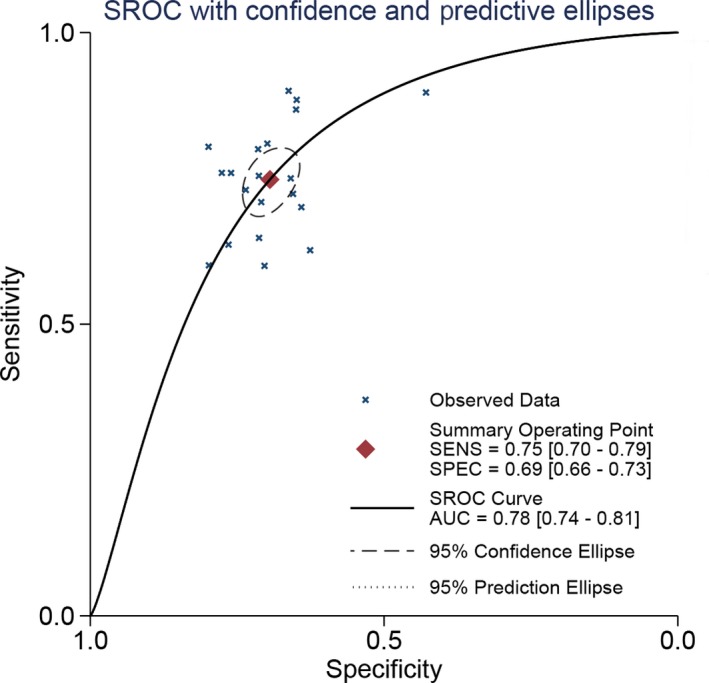
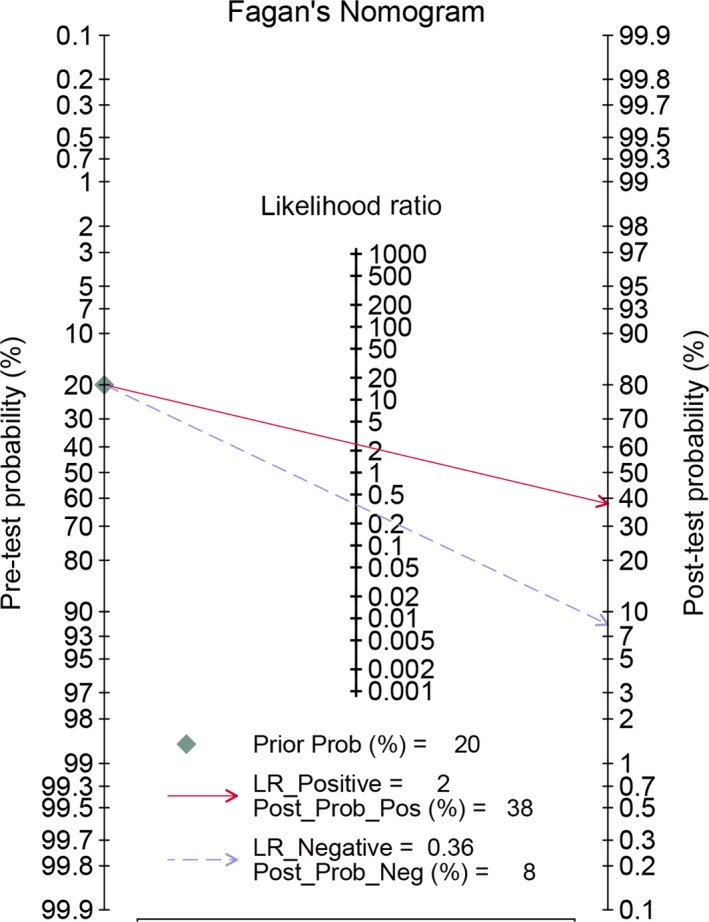
In this study, we performed a comprehensive estimation and assessment for the clinical value of prostate health index (PHI) in diagnosing prostate cancer. Using the bivariate mixed-effect model, we calculated the following parameters and their 95% confidence internals (CIs), including sensitivity, specificity, positive likelihood ratio, negative likelihood ratio, diagnostic odds ratio and symmetric receiver operator characteristic. Twenty eligible studies with a total number of 5543 subjects were included in the final analysis. The estimated sensitivity was 0.75 (95% CI: 0.70-0.79) and the specificity was 0.69 (95% CI: 0.58-0.83). The pooled area under the curve was 0.78 (95% CI: 0.74-0.81). The combined positive likelihood ratio was 2.45 (95% CI: 2.19-2.73) and the negative likelihood ratio was 0.36 (95% CI: 0.31-0.43). The diagnostic odds ratio was 6.73 (95% CI: 5.38-8.44). The posttest probability was 40% under the present positive likelihood ratio of 2.45. It seems there was no significant difference between Asian population and Caucasian population population in sensitivity and specificity. But the overlap of AUC 95% CI indicated that the diagnostic accuracy of PHI was slightly higher in the Asian population population setting than that in the Caucasian population population population (0.83 vs 0.76). Similarly, there was also overlap in AUC 95% CI, which suggested that sample size may be one of heterogeneity source. The PHI has a moderate diagnostic accuracy for detecting prostate cancer. The discrimination ability of PHI is slightly prior to free/total prostate-specific antigen. It seems that ethnicity has an influence on the clinical value of PHI in the diagnostic of prostate cancer.
在这项研究中,我们对前列腺健康指数(PHI)在诊断前列腺癌中的临床价值进行了全面评估和估计。我们使用双变量混合效应模型,计算了以下参数及其 95%置信区间(CI),包括敏感性、特异性、阳性似然比、阴性似然比、诊断优势比和对称接收者操作特征。最终分析共纳入 20 项符合条件的研究,共 5543 例受试者。估计的敏感性为 0.75(95%CI:0.70-0.79),特异性为 0.69(95%CI:0.58-0.83)。曲线下面积的合并值为 0.78(95%CI:0.74-0.81)。合并阳性似然比为 2.45(95%CI:2.19-2.73),阴性似然比为 0.36(95%CI:0.31-0.43)。诊断优势比为 6.73(95%CI:5.38-8.44)。当前阳性似然比为 2.45 时,后验概率为 40%。在敏感性和特异性方面,亚洲人群与高加索人群似乎没有显著差异。但是 AUC 95%CI 的重叠表明,PHI 的诊断准确性在亚洲人群中略高于高加索人群(0.83 比 0.76)。同样,AUC 95%CI 也有重叠,这表明样本量可能是异质性的一个来源。PHI 对检测前列腺癌具有中等的诊断准确性。PHI 的鉴别能力略优于游离/总前列腺特异性抗原。种族似乎对 PHI 在前列腺癌诊断中的临床价值有影响。