Guo Ting, Li Bin, Gu Chao, Chen Xiuying, Han Mengxin, Liu Xiaocheng, Xu Congjian
Department of Gynecology, Obstetrics and Gynecology Hospital of Fudan University, Shanghai 200011, PR China.
Aging (Albany NY). 2019 Jul 17;11(14):4890-4899. doi: 10.18632/aging.102082.
We previously found Cyclin E1-driven high grade serous ovarian cancer (HGSOC) showed metabolic shift. In this study, we aimed to elucidate signaling pathway therein.
In silico reproduction of TCGA ovarian cancer dataset and pathway analysis were performed. Candidate metabolic pathway was validated using and assays.
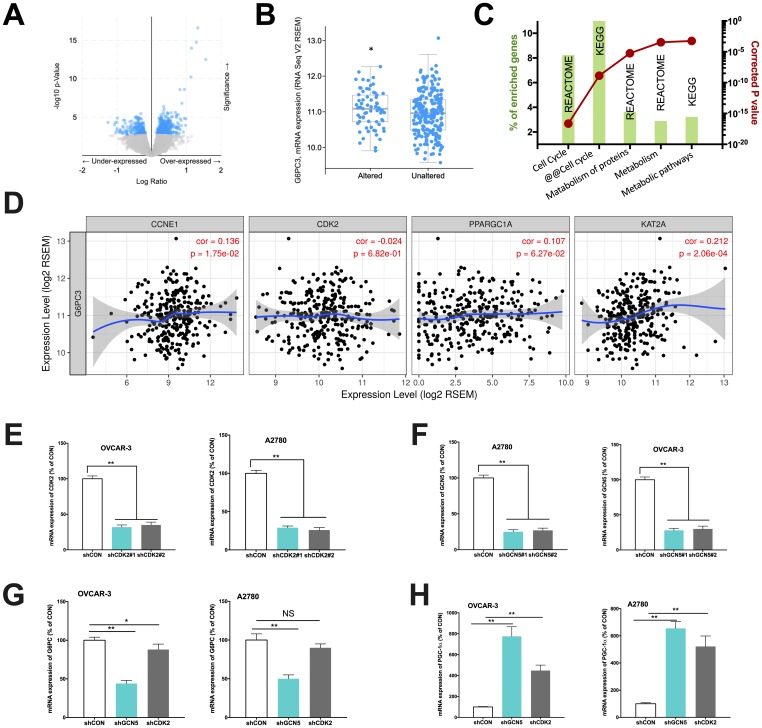
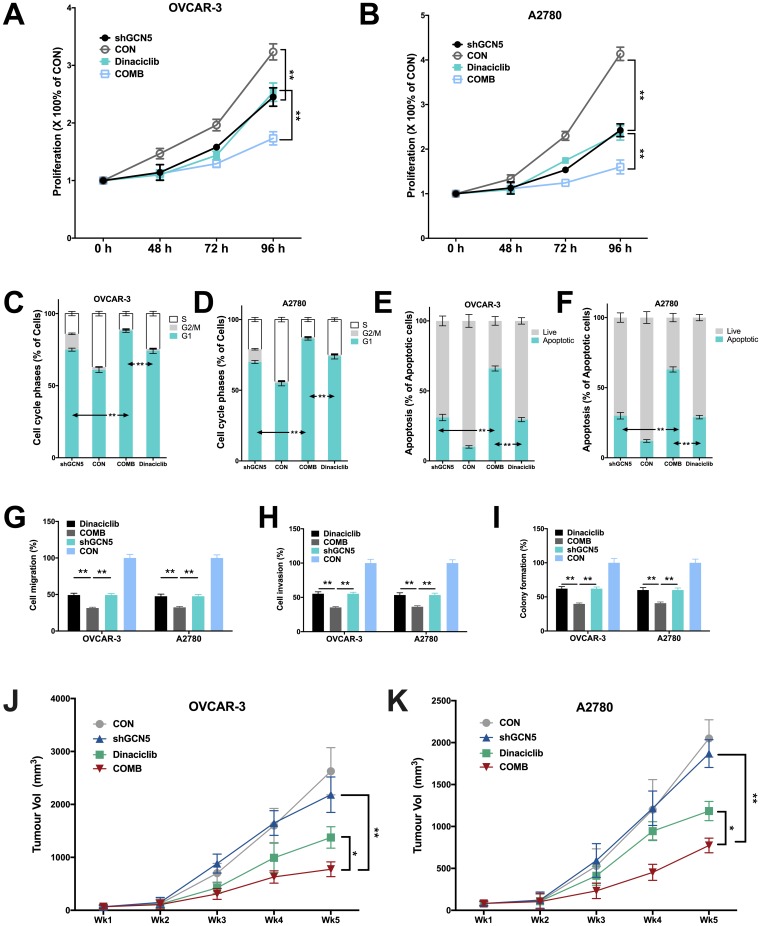
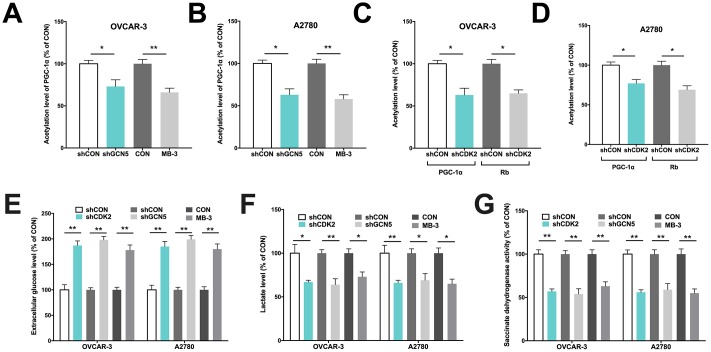
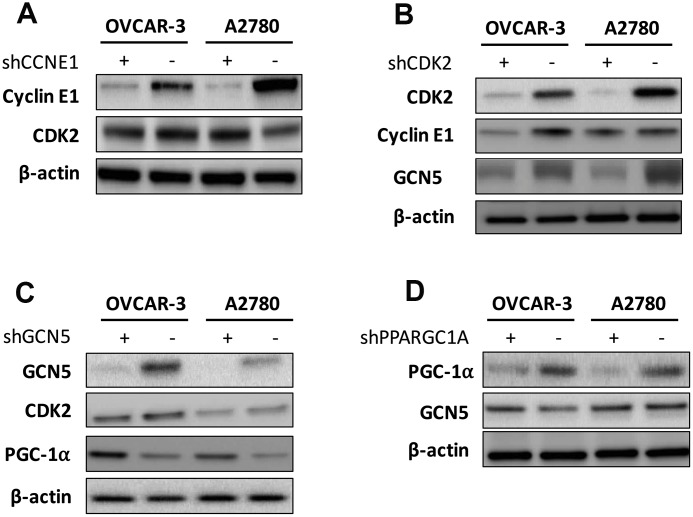
We found CCNE1-amplified HGSOC showed significant metabolic alteration besides canonical cell cycle control. Using CCNE1-amplified OVCAR-3 and A2780 OvCa cells, we found that knockdown of CDK2 and GCN5 resulted in decreased G6PC and increased PGC-1α level, and that both genetic and pharmaceutical (MB-3) inhibition of GCN5 resulted in significant decrease in acetylation of PGC-1α. Silencing of CDK2 also resulted in significant decrease in acetylation of both PGC-1α and Rb. GCN5-KD significantly decreased glucose uptake, increased lactate production and decreased SDH activity. Western blots showed hierarchy of the elements indicating Cyclin E1-CDK2/GCN5/PGC-1α regulatory axis from up- to down- stream. Inhibitory effect of Dinaciclib was similar to that of GCN5 silencing, whereas combination therapy further inhibited cell proliferation significantly. Similar findings were noted also in cell cycle arrest, apoptosis, invasion, migration and colony formation assays. Xenograft experiments showed that GCN5-KD alone did not alter tumor growth yet combination therapy of Dinaciclib and GCN5-KD conferred significant inhibition of tumor growth compared with either therapy alone with no toxicity observed.
GCN-5/PGC-1α signaling is activated and associated with metabolism in Cyclin E1-driven HGSOC. Targeting GCN5 hold promise to augment current CDK2-targeting strategy and further studies are warranted for clinical translation.
我们之前发现细胞周期蛋白E1驱动的高级别浆液性卵巢癌(HGSOC)表现出代谢转变。在本研究中,我们旨在阐明其中的信号通路。
对TCGA卵巢癌数据集进行计算机模拟再现并进行通路分析。使用[具体实验方法1]和[具体实验方法2]检测对候选代谢通路进行验证。
我们发现CCNE1扩增的HGSOC除了经典的细胞周期控制外还表现出显著的代谢改变。使用CCNE1扩增的OVCAR-3和A2780卵巢癌细胞系,我们发现敲低CDK2和GCN5导致G6PC水平降低和PGC-1α水平升高,并且GCN5的基因抑制和药物抑制(MB-3)均导致PGC-1α乙酰化显著降低。CDK2沉默也导致PGC-1α和Rb的乙酰化显著降低。GCN5基因敲除显著降低葡萄糖摄取,增加乳酸生成并降低SDH活性。蛋白质印迹显示各元件的层级关系,表明细胞周期蛋白E1 - CDK2/GCN5/PGC-1α从上游到下游的调控轴。Dinaciclib的抑制作用与GCN5沉默相似,而联合治疗进一步显著抑制细胞增殖。在细胞周期阻滞、凋亡、侵袭、迁移和集落形成实验中也观察到类似结果。异种移植实验表明,单独的GCN5基因敲除不改变肿瘤生长,但与单独使用任何一种治疗相比,Dinaciclib和GCN5基因敲除的联合治疗显著抑制肿瘤生长,且未观察到毒性。
GCN-5/PGC-1α信号通路在细胞周期蛋白E1驱动的HGSOC中被激活并与代谢相关。靶向GCN5有望增强当前针对CDK2的靶向策略,值得进一步开展临床转化研究。