Department of Bioengineering, Stanford University, Stanford, CA.
Department of Mechanical Engineering, Stanford University, Stanford, CA
J Cell Biol. 2019 Aug 5;218(8):2456-2469. doi: 10.1083/jcb.201903066. Epub 2019 Jul 17.
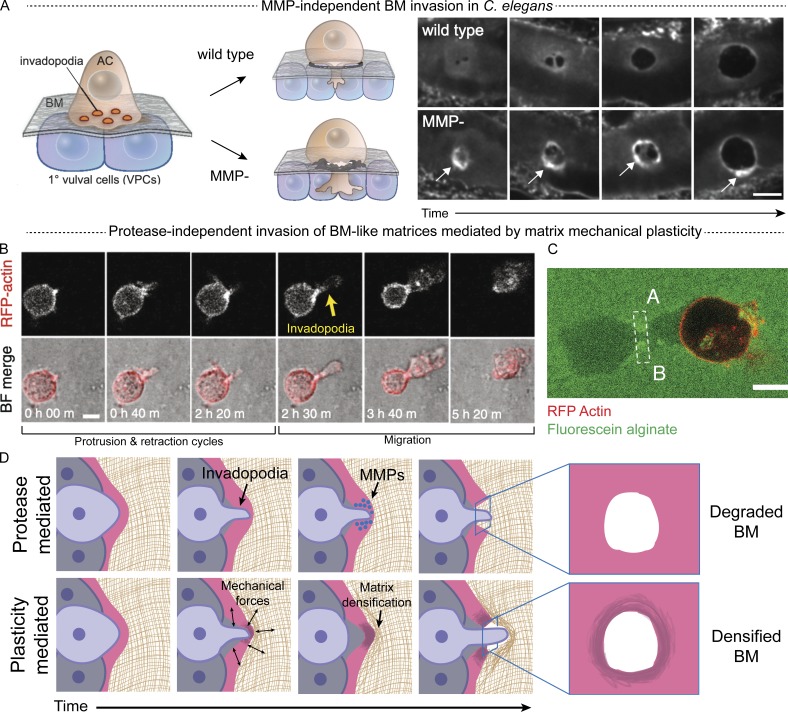
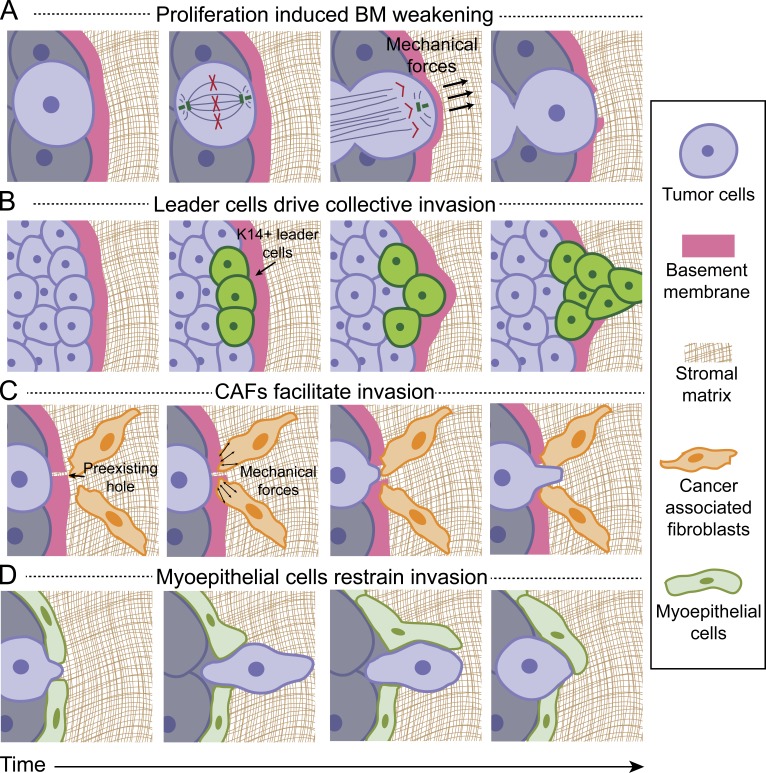
In epithelial cancers, cells must invade through basement membranes (BMs) to metastasize. The BM, a thin layer of extracellular matrix underlying epithelial and endothelial tissues, is primarily composed of laminin and collagen IV and serves as a structural barrier to cancer cell invasion, intravasation, and extravasation. BM invasion has been thought to require protease degradation since cells, which are typically on the order of 10 µm in size, are too large to squeeze through the nanometer-scale pores of the BM. However, recent studies point toward a more complex picture, with physical forces generated by cancer cells facilitating protease-independent BM invasion. Moreover, collective cell interactions, proliferation, cancer-associated fibroblasts, myoepithelial cells, and immune cells are all implicated in regulating BM invasion through physical forces. A comprehensive understanding of BM structure and mechanics and diverse modes of BM invasion may yield new strategies for blocking cancer progression and metastasis.
在上皮癌中,细胞必须穿过基底膜(BM)才能转移。BM 是位于上皮和内皮组织下方的一层薄细胞外基质,主要由层粘连蛋白和胶原 IV 组成,是阻止癌细胞侵袭、血管内渗和血管外渗的结构屏障。BM 侵袭一直被认为需要蛋白酶降解,因为细胞通常大小约为 10 µm,太大而无法通过 BM 的纳米级孔挤压。然而,最近的研究表明,情况更为复杂,癌细胞产生的物理力促进了蛋白酶非依赖性的 BM 侵袭。此外,细胞间的集体相互作用、增殖、癌症相关成纤维细胞、肌上皮细胞和免疫细胞都被牵连到通过物理力调节 BM 侵袭。全面了解 BM 的结构和力学以及 BM 侵袭的多种模式,可能会为阻止癌症进展和转移提供新的策略。