Department of Plant Pathology, Coastal Plain Experiment Station, University of Georgia, Tifton, Georgia, United States of America.
United States Department of Agriculture-Agriculture Research Service (USDA-ARS), Crop Genetics and Breeding Research Unit, Tifton, Georgia, United States of America.
PLoS One. 2019 Jul 18;14(7):e0219821. doi: 10.1371/journal.pone.0219821. eCollection 2019.
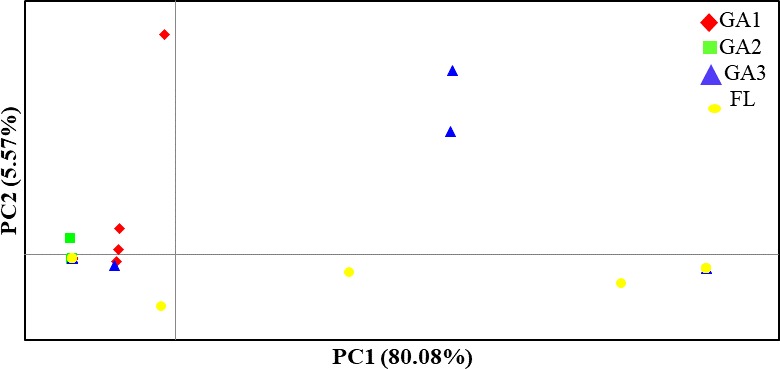
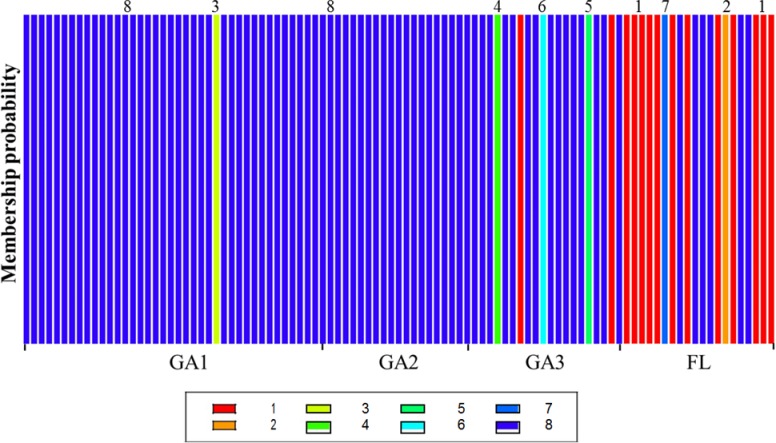
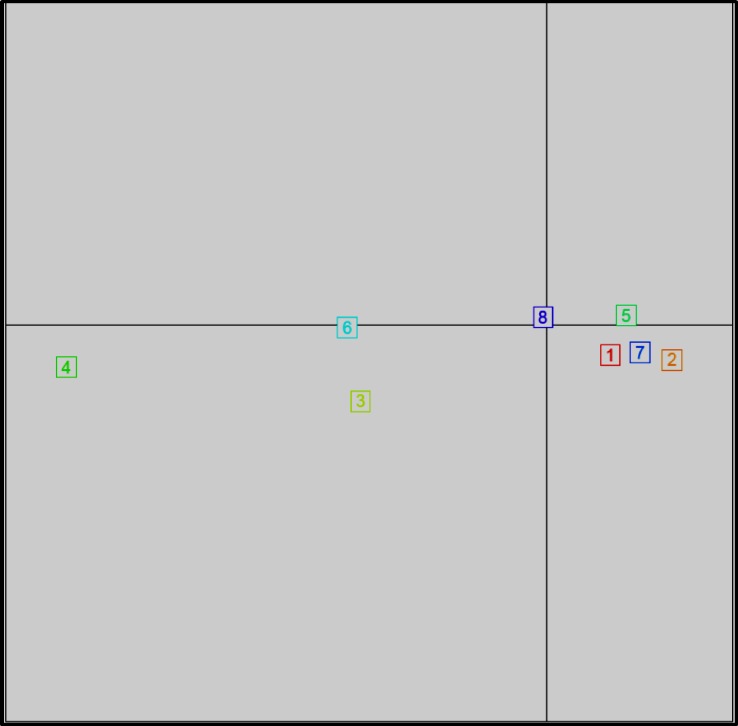
Fusarium wilt of watermelon, caused by Fusarium oxysporum f. sp. niveum (FON), occurs worldwide and is responsible for substantial yield losses in watermelon-producing areas of the southeastern United States. Management of this disease largely relies on the use of integrated pest management (i.e., fungicides, resistant cultivars, crop rotation, etc.). Knowledge about race structure and genetic diversity of FON in the southeastern US is limited. To determine genetic diversity of the pathogen, FON isolates were collected from symptomatic watermelon plants in commercial fields in Georgia and Florida, USA, and identified based on morphological characteristics and PCR analysis using FON-specific primers. Discriminant analysis of principal components (DAPC) of 99 isolates genotyped with 15 simple sequence repeat (SSR) markers grouped the isolates in eight distinct clusters with two prominent clusters (clusters 1 and 8). Cluster 1 consisted of a total of 14 isolates, out of which 85.7% of the isolates were collected in Florida. However, most of the isolates (92.4%) in cluster 8 were collected in Georgia. Both DAPC and pairwise population differentiation analysis (ФPT) revealed that the genetic groups were closely associated with geographical locations of pathogen collection. Three races of FON (races 0, 2 and 3) were identified in the phenotypic analysis; with race 3 identified for the first time in Georgia. Overall, 5.1%, 38.9% and 55.9% of the isolates were identified as race 0, race 2 and race 3, respectively. The majority of the isolates in cluster 1 and cluster 8 belonged to either race 2 (35.6%) or race 3 (45.8%). Additionally, no relationship between genetic cluster assignment and races of the isolates was observed. The information obtained on genotypic and phenotypic diversity of FON in the southeastern US will help in development of effective disease management programs to combat Fusarium wilt.
西瓜枯萎病,由尖孢镰刀菌西瓜专化型(FON)引起,广泛发生于世界各地,是美国东南部西瓜产区减产的主要原因。该病害的防治主要依赖于综合虫害管理(如杀菌剂、抗性品种、轮作等)。然而,目前对于美国东南部 FON 的群体结构和遗传多样性的了解十分有限。为了明确该病原菌的遗传多样性,本研究从美国佐治亚州和佛罗里达州商业西瓜田中出现症状的西瓜植株上采集 FON 分离物,基于形态学特征和使用 FON 特异性引物的 PCR 分析对其进行鉴定。对使用 15 个简单序列重复(SSR)标记进行基因型分析的 99 个分离物进行判别分析的主成分(DAPC)将分离物分为 8 个不同的聚类,其中 2 个聚类(聚类 1 和聚类 8)尤为突出。聚类 1 包含总共 14 个分离物,其中 85.7%的分离物来自佛罗里达州。然而,聚类 8 中的大多数分离物(92.4%)来自佐治亚州。DAPC 和成对群体分化分析(ФPT)均表明,遗传群体与病原菌采集地的地理位置密切相关。在表型分析中鉴定出 FON 的 3 个生理小种(生理小种 0、2 和 3);其中生理小种 3 是首次在佐治亚州发现。总体而言,0、2 和 3 生理小种的分离物分别占 5.1%、38.9%和 55.9%。聚类 1 和聚类 8 中的大多数分离物属于生理小种 2(35.6%)或生理小种 3(45.8%)。此外,并未观察到遗传聚类分配与分离物生理小种之间的关系。本研究获得的美国东南部 FON 的基因型和表型多样性信息将有助于制定有效的枯萎病防治计划。