Geriatric-Rehabilitation Department, Azienda Ospedaliero-Universitaria di Parma, Via Antonio Gramsci 14, 43126 Parma, Italy.
Microbiome Research Hub, University of Parma, Parco Area delle Scienze 11/A, 43124 Parma, Italy.
Nutrients. 2019 Jul 17;11(7):1633. doi: 10.3390/nu11071633.
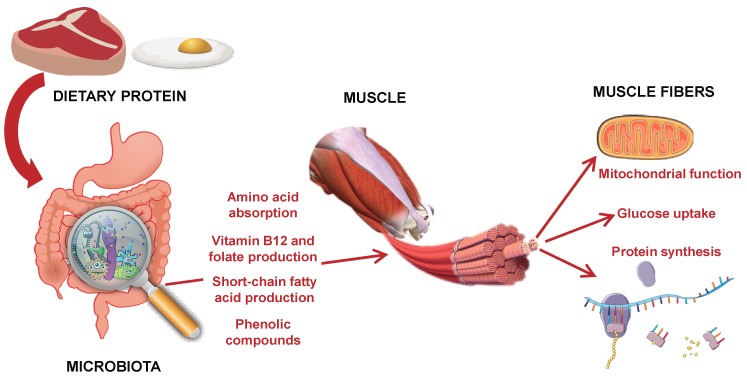
Human gut microbiota is able to influence the host physiology by regulating multiple processes, including nutrient absorption, inflammation, oxidative stress, immune function, and anabolic balance. Aging is associated with reduced microbiota biodiversity, increased inter-individual variability, and over-representation of pathobionts, and these phenomena may have great relevance for skeletal muscle mass and function. For this reason, the presence of a gut-muscle axis regulating the onset and progression of age-related physical frailty and sarcopenia has been recently hypothesized. In this narrative review, we summarize the studies supporting a possible association between gut microbiota-related parameters with measures of muscle mass, muscle function, and physical performance in animal models and humans. Reduced muscle mass has been associated with distinct microbiota composition and reduced fermentative capacity in mice, and the administration of probiotics or butyrate to mouse models of muscle wasting has been associated with improved muscle mass. However, no studies have targeted the human microbiome associated with sarcopenia. Limited evidence from human studies shows an association between microbiota composition, involving key taxa such as and , and grip strength. Similarly, few studies conducted on patients with parkinsonism showed a trend towards a different microbiota composition in those with reduced gait speed. No studies have assessed the association of fecal microbiota with other measures of physical performance. However, several studies, mainly with a cross-sectional design, suggest an association between microbiota composition and frailty, mostly assessed according to the deficit accumulation model. Namely, frailty was associated with reduced microbiota biodiversity, and lower representation of butyrate-producing bacteria. Therefore, we conclude that the causal link between microbiota and physical fitness is still uncertain due to the lack of targeted studies and the influence of a large number of covariates, including diet, exercise, multimorbidity, and polypharmacy, on both microbiota composition and physical function in older age. However, the relationship between gut microbiota and physical function remains a very promising area of research for the future.
人类肠道微生物群能够通过调节多种过程来影响宿主生理机能,包括营养吸收、炎症、氧化应激、免疫功能和合成代谢平衡。随着年龄的增长,微生物多样性减少,个体间的变异性增加,病原菌过度表达,这些现象可能与骨骼肌质量和功能有很大关系。因此,最近有人假设存在一个肠道-肌肉轴,调节与年龄相关的身体虚弱和肌肉减少症的发生和进展。在这篇叙述性综述中,我们总结了支持肠道微生物群相关参数与动物模型和人类肌肉质量、肌肉功能和身体表现之间可能存在关联的研究。在小鼠中,肌肉减少与特定的微生物群落组成和降低的发酵能力有关,而向肌肉消耗的小鼠模型中给予益生菌或丁酸盐与改善肌肉质量有关。然而,没有研究针对与肌肉减少症相关的人类微生物组。来自人类研究的有限证据表明,微生物群落组成与握力有关,涉及关键分类群,如 和 。同样,对帕金森病患者进行的少数研究表明,那些行走速度降低的患者的微生物群落组成存在差异的趋势。没有研究评估粪便微生物群与其他身体表现指标的关联。然而,几项研究,主要是横断面设计,表明微生物群落组成与虚弱之间存在关联,虚弱主要根据缺陷积累模型来评估。也就是说,虚弱与微生物多样性减少和产生丁酸盐的细菌代表性降低有关。因此,由于缺乏靶向研究以及饮食、运动、多种疾病和多种药物治疗对老年人群的微生物群落组成和身体功能的影响,我们得出结论,微生物群与身体健康之间的因果关系仍然不确定。然而,肠道微生物群与身体功能之间的关系仍然是未来非常有前途的研究领域。