Departments of Medicine and Pediatrics, University of Chicago, 5841 S. Maryland Ave, MC 2007, Chicago, IL, 60637, USA.
Department of Pediatric Critical Care, Nationwide Children's Hospital, 700 Children's Drive, Columbus, OH, 43205, USA.
BMC Med Educ. 2019 Jul 18;19(1):266. doi: 10.1186/s12909-019-1702-z.
Active learning has been shown to improve knowledge retention, facilitate feedback, and motivate learners. Despite this evidence, lecture, a passive mode of instruction, is the most widely utilized instructional method for residency educational conferences. Team-based learning fosters active learning but is infrequently used during residency training.
Three team-based learning sessions (one introductory and two content-based) were held during noon conferences in a pediatrics residency program. A pre-post static-group design was used to evaluate learner satisfaction and knowledge gains. Additional data was collected about facilitator preparation, session attendance, and readiness assurance test scores. Descriptive statistics and qualitative content analyses were conducted.
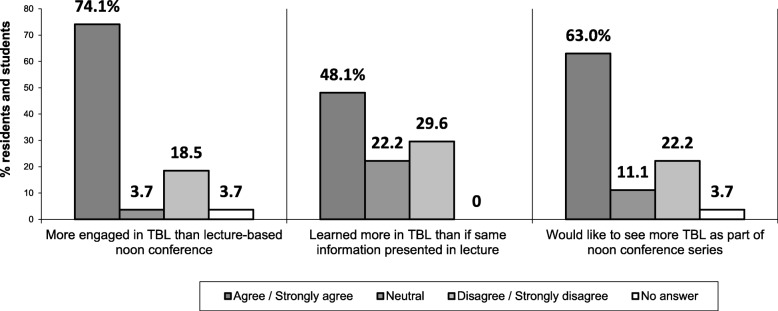
Forty-seven residents and students participated (81%, 47 of 58). Prior to the introductory session, the majority of participants (55%) were not familiar with team-based learning. After the three sessions, 65% of residents and students reported high levels of satisfaction with team-based learning. When compared to traditional, lecture-based noon conferences, 76% of participants reported more engagement and 48% perceived more learning in team-based learning sessions. Challenges included low completion rates of the assigned reading prior to the session and abridged discussions due to time limitations during sessions. Each session required 10 hours of preparation for curriculum development.
Team-based learning resulted in greater satisfaction and engagement among learners when compared to lecture-based formats. However, it did not prove to be a feasible instructional method during one-hour residency conferences. Adaptations that promote learner preparation for sessions and overcome time limitations during sessions may improve the feasibility and impact of team-based learning during one-hour conferences.
Not applicable.
主动学习已被证明可以提高知识保留率、促进反馈,并激发学习者的积极性。尽管有此证据,但讲座作为一种被动的教学模式,仍然是住院医师教育会议中最广泛使用的教学方法。团队学习促进主动学习,但在住院医师培训中很少使用。
在儿科学住院医师培训计划的午休会议期间,举办了三个团队学习课程(一个入门课程和两个基于内容的课程)。采用预-后静态组设计来评估学习者的满意度和知识收益。还收集了有关促进者准备情况、课程出勤率和准备情况保证测试成绩的数据。进行了描述性统计和定性内容分析。
共有 47 名住院医师和学生参加(81%,58 名中的 47 名)。在入门课程之前,大多数参与者(55%)对团队学习不熟悉。在三个课程之后,65%的住院医师和学生报告对团队学习高度满意。与传统的基于讲座的午休会议相比,76%的参与者报告在团队学习课程中更投入,48%的参与者认为学习更多。挑战包括在课程开始前完成指定阅读的完成率低,以及由于课程时间限制导致讨论时间缩短。每个课程需要 10 个小时的课程开发准备时间。
与基于讲座的格式相比,团队学习使学习者的满意度和参与度更高。然而,它在一小时的住院医师会议中并不适合作为一种可行的教学方法。促进学习者为课程做准备并克服课程时间限制的调整可能会提高团队学习在一小时会议中的可行性和影响力。
不适用。