Department of Human Genetics, University of Chicago, Chicago, Illinois, United States of America.
Department of Medicine, University of Chicago, Chicago, Illinois, United States of America.
PLoS Genet. 2019 Jul 19;15(7):e1008278. doi: 10.1371/journal.pgen.1008278. eCollection 2019 Jul.
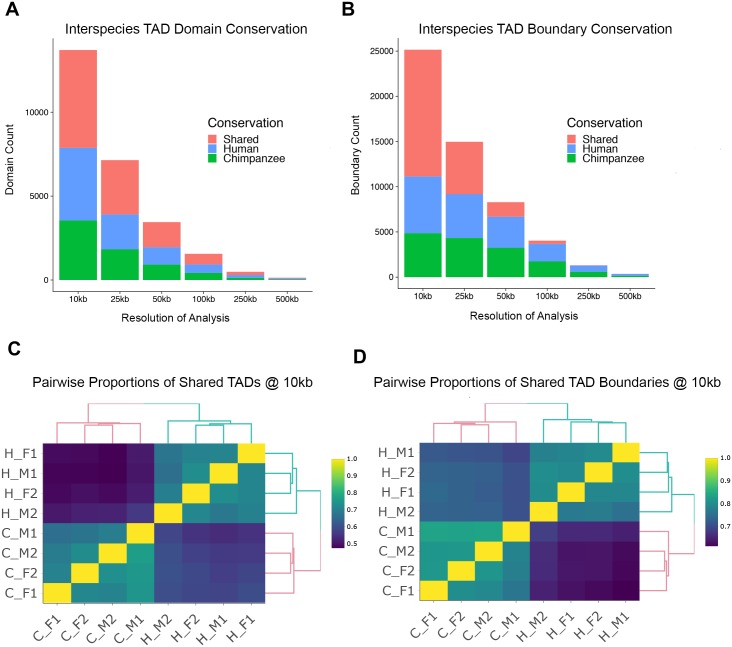
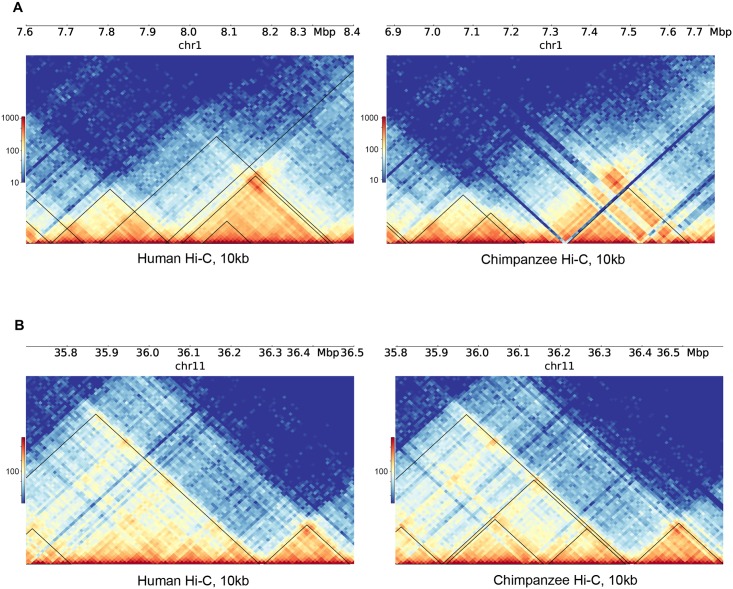
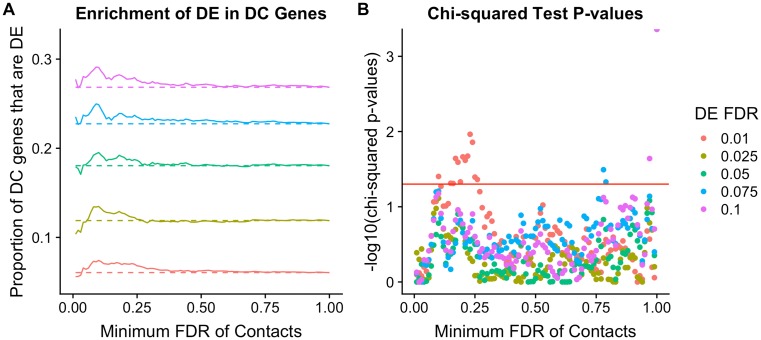
A growing body of evidence supports the notion that variation in gene regulation plays a crucial role in both speciation and adaptation. However, a comprehensive functional understanding of the mechanisms underlying regulatory evolution remains elusive. In primates, one of the crucial missing pieces of information towards a better understanding of regulatory evolution is a comparative annotation of interactions between distal regulatory elements and promoters. Chromatin conformation capture technologies have enabled genome-wide quantifications of such distal 3D interactions. However, relatively little comparative research in primates has been done using such technologies. To address this gap, we used Hi-C to characterize 3D chromatin interactions in induced pluripotent stem cells (iPSCs) from humans and chimpanzees. We also used RNA-seq to collect gene expression data from the same lines. We generally observed that lower-order, pairwise 3D genomic interactions are conserved in humans and chimpanzees, but higher order genomic structures, such as topologically associating domains (TADs), are not as conserved. Inter-species differences in 3D genomic interactions are often associated with gene expression differences between the species. To provide additional functional context to our observations, we considered previously published chromatin data from human stem cells. We found that inter-species differences in 3D genomic interactions, which are also associated with gene expression differences between the species, are enriched for both active and repressive marks. Overall, our data demonstrate that, as expected, an understanding of 3D genome reorganization is key to explaining regulatory evolution.
越来越多的证据支持这样一种观点,即基因调控的变化在物种形成和适应中起着至关重要的作用。然而,对于调控进化背后的机制的全面功能理解仍然难以捉摸。在灵长类动物中,要更好地理解调控进化,一个关键的缺失信息是对远端调控元件和启动子之间相互作用的比较注释。染色质构象捕获技术使我们能够对这种远端的 3D 相互作用进行全基因组定量。然而,利用这些技术在灵长类动物中进行的相对较少的比较研究。为了解决这一差距,我们使用 Hi-C 技术来描述人类和黑猩猩诱导多能干细胞(iPSC)中的 3D 染色质相互作用。我们还使用 RNA-seq 从相同的细胞系中收集基因表达数据。我们通常观察到,在人类和黑猩猩中,较低阶的成对 3D 基因组相互作用是保守的,但高阶基因组结构,如拓扑关联域(TADs),则不那么保守。物种间 3D 基因组相互作用的差异通常与物种间的基因表达差异有关。为了为我们的观察结果提供额外的功能背景,我们考虑了以前发表的人类干细胞中的染色质数据。我们发现,物种间 3D 基因组相互作用的差异,也与物种间的基因表达差异有关,与活性和抑制性标记都有关。总的来说,我们的数据表明,正如预期的那样,对 3D 基因组重排的理解是解释调控进化的关键。