Shanghai Key Laboratory of Stomatology, Department of Oral and Maxillofacial-Head and Neck Oncology, Ninth People's Hospital, School of Stomatology, Shanghai Jiao Tong University School of Medicine, Shanghai, 200011, China.
Department of Oral and Maxillofacial-Head and Neck Oncology, Fengcheng Hospital & Shanghai Ninth People's Hospital (Fengcheng Branch Hospital) Affiliated to School of Medicine of Shanghai Jiao Tong University, Shanghai, 201411, China.
BMC Cancer. 2019 Jul 19;19(1):714. doi: 10.1186/s12885-019-5859-y.
Tongue squamous cell carcinoma (TSCC) is a special type of oral cancer. Cervical lymph node relapse may occur in a large percentage of TSCC patients, which usually indicates poor prognosis. In this cohort study, we focused on the predictive value of the pathological features on cervical lymph node relapse and TSCC prognosis (disease free survival).
One hundred forty-one TSCC patients staged as TN were enrolled and categorized. Subjects were followed-up for 60 months. Univariate analysis was performed with Chi-square test for cervical lymph node relapse and Kaplan-Meier survival analysis and log rank P value for patient prognosis; multivariate analysis was also utilized with Cox regression.
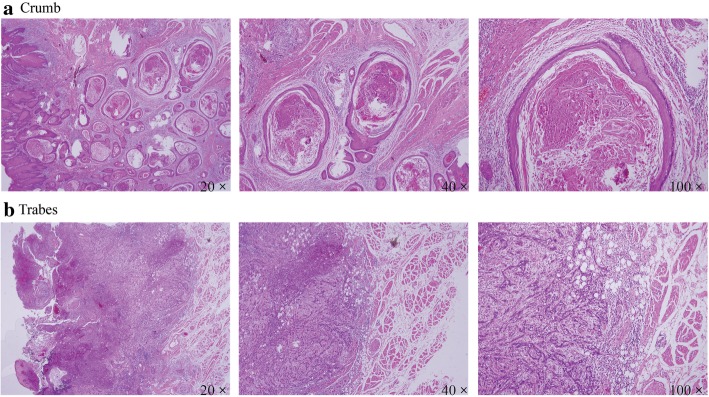
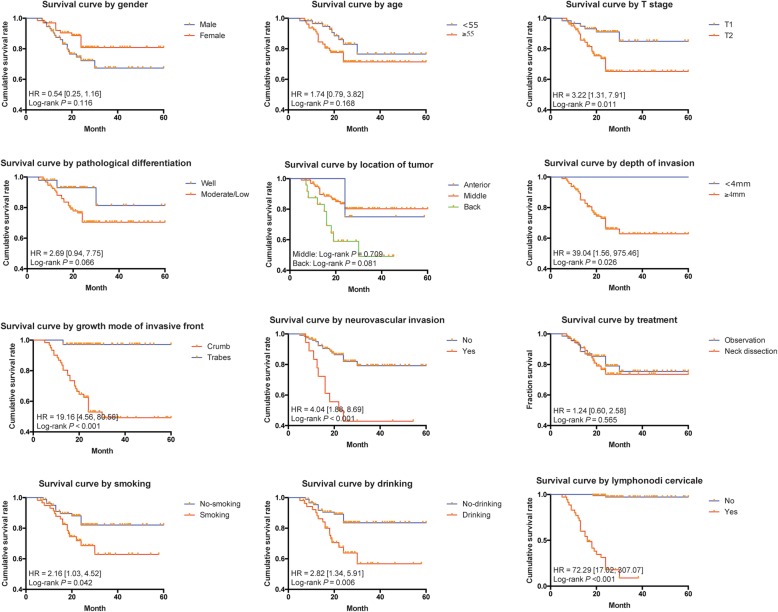
In univariate analysis, trabes growth pattern, depth of invasion greater than 4 mm, poor pathological differentiation and neurovascular invasion were considered as risk factors for cervical lymph node relapse and poor prognosis. In multivariate analysis, only patients with trabes growth pattern in the invasive front or depth of invasion larger than 4 mm had a higher risk of metastasis. Elder age group and trabes growth pattern of invasive front were considered as predictors of poor prognosis. Bad habits of smoking and alcohol consumption were related to the higher risk of metastasis.
Trabes growth pattern of invasive front was a potent risk factor for TSCC cervical lymph node relapse and indicated poor prognosis. Preventive therapy including selective neck dissection was thus suggested for certain patients.
Not applicable.
舌鳞状细胞癌(TSCC)是一种特殊类型的口腔癌。颈淋巴结复发可能发生在很大比例的 TSCC 患者中,这通常预示着预后不良。在这项队列研究中,我们专注于病理特征对颈淋巴结复发和 TSCC 预后(无病生存)的预测价值。
纳入并分类了 141 例 TN 分期的 TSCC 患者。对受试者进行了 60 个月的随访。采用卡方检验进行单因素分析,用于颈淋巴结复发和 Kaplan-Meier 生存分析及对数秩 P 值用于患者预后;也采用 Cox 回归进行多因素分析。
单因素分析中,小梁生长模式、浸润深度大于 4mm、病理分化差和神经血管侵犯被认为是颈淋巴结复发和预后不良的危险因素。多因素分析中,只有浸润前缘有小梁生长模式或浸润深度大于 4mm 的患者转移风险更高。高龄组和浸润前缘的小梁生长模式被认为是预后不良的预测因素。吸烟和饮酒等不良习惯与转移风险增加有关。
浸润前缘的小梁生长模式是 TSCC 颈淋巴结复发的一个有力危险因素,并提示预后不良。因此,建议对某些患者进行预防性治疗,包括选择性颈淋巴结清扫术。
不适用。