Grace-Farfaglia Patricia
Department of Nutritional Sciences, University of Connecticut, Waterbury, CT, United States.
JMIR Hum Factors. 2019 Jul 19;6(3):e11544. doi: 10.2196/11544.
There are several social cognitive theories (SCTs) and models that support platform design in electronic health (eHealth) promotion trials. The rationale for this scoping review was to determine how social design features (informational aid, expressive support, gaming, and tailored content) are used to promote self-efficacy, engagement, knowledge, and behavior change.
This study aimed to review a broad spectrum of digital health interventions in the literature seeking trials that use SCTs for the design of eHealth applications.
The author conducted a systematic scoping review of 161 Web-based health interventions from published randomized clinical trials using 1 or more tools to address the social cognitive determinants in their website design from January 2006 to April 2016. An iterative approach was used in the selection of studies and data extraction. The studies were analyzed for quality and coded for type of social design features employed.
Expressive interaction tools were found in 48.6% (54/111) of studies categorized as a strong recommendation by the Joanna Briggs Institute criteria. Overall, less than half of the studies addressed participant social support and motivational needs (43.8%). The vast majority of studies (100%) relied on the use of the Web for delivery of informational aid and tailored content for the individual participant (75.9%).
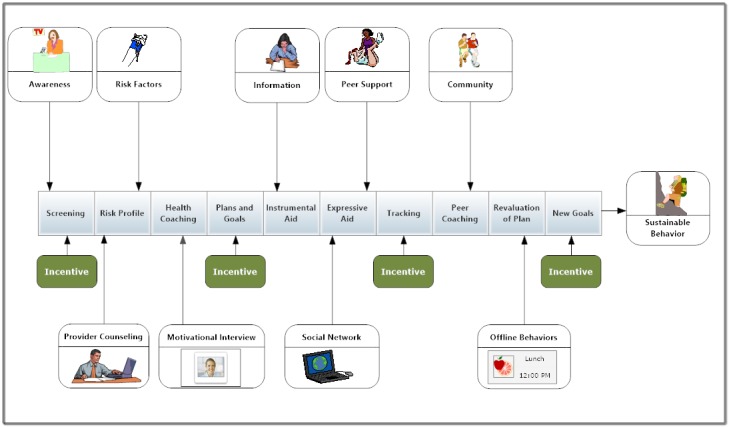
This review fills a research gap by linking social theory to Web strategy to improve the impact and sustainability of eHealth interventions. A Digital Health Intervention Model was developed to provide a framework to enhance future Web-based health intervention design and execution.
有几种社会认知理论(SCTs)和模型支持电子健康(eHealth)促进试验中的平台设计。本范围综述的基本原理是确定社会设计特征(信息援助、表达性支持、游戏和定制内容)如何用于促进自我效能感、参与度、知识和行为改变。
本研究旨在综述文献中广泛的数字健康干预措施,寻找使用社会认知理论进行电子健康应用设计的试验。
作者对2006年1月至2016年4月发表的随机临床试验中的161项基于网络的健康干预措施进行了系统的范围综述,这些试验使用一种或多种工具来解决其网站设计中的社会认知决定因素。在研究选择和数据提取中采用了迭代方法。对研究进行质量分析,并对所采用的社会设计特征类型进行编码。
在被乔安娜·布里格斯研究所标准归类为强烈推荐的研究中,48.6%(54/111)的研究发现了表达性互动工具。总体而言,不到一半的研究满足了参与者的社会支持和动机需求(43.8%)。绝大多数研究(100%)依赖网络提供信息援助,并为个体参与者提供定制内容(75.9%)。
本综述通过将社会理论与网络策略联系起来,填补了研究空白,以提高电子健康干预措施的影响力和可持续性。开发了一个数字健康干预模型,以提供一个框架,增强未来基于网络的健康干预设计和实施。