Electronics and Telecommunications Research Institute, 218 Gajeong-ro, Yuseong-gu, Daejeon 34129, Korea.
Sensors (Basel). 2019 Jul 20;19(14):3200. doi: 10.3390/s19143200.
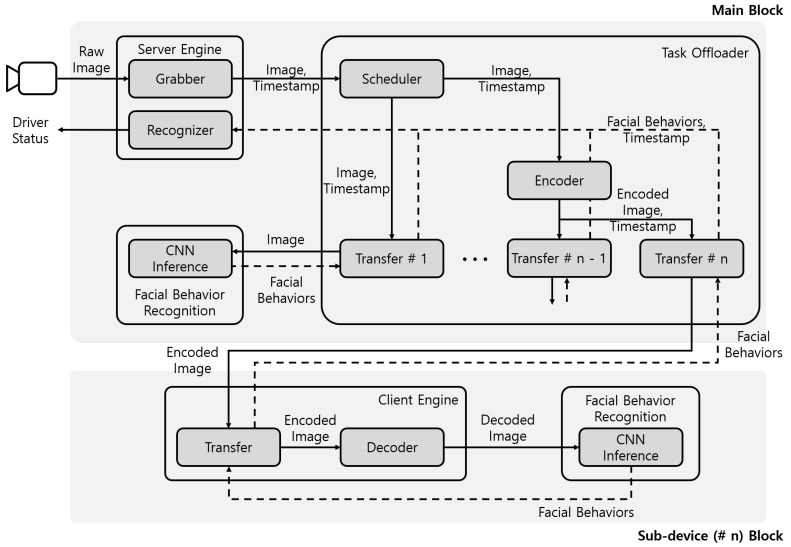
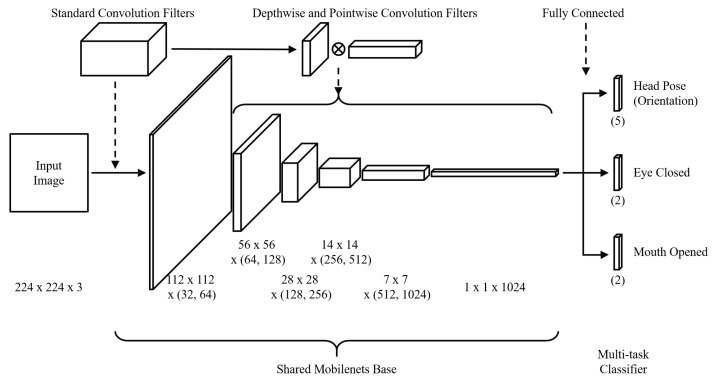
Research on driver status recognition has been actively conducted to reduce fatal crashes caused by the driver's distraction and drowsiness. As in many other research areas, deep-learning-based algorithms are showing excellent performance for driver status recognition. However, despite decades of research in the driver status recognition area, the visual image-based driver monitoring system has not been widely used in the automobile industry. This is because the system requires high-performance processors, as well as has a hierarchical structure in which each procedure is affected by an inaccuracy from the previous procedure. To avoid using a hierarchical structure, we propose a method using Mobilenets without the functions of face detection and tracking and show this method is enabled to recognize facial behaviors that indicate the driver's distraction. However, frames per second processed by Mobilenets with a Raspberry pi, one of the single-board computers, is not enough to recognize the driver status. To alleviate this problem, we propose a lightweight driver monitoring system using a resource sharing device in a vehicle (e.g., a driver's mobile phone). The proposed system is based on Multi-Task Mobilenets (MT-Mobilenets), which consists of the Mobilenets' base and multi-task classifier. The three Softmax regressions of the multi-task classifier help one Mobilenets base recognize facial behaviors related to the driver status, such as distraction, fatigue, and drowsiness. The proposed system based on MT-Mobilenets improved the accuracy of the driver status recognition with Raspberry Pi by using one additional device.
研究驾驶员状态识别,旨在减少因驾驶员分心和困倦导致的致命事故。与许多其他研究领域一样,基于深度学习的算法在驾驶员状态识别方面表现出了优异的性能。然而,尽管在驾驶员状态识别领域已经进行了数十年的研究,但基于视觉图像的驾驶员监控系统并未在汽车行业得到广泛应用。这是因为该系统需要高性能的处理器,并且具有层次结构,其中每个过程都会受到前一个过程的不准确性的影响。为了避免使用层次结构,我们提出了一种使用 Mobilenets 的方法,该方法不具有人脸检测和跟踪功能,并展示了这种方法能够识别表明驾驶员分心的面部行为。然而,使用单板计算机之一的 Raspberry pi 处理的 Mobilenets 的每秒帧数不足以识别驾驶员状态。为了解决这个问题,我们提出了一种使用车辆中资源共享设备(例如驾驶员的移动电话)的轻量级驾驶员监控系统。所提出的系统基于多任务 Mobilenets(MT-Mobilenets),它由 Mobilenets 的基础和多任务分类器组成。多任务分类器的三个 Softmax 回归有助于一个 Mobilenets 基础识别与驾驶员状态相关的面部行为,例如分心、疲劳和困倦。基于 MT-Mobilenets 的所提出的系统通过使用一个额外的设备,提高了使用 Raspberry pi 的驾驶员状态识别的准确性。