Stanley Manne Children's Research Institute, Ann & Robert H. Lurie Children's Hospital of Chicago, Chicago, IL 60611, USA.
Department of Computer Science, Loyola University Chicago, Chicago, IL 60660, USA.
Int J Environ Res Public Health. 2019 Jul 21;16(14):2598. doi: 10.3390/ijerph16142598.
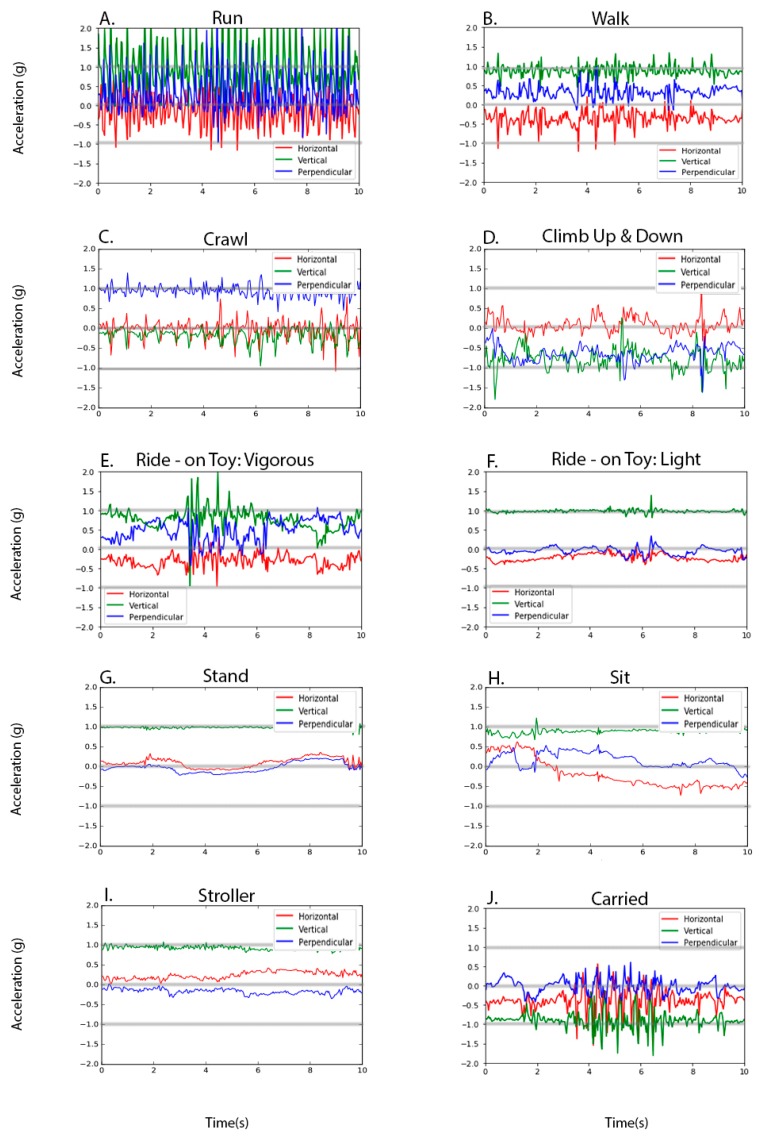
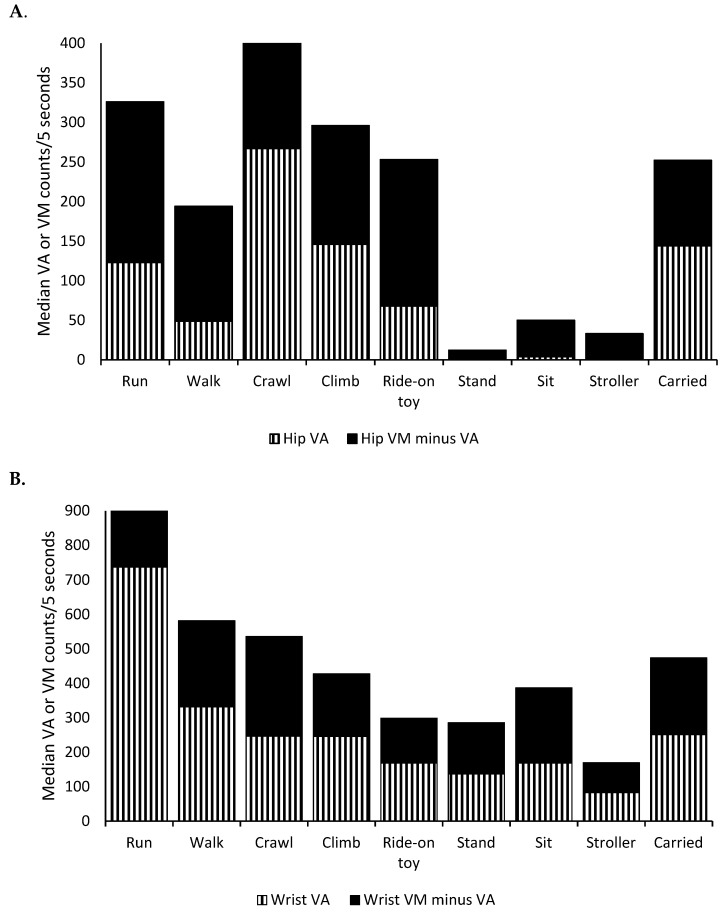
Although accelerometry data are widely utilized to estimate physical activity and sedentary behavior among children age 3 years or older, for toddlers age 1 and 2 year(s), accelerometry data recorded during such behaviors have been far less examined. In particular, toddler's unique behaviors, such as riding in a stroller or being carried by an adult, have not yet been examined. The objective of this study was to describe accelerometry signal outputs recorded during participation in nine types of behaviors (i.e., running, walking, climbing up/down, crawling, riding a ride-on toy, standing, sitting, riding in a stroller/wagon, and being carried by an adult) among toddlers. Twenty-four toddlers aged 13 to 35 months (50% girls) performed various prescribed behaviors during free play in a commercial indoor playroom while wearing ActiGraph wGT3X-BT accelerometers on a hip and a wrist. Participants' performances were video-recorded. Based on the video data, accelerometer data were annotated with behavior labels to examine accelerometry signal outputs while performing the nine types of behaviors. Accelerometer data collected during 664 behavior assessments from the 21 participants were used for analysis. Hip vertical axis counts for walking were low (median = 49 counts/5 s). They were significantly lower than those recorded while a toddler was "carried" by an adult (median = 144 counts/5 s; < 0.01). While standing, sitting, and riding in a stroller, very low hip vertical axis counts were registered (median ≤ 5 counts/5 s). Although wrist vertical axis and vector magnitude counts for "carried" were not higher than those for walking, they were higher than the cut-points for sedentary behaviors. Using various accelerometry signal features, machine learning techniques showed 89% accuracy to differentiate the "carried" behavior from ambulatory movements such as running, walking, crawling, and climbing. In conclusion, hip vertical axis counts alone may be unable to capture walking as physical activity and "carried" as sedentary behavior among toddlers. Machine learning techniques that utilize additional accelerometry signal features could help to recognize behavior types, especially to differentiate being "carried" from ambulatory movements.
虽然加速度计数据被广泛用于估计 3 岁及以上儿童的身体活动和久坐行为,但对于 1 岁和 2 岁的幼儿,对于他们在这些行为中记录的加速度计数据的研究要少得多。特别是,幼儿独特的行为,如坐在婴儿车或被成人抱,尚未被研究过。本研究的目的是描述幼儿参与九种行为(即跑步、行走、上下攀爬、爬行、骑乘玩具车、站立、坐着、坐在婴儿车/手推车里和被成人抱)时记录的加速度计信号输出。24 名 13 至 35 个月大(50%为女孩)的幼儿在商业室内游乐室自由玩耍时,佩戴 ActiGraph wGT3X-BT 加速度计,分别在臀部和手腕处佩戴一个,进行了各种规定的行为。参与者的表现被拍摄下来。根据视频数据,使用行为标签注释加速度计数据,以检查进行九种行为时的加速度计信号输出。对 21 名参与者的 664 次行为评估收集的加速度计数据进行了分析。行走时臀部垂直轴计数较低(中位数=49 计数/5 秒)。与幼儿被成人“抱”时(中位数=144 计数/5 秒;<0.01)相比,行走时的记录明显较低。当站立、坐着和坐在婴儿车/手推车里时,记录的臀部垂直轴计数非常低(中位数≤5 计数/5 秒)。虽然“被抱”时的手腕垂直轴和矢量幅度计数没有高于行走时的计数,但高于久坐行为的切点。使用各种加速度计信号特征,机器学习技术显示出 89%的准确率,可将“被抱”行为与跑步、行走、爬行和攀爬等可移动运动区分开来。总之,仅使用臀部垂直轴计数可能无法将幼儿的行走视为身体活动,也无法将“被抱”视为久坐行为。使用其他加速度计信号特征的机器学习技术可以帮助识别行为类型,特别是将“被抱”与可移动运动区分开来。