Zoological Institute, Christian-Albrechts University Kiel, Am Botanischen Garten 1-9, 24118, Kiel, Germany.
Department of Bioengineering, University of Massachusetts Dartmouth, 285 Old Westport Rd, Dartmouth, MA, 02747, USA.
Nat Commun. 2019 Jul 22;10(1):3257. doi: 10.1038/s41467-019-11136-6.
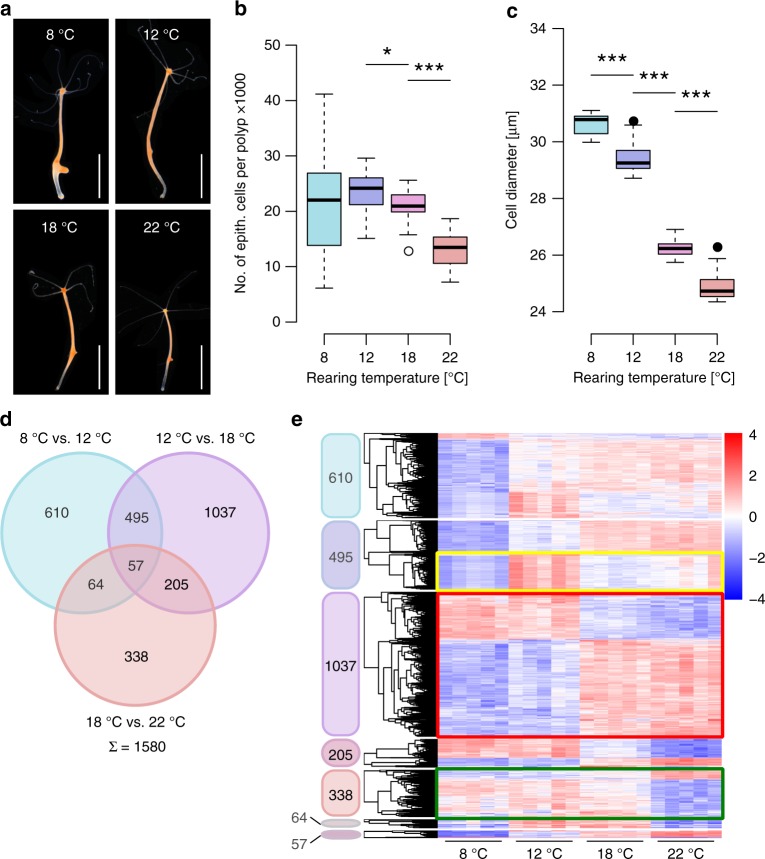
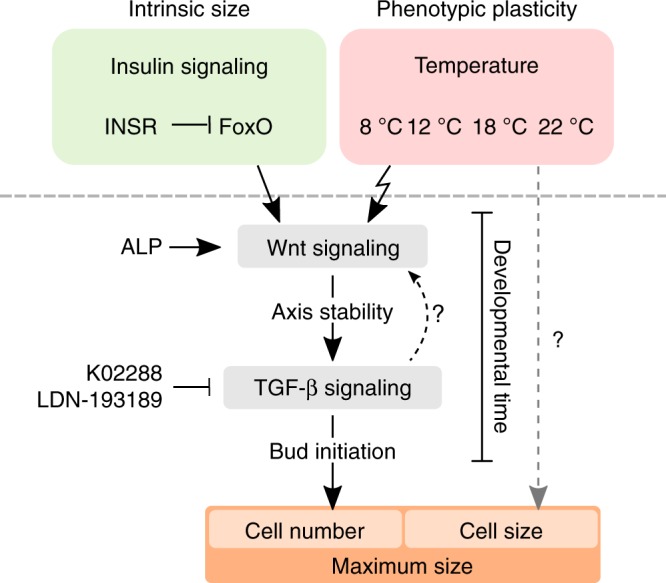
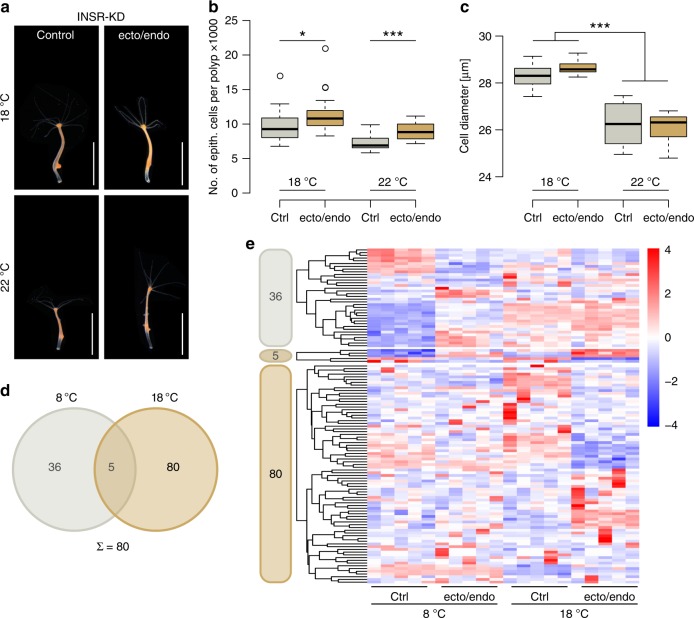
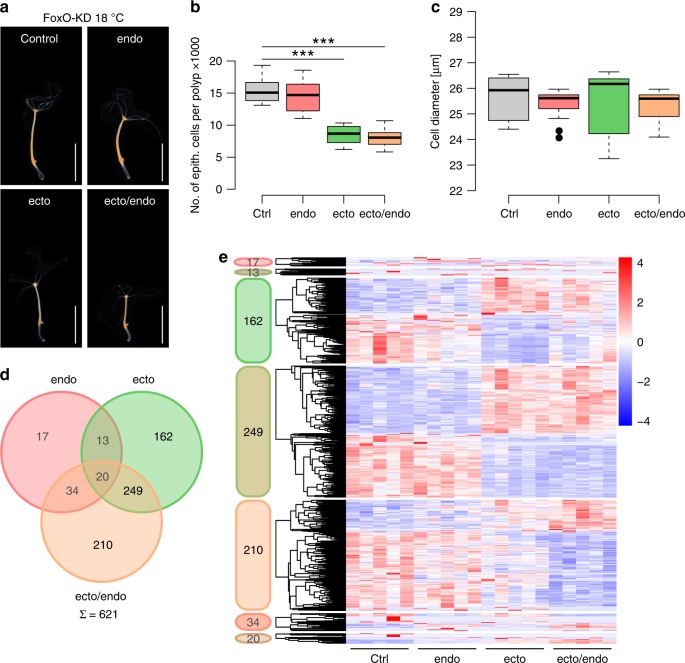
How multicellular organisms assess and control their size is a fundamental question in biology, yet the molecular and genetic mechanisms that control organ or organism size remain largely unsolved. The freshwater polyp Hydra demonstrates a high capacity to adapt its body size to different temperatures. Here we identify the molecular mechanisms controlling this phenotypic plasticity and show that temperature-induced cell number changes are controlled by Wnt- and TGF-β signaling. Further we show that insulin-like peptide receptor (INSR) and forkhead box protein O (FoxO) are important genetic drivers of size determination controlling the same developmental regulators. Thus, environmental and genetic factors directly affect developmental mechanisms in which cell number is the strongest determinant of body size. These findings identify the basic mechanisms as to how size is regulated on an organismic level and how phenotypic plasticity is integrated into conserved developmental pathways in an evolutionary informative model organism.
多细胞生物如何评估和控制其大小是生物学中的一个基本问题,但控制器官或生物体大小的分子和遗传机制在很大程度上仍未得到解决。淡水水螅具有高度适应不同温度的体型的能力。在这里,我们确定了控制这种表型可塑性的分子机制,并表明温度诱导的细胞数量变化受 Wnt 和 TGF-β信号的控制。此外,我们还表明胰岛素样肽受体 (INSR) 和叉头框蛋白 O (FoxO) 是大小决定的重要遗传驱动因素,它们控制着相同的发育调节剂。因此,环境和遗传因素直接影响细胞数量是体型最强决定因素的发育机制。这些发现确定了在生物体水平上如何调节大小以及表型可塑性如何整合到进化信息模型生物中的保守发育途径中的基本机制。