Department of Medicine, Merkur University Hospital; School of Medicine, University of Zagreb, Zagreb 10000, Grad Zagreb, Croatia.
Department of Medicine, Merkur University Hospital, Zagreb 10000, Grad Zagreb, Croatia.
World J Gastroenterol. 2019 Jul 7;25(25):3168-3182. doi: 10.3748/wjg.v25.i25.3168.
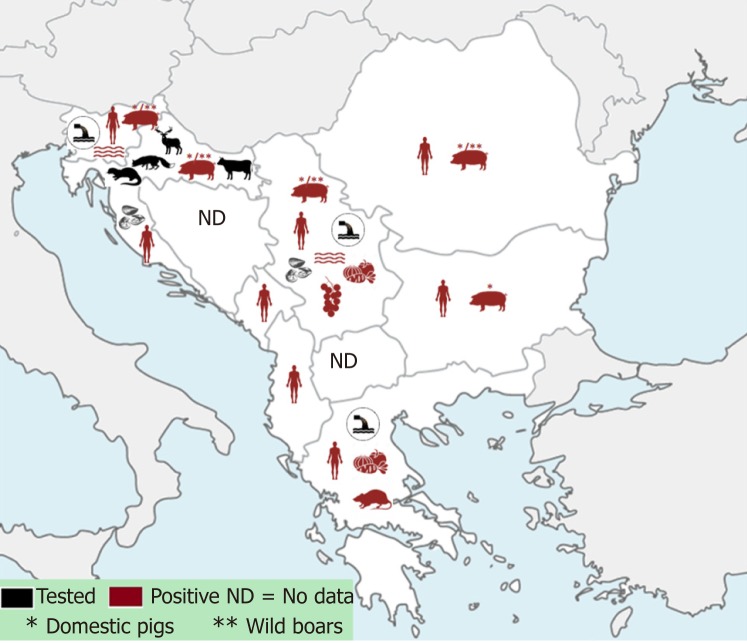
The significance of hepatitis E virus (HEV) as an important public health problem is rising. Until a decade ago, cases of HEV infection in Eur-ope were mainly confined to returning travelers, but nowadays, hepatitis E represents an emerging zoonotic infection in many European countries. The aim of this manuscript is to perform a systematic review of the published literature on hepatitis E distribution in humans, animals and environmental samples ("One Health" concept) in the South-Eastern European countries. Comparison of the available data showed that the anti-HEV seroprevalence in the South-Eastern Europe varies greatly, depending on the population studied, geographical area and methods used. The IgG seroprevalence rates in different population groups were found to be 1.1%-24.5% in Croatia, up to 20.9% in Bulgaria, 5.9-%17.1% in Romania, 15% in Serbia, up to 9.7% in Greece and 2%-9.7% in Albania. Among possible risk factors, older age was the most significant predictor for HEV seropositivity in most studies. Higher seroprevalence rates were found in animals. HEV IgG antibodies in domestic pigs were detected in 20%-54.5%, 29.2%-50%, 38.94%-50% and 31.1%-91.7% in Serbia, Bulgaria, Romania and Croatia, respectively. In wild boars seroprevalence rates were up to 10.3%, 30.3% and 31.1% in Romania, Slovenia and Croatia, respectively. A high HEV RNA prevalence in wild boars in some countries (Croatia and Romania) indicated that wild boars may have a key role in the HEV epidemiology. There are very few data on HEV prevalence in environmental samples. HEV RNA was detected in 3.3% and 16.7% surface waters in Slovenia and Serbia, respectively. There is no evidence of HEV RNA in sewage systems in this region. The available data on genetic characterization show that human, animal and environmental HEV strains mainly belong to the genotype 3.
戊型肝炎病毒(HEV)作为一个重要的公共卫生问题的意义正在上升。就在十年前,欧洲的 HEV 感染病例主要局限于返回的旅行者,但如今,戊型肝炎在许多欧洲国家已成为一种新兴的人畜共患病感染。本文的目的是对东南欧国家人类、动物和环境样本中戊型肝炎分布的已发表文献进行系统综述(“同一健康”概念)。对现有数据的比较表明,东南欧的抗-HEV 血清流行率差异很大,取决于所研究的人群、地理位置和使用的方法。在不同人群中发现 IgG 血清流行率为 1.1%-24.5%在克罗地亚,高达 20.9%在保加利亚,5.9%-17.1%在罗马尼亚,15%在塞尔维亚,高达 9.7%在希腊和 2%-9.7%在阿尔巴尼亚。在可能的危险因素中,在大多数研究中,年龄较大是 HEV 血清阳性的最重要预测因素。在动物中发现了更高的血清流行率。在塞尔维亚、保加利亚、罗马尼亚和克罗地亚,家猪中检测到 HEV IgG 抗体的流行率分别为 20%-54.5%、29.2%-50%、38.94%-50%和 31.1%-91.7%。在野猪中,血清流行率分别高达 10.3%、30.3%和 31.1%在罗马尼亚、斯洛文尼亚和克罗地亚。一些国家(克罗地亚和罗马尼亚)野猪中 HEV RNA 的高流行率表明,野猪可能在 HEV 流行病学中发挥关键作用。关于环境样本中 HEV 流行率的数据非常少。在斯洛文尼亚和塞尔维亚,分别在 3.3%和 16.7%的地表水样本中检测到 HEV RNA。该地区的污水系统中没有发现 HEV RNA 的证据。现有的遗传特征描述数据表明,人类、动物和环境 HEV 株主要属于基因型 3。