Department of Chemical and Biomolecular Engineering, National University of Singapore, Singapore, 119077, Singapore.
Disruptive & Sustainable Technologies for Agricultural Precision, Singapore-MIT Alliance for Research and Technology, Singapore, 138602, Singapore.
Nat Commun. 2019 Jul 23;10(1):3294. doi: 10.1038/s41467-019-11263-0.
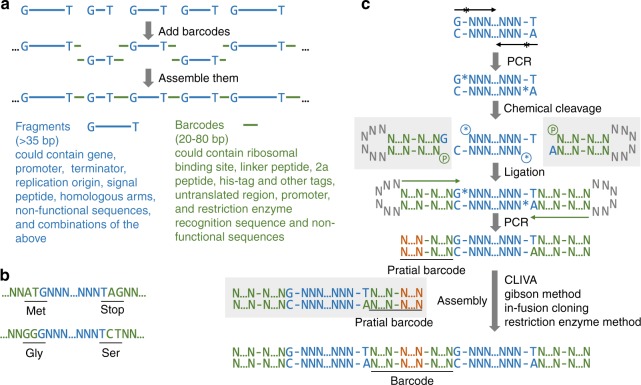
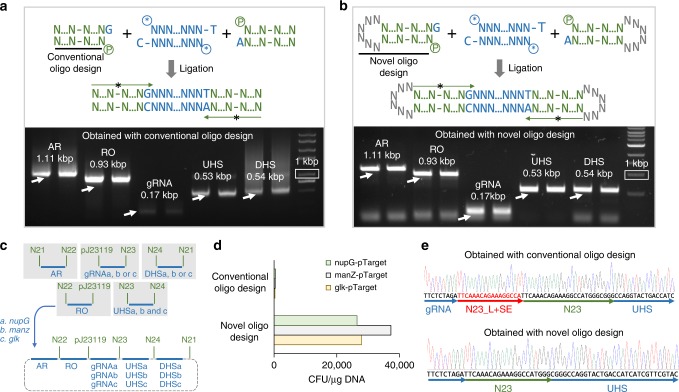
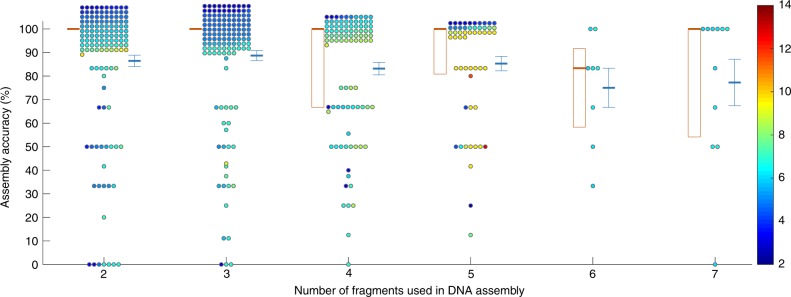
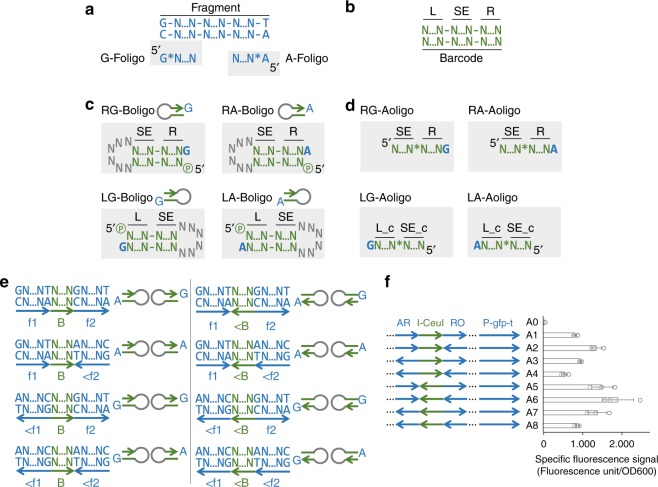
Here we report GT (Guanin/Thymine) standard (GTS) for plasmid construction under which DNA sequences are defined as two types of standard, reusable parts (fragment and barcode). We develop a technology that can efficiently add any two barcodes to two ends of any fragment without leaving scars in most cases. We can assemble up to seven such barcoded fragments into one plasmid by using one of the existing DNA assembly methods, including CLIVA, Gibson assembly, In-fusion cloning, and restriction enzyme-based methods. Plasmids constructed under GTS can be easily edited, and/or be further assembled into more complex plasmids by using standard DNA oligonucleotides (oligos). Based on 436 plasmids we constructed under GTS, the averaged accuracy of the workflow was 85.9%. GTS can also construct a library of plasmids from a set of fragments and barcodes combinatorically, which has been demonstrated to be useful for optimizing metabolic pathways.
在这里,我们报告了 GT(鸟嘌呤/胸腺嘧啶)标准(GTS),用于质粒构建,其中 DNA 序列被定义为两种类型的标准、可重复使用的部分(片段和条码)。我们开发了一种技术,能够在大多数情况下有效地将任意两个条码添加到任意片段的两端,而不会留下痕迹。我们可以使用现有的 DNA 组装方法之一,包括 CLIVA、Gibson 组装、In-fusion 克隆和基于限制性内切酶的方法,将多达七个这样的条码化片段组装到一个质粒中。在 GTS 下构建的质粒可以很容易地进行编辑,并且/或者可以使用标准 DNA 寡核苷酸(oligos)进一步组装成更复杂的质粒。基于我们在 GTS 下构建的 436 个质粒,该工作流程的平均准确性为 85.9%。GTS 还可以从一组片段和条码组合中构建质粒文库,这已被证明对于优化代谢途径很有用。