Swan Kristine Zøylner, Bonnema Steen Joop, Jespersen Marie Louise, Nielsen Viveque Egsgaard
Department of Otorhinolaryngology Head & Neck Surgery, Aarhus University Hospital, Aarhus N, Denmark.
Department of Clinical Medicine, Health, Aarhus University, Aarhus N, Denmark.
Endocr Connect. 2019 Aug;8(8):1195-1205. doi: 10.1530/EC-19-0324.
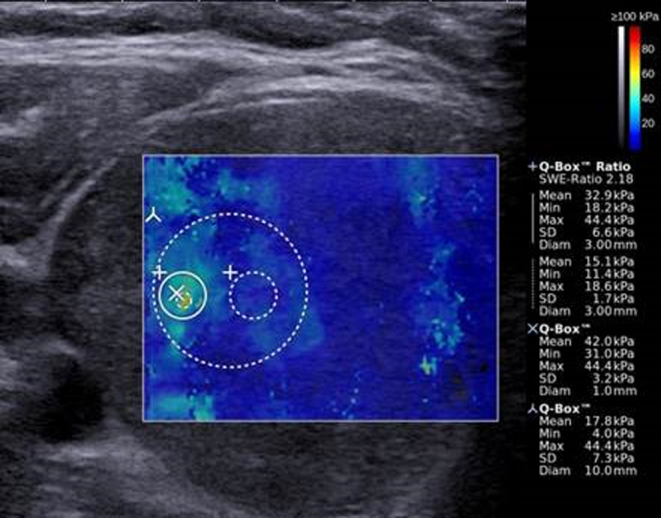
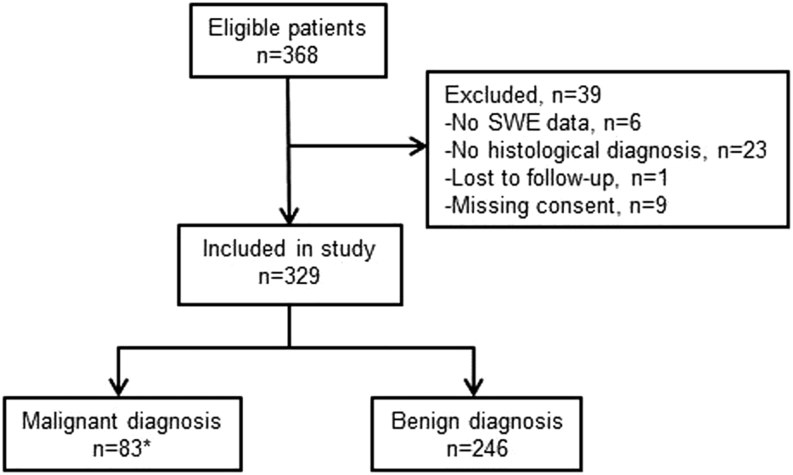
Thyroid nodular disease is common, but predicting the risk of malignancy can be difficult. In this prospective study, we aimed to assess the diagnostic accuracy of shear wave elastography (SWE) in predicting thyroid malignancy. Patients with thyroid nodules were enrolled from a surgical tertiary unit. Elasticity index (EI) measured by SWE was registered for seven EI outcomes assessing nodular stiffness and heterogeneity. The diagnosis was determined histologically. In total, 329 patients (mean age: 55 ± 13 years) with 413 thyroid nodules (mean size: 32 ± 13 mm, 88 malignant) were enrolled. Values of SWE region of interest (ROI) for malignant and benign nodules were highly overlapping (ranges for SWE-ROImean: malignant 3-100 kPa; benign 4-182 kPa), and no difference between malignant and benign nodules was found for any other EI outcome investigated (P = 0.13-0.96). There was no association between EI and the histological diagnosis by receiver operating characteristics analysis (area under the curve: 0.51-0.56). Consequently, defining a cut-off point of EI for the prediction of malignancy was not clinically meaningful. Testing our data on previously proposed cut-off points revealed a low accuracy of SWE (56-80%). By regression analysis, factors affecting EI included nodule size >30 mm, heterogeneous echogenicity, micro- or macrocalcifications and solitary nodule. In conclusion, EI, measured by SWE, showed huge overlap between malignant and benign nodules, and low diagnostic accuracy in the prediction of thyroid malignancy. Our study supports that firmness of thyroid nodules, as assessed by SWE, should not be a key feature in the evaluation of such lesions.
甲状腺结节性疾病很常见,但预测其恶性风险可能具有挑战性。在这项前瞻性研究中,我们旨在评估剪切波弹性成像(SWE)预测甲状腺恶性肿瘤的诊断准确性。甲状腺结节患者来自一家外科三级医疗单位。通过SWE测量的弹性指数(EI)被记录为七个评估结节硬度和异质性的EI结果。诊断通过组织学确定。总共纳入了329例患者(平均年龄:55±13岁),有413个甲状腺结节(平均大小:32±13mm,88个为恶性)。恶性和良性结节的SWE感兴趣区域(ROI)值高度重叠(SWE-ROImean范围:恶性为3-100kPa;良性为4-182kPa),并且在所研究的任何其他EI结果中,恶性和良性结节之间均未发现差异(P = 0.13-0.96)。通过受试者工作特征分析,EI与组织学诊断之间无关联(曲线下面积:0.51-0.56)。因此,定义EI的临界值以预测恶性肿瘤在临床上并无意义。用先前提出的临界值测试我们的数据显示SWE的准确性较低(56-80%)。通过回归分析,影响EI的因素包括结节大小>30mm、回声不均匀、微钙化或大钙化以及孤立结节。总之,通过SWE测量的EI显示恶性和良性结节之间有很大重叠,且在预测甲状腺恶性肿瘤方面诊断准确性较低。我们的研究支持,通过SWE评估的甲状腺结节硬度不应成为评估此类病变的关键特征。