Angora Etienne K, Boissier Jérôme, Menan Hervé, Rey Olivier, Tuo Karim, Touré Andre O, Coulibaly Jean T, Méité Aboulaye, Raso Giovanna, N'Goran Eliézer K, Utzinger Jürg, Balmer Oliver
Swiss Tropical and Public Health Institute, P.O. Box, CH-4002 Basel, Switzerland.
University of Basel, P.O. Box, CH-4003 Basel, Switzerland.
Trop Med Infect Dis. 2019 Jul 23;4(3):110. doi: 10.3390/tropicalmed4030110.
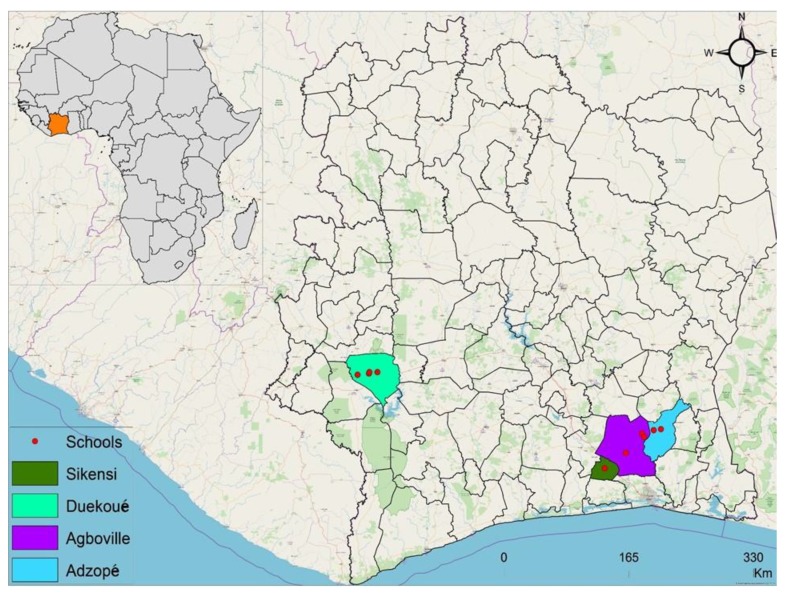
Schistosomiasis is a parasitic disease affecting more than 250 million people, primarily in sub-Saharan Africa. In Côte d'Ivoire both (causing urogenital schistosomiasis) and (causing intestinal schistosomiasis) co-exist. This study aimed to determine the prevalence of and and to identify risk factors among schoolchildren in the western and southern parts of Côte d'Ivoire. From January to April 2018, a cross-sectional study was carried out including 1187 schoolchildren aged 5-14 years. Urine samples were examined by a filtration method to identify and count eggs, while stool samples were subjected to duplicate Kato-Katz thick smears to quantify eggs of and soil-transmitted helminths. Data on sociodemographic, socioeconomic, and environmental factors were obtained using a pretested questionnaire. Multivariate logistic regression was employed to test for associations between variables. We found a prevalence of of 14.0% (166 of 1187 schoolchildren infected) and a prevalence of of 6.1% (66 of 1089 schoolchildren infected). In the southern part of Côte d'Ivoire, the prevalence of was 16.1% with a particularly high prevalence observed in Sikensi (35.6%), while was most prevalent in Agboville (11.2%). Swimming in open freshwater bodies was the main risk factor for infection (adjusted odds ratio (AOR) = 127.0, 95% confidence interval (CI): 25.0-634.0, < 0.001). Fishing and washing clothes in open freshwater bodies were positively associated with and infection, respectively. Preventive chemotherapy using praziquantel should be combined with setting-specific information, education, and communication strategies in order to change children's behavior, thus avoiding contact with unprotected open freshwater.
血吸虫病是一种寄生虫病,主要影响撒哈拉以南非洲地区超过2.5亿人。在科特迪瓦,曼氏血吸虫(导致泌尿生殖系统血吸虫病)和埃及血吸虫(导致肠道血吸虫病)同时存在。本研究旨在确定曼氏血吸虫和埃及血吸虫的流行率,并确定科特迪瓦西部和南部学童中的危险因素。2018年1月至4月,开展了一项横断面研究,纳入了1187名5至14岁的学童。通过过滤法检查尿液样本以识别和计数曼氏血吸虫卵,而粪便样本则进行两次加藤厚涂片以量化埃及血吸虫和土源性蠕虫的虫卵。使用经过预测试的问卷获取社会人口学、社会经济和环境因素的数据。采用多变量逻辑回归检验变量之间的关联。我们发现曼氏血吸虫的流行率为14.0%(1187名学童中有166名感染),埃及血吸虫的流行率为6.1%(1089名学童中有66名感染)。在科特迪瓦南部,曼氏血吸虫的流行率为16.1%,在锡肯西观察到特别高的流行率(35.6%),而埃及血吸虫在阿博维尔最为流行(11.2%)。在开放淡水体中游泳是曼氏血吸虫感染的主要危险因素(调整后的优势比(AOR)=127.0,95%置信区间(CI):25.0 - 634.0,P<0.001)。在开放淡水体中捕鱼和洗衣服分别与埃及血吸虫和曼氏血吸虫感染呈正相关。使用吡喹酮进行预防性化疗应与针对特定环境的信息、教育和宣传策略相结合,以改变儿童的行为,从而避免接触未受保护的开放淡水。