Amsterdam UMC, Vrije Universiteit, Psychiatry, Amsterdam Public Health Research Institute, Amsterdam, The Netherlands.
University of Groningen, University Medical Center Groningen, Department of Psychiatry, Interdisciplinary Center for Psychopathology and Emotion Regulation, Groningen, The Netherlands.
Depress Anxiety. 2019 Oct;36(10):975-986. doi: 10.1002/da.22949. Epub 2019 Jul 26.
Actigraphy may provide a more valid assessment of sleep, circadian rhythm (CR), and physical activity (PA) than self-reported questionnaires, but has not been used widely to study the association with depression/anxiety and their clinical characteristics.
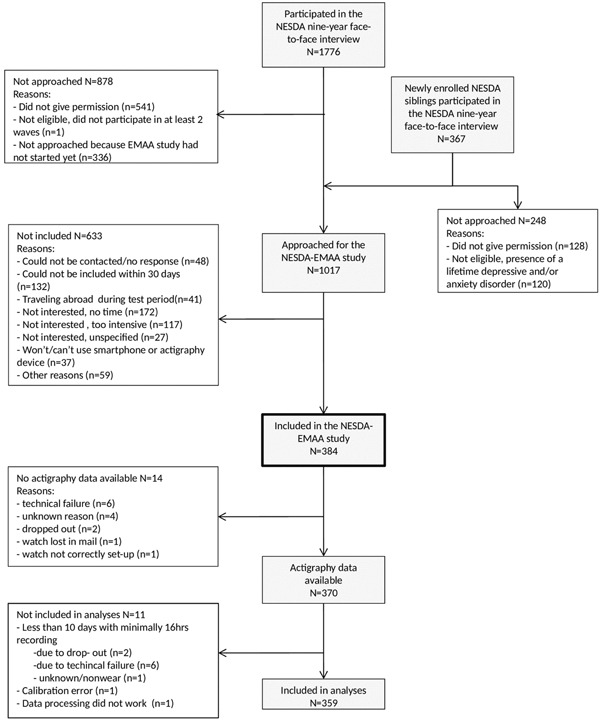
Fourteen-day actigraphy data of 359 participants with current (n = 93), remitted (n = 176), or no (n = 90) composite international diagnostic interview depression/anxiety diagnoses were obtained from the Netherlands Study of Depression and Anxiety. Objective estimates included sleep duration (SD), sleep efficiency, relative amplitude (RA) between day-time and night-time activity, mid sleep on free days (MSF), gross motor activity (GMA), and moderate-to-vigorous PA (MVPA). Self-reported measures included insomnia rating scale, SD, MSF, metabolic equivalent total, and MVPA.
Compared to controls, individuals with current depression/anxiety had a significantly different objective, but not self-reported, PA and CR: lower GMA (23.83 vs. 27.4 milli-gravity/day, p = .022), lower MVPA (35.32 vs. 47.64 min/day, p = .023), lower RA (0.82 vs. 0.83, p = .033). In contrast, self-reported, but not objective, sleep differed between people with current depression/anxiety compared to those without current disorders; people with current depression/anxiety reported both shorter and longer SD and more insomnia. More depressive/anxiety symptoms and number of depressive/anxiety diagnoses were associated with larger disturbances of the actigraphy measures.
Actigraphy provides ecologically valid information on sleep, CR, and PA that enhances data from self-reported questionnaires. As those with more severe or comorbid forms showed the lowest PA and most CR disruptions, the potential for adjunctive behavioral and chronotherapy interventions should be explored, as well as the potential of actigraphy to monitor treatment response to such interventions.
相较于自我报告问卷,活动记录仪在评估睡眠、昼夜节律(CR)和身体活动(PA)方面可能更为有效,但尚未广泛用于研究其与抑郁/焦虑的相关性及其临床特征。
从荷兰抑郁与焦虑研究中获取了 359 名参与者(当前抑郁/焦虑患者 n=93,缓解期抑郁/焦虑患者 n=176,无抑郁/焦虑患者 n=90)的 14 天活动记录仪数据。客观评估指标包括睡眠时间(SD)、睡眠效率、日间与夜间活动的相对幅度(RA)、自由日的中间睡眠(MSF)、总运动量(GMA)和中高强度 PA(MVPA)。自我报告评估指标包括失眠严重程度指数、SD、MSF、代谢当量总和和 MVPA。
与对照组相比,当前抑郁/焦虑患者的客观 PA 和 CR 存在显著差异,但自我报告 PA 和 CR 无显著差异:GMA 更低(23.83 比 27.4 毫重力/天,p=0.022),MVPA 更低(35.32 比 47.64 分钟/天,p=0.023),RA 更低(0.82 比 0.83,p=0.033)。相比之下,当前抑郁/焦虑患者与无当前障碍者的自我报告睡眠存在差异;当前抑郁/焦虑患者报告的 SD 更短和更长,且失眠更严重。抑郁/焦虑症状更多和抑郁/焦虑诊断数更多与活动记录仪测量值的更大干扰相关。
活动记录仪可提供睡眠、CR 和 PA 的生态有效信息,增强了自我报告问卷的数据。由于更严重或共病形式的患者表现出最低的 PA 和最严重的 CR 破坏,因此应探索辅助行为和时间疗法干预的潜力,以及活动记录仪监测此类干预治疗反应的潜力。