Lindor Ebony, Sivaratnam Carmel, May Tamara, Stefanac Nicole, Howells Katherine, Rinehart Nicole
Faculty of Health, School of Psychology, Deakin Child Study Centre, Deakin University, Geelong, VIC, Australia.
Front Psychiatry. 2019 Jul 12;10:487. doi: 10.3389/fpsyt.2019.00487. eCollection 2019.
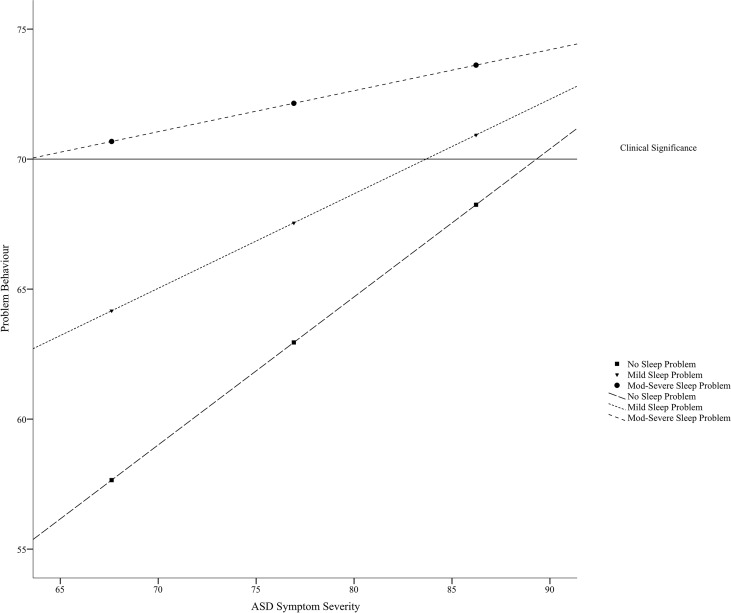
In addition to the core symptoms that define autism spectrum disorder (ASD), many individuals experience broader problem behavior at a level significant enough for families to seek further clinical assessment and intervention. We define "problem behavior" as any significant emotional or behavioral issue captured by the Child Behavior Checklist (CBCL) including anxiety, depression, withdrawal, somatic complaints, problems with socialization, thought or attention, rule-breaking, and aggression. While greater ASD symptom severity and accompanying sleep disturbance have each been linked with more severe problem behavior, there is little understanding about how these two key factors interact; that is, it is unclear whether the severity and type of sleep disturbance an individual experiences differentially influences the relationship between ASD symptom severity and problem behavior. The aim of the current study was, thus, to explore whether the link between greater ASD symptom severity and clinically elevated problem behavior is moderated by the presence/degree of accompanying sleep disturbance. Forty males with ASD, aged 5-12, participated in the study. The Social Responsiveness Scale, CBCL, and Children's Sleep Habits Questionnaire were administered to obtain information about ASD symptom severity, problem behavior, and sleep habits, respectively. Results indicated that the relationship between ASD symptom severity and problem behavior differed among individuals with ASD depending on the degree of sleep disturbance they experienced. Specifically, there was a significant positive relationship between ASD symptom severity and problem behavior for individuals with no sleep disturbance or milder sleep disturbance (i.e., in these cases, individuals with severe ASD symptoms experienced clinically elevated problem behavior, while those with milder ASD symptoms experienced milder problem behavior). In contrast, there was no significant relationship between ASD symptom severity and problem behavior for individuals with moderate-to-severe sleep disturbance; rather, clinically significant problem behavior was apparent across all individuals irrespective of ASD symptom severity. Follow-up analyses indicated that disturbances in sleep duration, disordered breathing, and daytime sleepiness were related to clinically elevated problem behavior even among those with milder ASD symptoms. These findings emphasize the importance of routinely assessing for accompanying sleep disturbance in this population regardless of whether individuals present with mild, moderate, or severe ASD.
除了定义自闭症谱系障碍(ASD)的核心症状外,许多患者还存在更广泛的问题行为,其严重程度足以让家庭寻求进一步的临床评估和干预。我们将“问题行为”定义为儿童行为量表(CBCL)所涵盖的任何显著的情绪或行为问题,包括焦虑、抑郁、退缩、躯体不适、社交问题、思维或注意力问题、违规行为和攻击行为。虽然ASD症状严重程度的增加以及伴随的睡眠障碍都与更严重的问题行为有关,但对于这两个关键因素如何相互作用却知之甚少;也就是说,尚不清楚个体所经历的睡眠障碍的严重程度和类型是否会对ASD症状严重程度与问题行为之间的关系产生不同的影响。因此,本研究的目的是探讨伴随睡眠障碍的存在/程度是否会调节ASD症状严重程度增加与临床上问题行为增加之间的联系。40名年龄在5至12岁之间的患有ASD的男性参与了这项研究。分别使用社会反应量表、CBCL和儿童睡眠习惯问卷来获取有关ASD症状严重程度、问题行为和睡眠习惯的信息。结果表明,根据所经历的睡眠障碍程度不同,患有ASD的个体中ASD症状严重程度与问题行为之间的关系也有所不同。具体而言,对于没有睡眠障碍或睡眠障碍较轻的个体,ASD症状严重程度与问题行为之间存在显著的正相关(即,在这些情况下,ASD症状严重的个体临床上存在问题行为增加,而ASD症状较轻的个体问题行为较轻)。相比之下,对于中度至重度睡眠障碍的个体,ASD症状严重程度与问题行为之间没有显著关系;相反,无论ASD症状严重程度如何,所有个体都存在临床上显著的问题行为。后续分析表明,即使在ASD症状较轻的个体中,睡眠时间紊乱、呼吸障碍和日间嗜睡也与临床上问题行为增加有关。这些发现强调了在该人群中常规评估伴随睡眠障碍的重要性,无论个体表现为轻度、中度还是重度ASD。