Division of Epidemiology and Clinical Applications, National Eye Institute, National Institutes of Health, Bethesda, Maryland.
Division of Epidemiology and Clinical Applications, National Eye Institute, National Institutes of Health, Bethesda, Maryland; National Center for Biotechnology Information, National Library of Medicine, National Institutes of Health, Bethesda, Maryland.
Ophthalmology. 2019 Nov;126(11):1533-1540. doi: 10.1016/j.ophtha.2019.06.005. Epub 2019 Jun 11.
To assess the utility of deep learning in the detection of geographic atrophy (GA) from color fundus photographs and to explore potential utility in detecting central GA (CGA).
A deep learning model was developed to detect the presence of GA in color fundus photographs, and 2 additional models were developed to detect CGA in different scenarios.
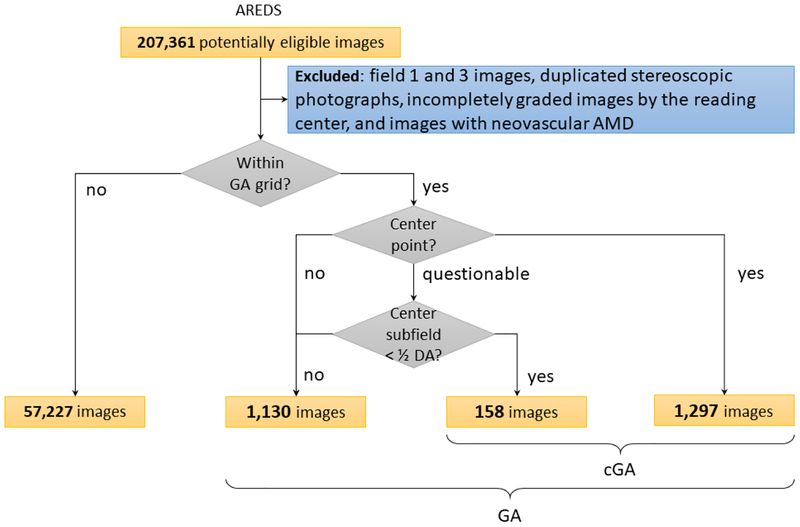
A total of 59 812 color fundus photographs from longitudinal follow-up of 4582 participants in the Age-Related Eye Disease Study (AREDS) dataset. Gold standard labels were from human expert reading center graders using a standardized protocol.
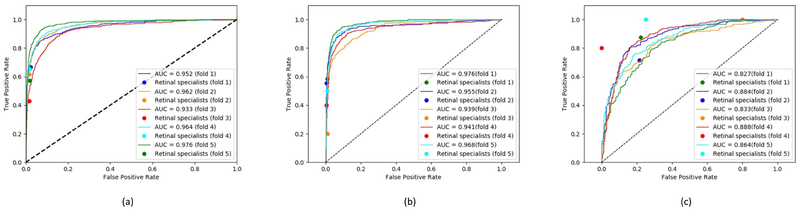
A deep learning model was trained to use color fundus photographs to predict GA presence from a population of eyes with no AMD to advanced AMD. A second model was trained to predict CGA presence from the same population. A third model was trained to predict CGA presence from the subset of eyes with GA. For training and testing, 5-fold cross-validation was used. For comparison with human clinician performance, model performance was compared with that of 88 retinal specialists.
Area under the curve (AUC), accuracy, sensitivity, specificity, and precision.
The deep learning models (GA detection, CGA detection from all eyes, and centrality detection from GA eyes) had AUCs of 0.933-0.976, 0.939-0.976, and 0.827-0.888, respectively. The GA detection model had accuracy, sensitivity, specificity, and precision of 0.965 (95% confidence interval [CI], 0.959-0.971), 0.692 (0.560-0.825), 0.978 (0.970-0.985), and 0.584 (0.491-0.676), respectively, compared with 0.975 (0.971-0.980), 0.588 (0.468-0.707), 0.982 (0.978-0.985), and 0.368 (0.230-0.505) for the retinal specialists. The CGA detection model had values of 0.966 (0.957-0.975), 0.763 (0.641-0.885), 0.971 (0.960-0.982), and 0.394 (0.341-0.448). The centrality detection model had values of 0.762 (0.725-0.799), 0.782 (0.618-0.945), 0.729 (0.543-0.916), and 0.799 (0.710-0.888).
A deep learning model demonstrated high accuracy for the automated detection of GA. The AUC was noninferior to that of human retinal specialists. Deep learning approaches may also be applied to the identification of CGA. The code and pretrained models are publicly available at https://github.com/ncbi-nlp/DeepSeeNet.
评估深度学习在检测彩色眼底照片中的地图状萎缩(GA)中的应用,并探索其在检测中心性 GA(CGA)中的潜在应用。
开发了一种深度学习模型来检测彩色眼底照片中 GA 的存在,并开发了另外两种模型来在不同场景中检测 CGA。
来自年龄相关性眼病研究(AREDS)数据集的 4582 名参与者的纵向随访共 59812 张彩色眼底照片。金标准标签是由人类专家阅读中心分级器使用标准化协议获得的。
训练深度学习模型使用彩色眼底照片从无 AMD 至晚期 AMD 的人群中预测 GA 的存在。第二个模型用于从相同人群中预测 CGA 的存在。第三个模型用于从有 GA 的眼中预测 CGA 的存在。用于训练和测试的是 5 折交叉验证。为了与人类临床医生的表现进行比较,比较了模型性能与 88 名视网膜专家的表现。
曲线下面积(AUC)、准确性、灵敏度、特异性和精度。
深度学习模型(GA 检测、来自所有眼睛的 CGA 检测和来自 GA 眼睛的中心性检测)的 AUC 分别为 0.933-0.976、0.939-0.976 和 0.827-0.888。GA 检测模型的准确性、灵敏度、特异性和精度分别为 0.965(95%置信区间[CI],0.959-0.971)、0.692(0.560-0.825)、0.978(0.970-0.985)和 0.584(0.491-0.676),而视网膜专家的准确性、灵敏度、特异性和精度分别为 0.975(0.971-0.980)、0.588(0.468-0.707)、0.982(0.978-0.985)和 0.368(0.230-0.505)。CGA 检测模型的数值为 0.966(0.957-0.975)、0.763(0.641-0.885)、0.971(0.960-0.982)和 0.394(0.341-0.448)。中心性检测模型的数值为 0.762(0.725-0.799)、0.782(0.618-0.945)、0.729(0.543-0.916)和 0.799(0.710-0.888)。
深度学习模型在 GA 的自动检测中表现出很高的准确性。AUC 与人类视网膜专家相当。深度学习方法也可用于 CGA 的识别。代码和预训练模型可在 https://github.com/ncbi-nlp/DeepSeeNet 上获得。