Research Institute of Wildlife Ecology, University of Veterinary Medicine, Vienna, Austria.
Tropical Diseases Research Program, School of Veterinary Medicine, National University, Heredia, Costa Rica.
Zoonoses Public Health. 2019 Nov;66(7):852-860. doi: 10.1111/zph.12635. Epub 2019 Jul 29.
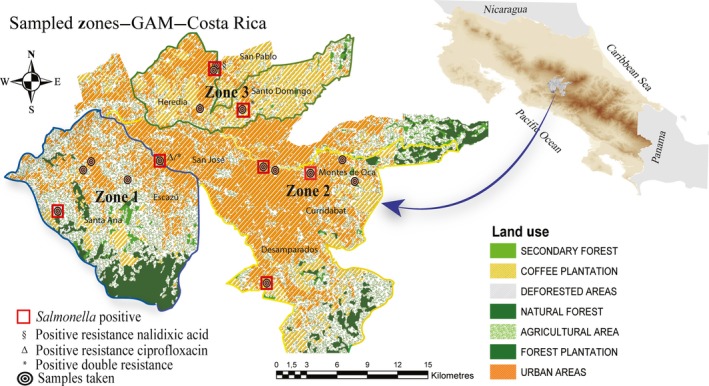
Wild animals are involved in zoonotic disease transmission cycles. These are generally complex and poorly understood, especially among animals adapted to life in human ecosystems. Raccoons are reservoirs and effective carriers for infectious agents such as Salmonella throughout different environments and contribute to the transference of resistance genes. This study examined the presence of circulating Salmonella sp. in a population of raccoons in a tropical urban environment and evaluated resistance to antibiotics commonly used to treat salmonellosis. A total of 97 raccoons of different ages and sex were included in this study. 49% (38-60 CI) of the faecal samples were positive for Salmonella spp. The study identified 15 circulating serovars with the most prevalent being S. Hartford (7/15), S. Typhimurium (4/15) and S. Bovismorbificans (4/15). These serovars correspond to the serovars detected in humans with clinical symptoms in Costa Rica. 9.5% of the Salmonella strains recovered demonstrated ciprofloxacin resistance, and 7.1% showed resistance to nalidixic acid. This study provides evidence of multiple Salmonella serovars circulating in a population of urban raccoons in Costa Rica. Furthermore, the study confirms the existence of antimicrobial resistance to two antibiotics used to treat human salmonellosis. The findings emphasize the role of the raccoon as a reservoir of Salmonella in the Greater Metropolitan Area of Costa Rica (GAM) and stress the need for active monitoring of the presence and possible spread in antibiotic resistance due to this peri-domestic carnivore.
野生动物是人畜共患病传播周期的参与者。这些传播周期通常很复杂且人们了解甚少,尤其是对于那些适应人类生态系统生活的动物而言。浣熊是沙门氏菌等传染性病原体的宿主和有效携带者,在不同环境中都有存在,并有助于耐药基因的转移。本研究调查了热带城市环境中浣熊种群中循环沙门氏菌的存在情况,并评估了对抗生素的耐药性,这些抗生素通常用于治疗沙门氏菌病。本研究共纳入了不同年龄和性别的 97 只浣熊。49%(38-60 CI)的粪便样本中存在沙门氏菌属。研究鉴定出 15 种循环血清型,其中最常见的是 S. Hartford(7/15)、S. Typhimurium(4/15)和 S. Bovismorbificans(4/15)。这些血清型与哥斯达黎加有临床症状的人类中检测到的血清型相对应。回收的 9.5%沙门氏菌菌株表现出对环丙沙星的耐药性,7.1%表现出对萘啶酸的耐药性。本研究提供了证据表明,在哥斯达黎加的城市浣熊种群中存在多种沙门氏菌血清型。此外,该研究证实了两种用于治疗人类沙门氏菌病的抗生素存在耐药性。这些发现强调了浣熊作为哥斯达黎加大都会区(GAM)沙门氏菌储存库的作用,并强调需要积极监测这种半驯化食肉动物的存在及其可能传播的抗生素耐药性。