Gonçalves Letícia Machado, Madeira Petrus Levid Barros, Diniz Rafael Soares, Nonato Rammon Farias, de Siqueira Fabiana Suelen Figuerêdo, de Sousa Eduardo Martins, Farias David Cardoso Sandes, Rocha Flaviane Maria Galvão, Rocha Carlos Henrique Lopes, Lago Andréa Dias Neves, Monteiro Cristina de Andrade
Department of Dentistry, Post-Graduate Program in Dentistry, CEUMA University, Sao Luis, Maranhao, Brazil.
Department of Dentistry, CEUMA University, Sao Luis, Maranhao, Brazil.
Evid Based Complement Alternat Med. 2019 Jul 7;2019:7481341. doi: 10.1155/2019/7481341. eCollection 2019.
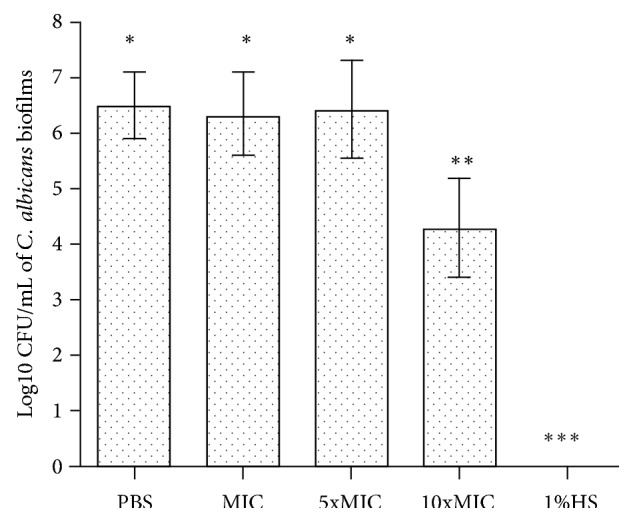
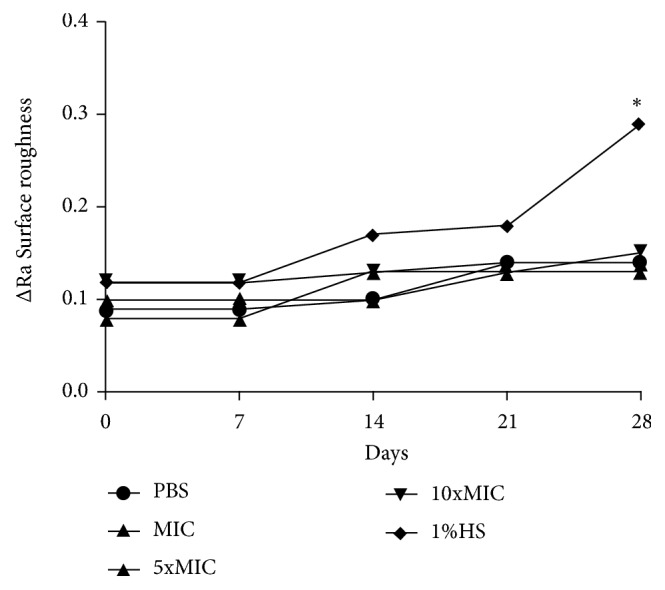
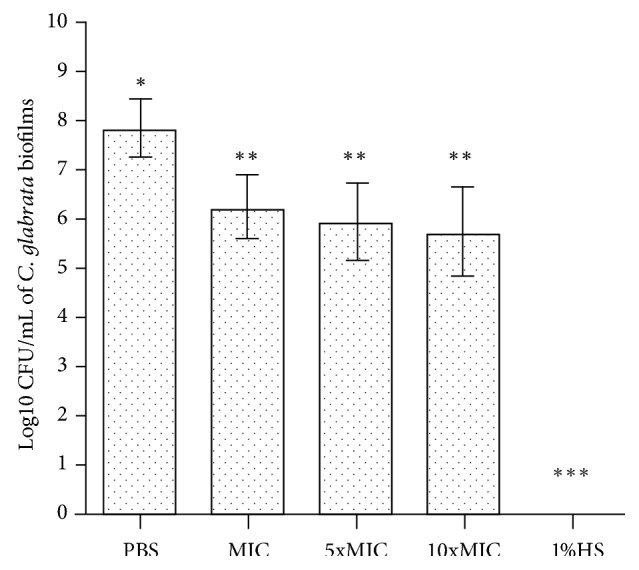
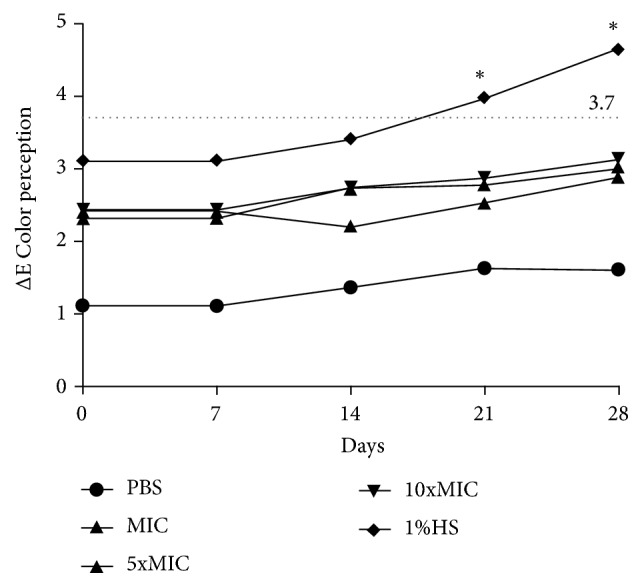
This study aimed to investigate the effect of the n-butanol fraction of Linn., (FBuTC) on biofilm of and , as well as changes in color and roughness of polymethyl methacrylate resin (PMMA). The susceptibility of and to FBuTC was evaluated by means of the Minimum Inhibitory and Minimum Fungicidal Concentration (MIC and MFC). PMMA acrylic resin discs (N= 108) were fabricated. For the susceptibility tests, biofilms of and were developed on discs for 48 h and immersed in phosphate-saline buffer solution (PBS), 1% sodium hypochlorite (SH 1%), or FBuTC at MIC, 5xMIC, or 10xMIC. For the color and roughness change tests, the discs were immersed in distilled water, SH 1%, or FBuTC in the concentrations of 0.25 mg/mL, 2.5 mg/mL, or 25.0 mg/mL. After 28 days of incubation, color change was evaluated by spectrophotometry and roughness, by using a profilometer. The biofilms were investigated by one-way ANOVA and, the color and roughness changes (two-way ANOVA and the Tukey test; =0.05). For both MIC and MFC the value of 0.25 mg/mL of FBuTC was observed for the planktonic cells of and . Exposure to FBuTC at 10xMIC had a significant effect on the biofilm of , showing a reduction in cell counts when compared with PBS, (=0.001). For the biofilm of , the MIC was sufficient for significantly reducing the cell count (<0.001). No important changes in color and roughness of the acrylic resin were observed, even after 28 days, irrespective of the concentration of FBuTC used ( >0.05). It could be concluded that the immersion of acrylic resin for dental prosthesis in FBuTC was effective in reducing the biofilms of and without evidence of change in roughness and color of this substrate.
本研究旨在探讨丁香罗勒(Ocimum gratissimum Linn.)正丁醇部位(FBuTC)对白色念珠菌(Candida albicans)和热带念珠菌(Candida tropicalis)生物膜的影响,以及对聚甲基丙烯酸甲酯树脂(PMMA)颜色和粗糙度的改变。通过最低抑菌浓度和最低杀菌浓度(MIC和MFC)评估白色念珠菌和热带念珠菌对FBuTC的敏感性。制作了PMMA丙烯酸树脂圆盘(N = 108)。在敏感性试验中,白色念珠菌和热带念珠菌的生物膜在圆盘上形成48小时,然后浸入磷酸盐缓冲盐水溶液(PBS)、1%次氯酸钠(SH 1%)或MIC、5xMIC或10xMIC浓度的FBuTC中。在颜色和粗糙度变化试验中,圆盘浸入蒸馏水、SH 1%或浓度为0.25mg/mL、2.5mg/mL或25.0mg/mL的FBuTC中。孵育28天后,通过分光光度法评估颜色变化,使用轮廓仪评估粗糙度。生物膜通过单因素方差分析进行研究,颜色和粗糙度变化通过双因素方差分析和Tukey检验进行研究(α = 0.05)。对于MIC和MFC,观察到FBuTC对白色念珠菌和热带念珠菌浮游细胞的浓度为0.25mg/mL。在10xMIC浓度下暴露于FBuTC对热带念珠菌的生物膜有显著影响,与PBS相比,细胞计数减少(P = 0.001)。对于白色念珠菌的生物膜,MIC足以显著减少细胞计数(P < 0.001)。即使在28天后,无论使用的FBuTC浓度如何,均未观察到丙烯酸树脂颜色和粗糙度的重要变化(P > 0.05)。可以得出结论,将牙科修复用丙烯酸树脂浸入FBuTC中可有效减少白色念珠菌和热带念珠菌的生物膜,且该基质的粗糙度和颜色无变化迹象。