Faculty of Health and Medicine, Lancaster University, Lancaster, UK.
Population Health Sciences, University of Bristol, Bristol, UK.
BMC Public Health. 2022 Dec 2;22(1):2247. doi: 10.1186/s12889-022-14688-3.
Peer education, whereby peers ('peer educators') teach their other peers ('peer learners') about aspects of health is an approach growing in popularity across school contexts, possibly due to adolescents preferring to seek help for health-related concerns from their peers rather than adults or professionals. Peer education interventions cover a wide range of health areas but their overall effectiveness remains unclear. This review aims to summarise the effectiveness of existing peer-led health interventions implemented in schools worldwide.
Five electronic databases were searched for eligible studies in October 2020. To be included, studies must have evaluated a school-based peer education intervention designed to address the health of students aged 11-18-years-old and include quantitative outcome data to examine effectiveness. The number of interventions were summarised and the impact on improved health knowledge and reductions in health problems or risk-taking behaviours were investigated for each health area separately, the Mixed Methods Appraisal Tool was used to assess quality.
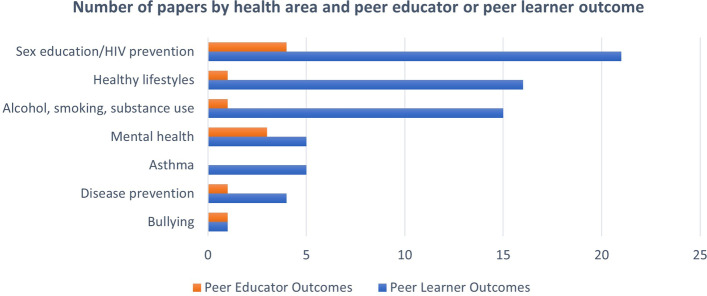
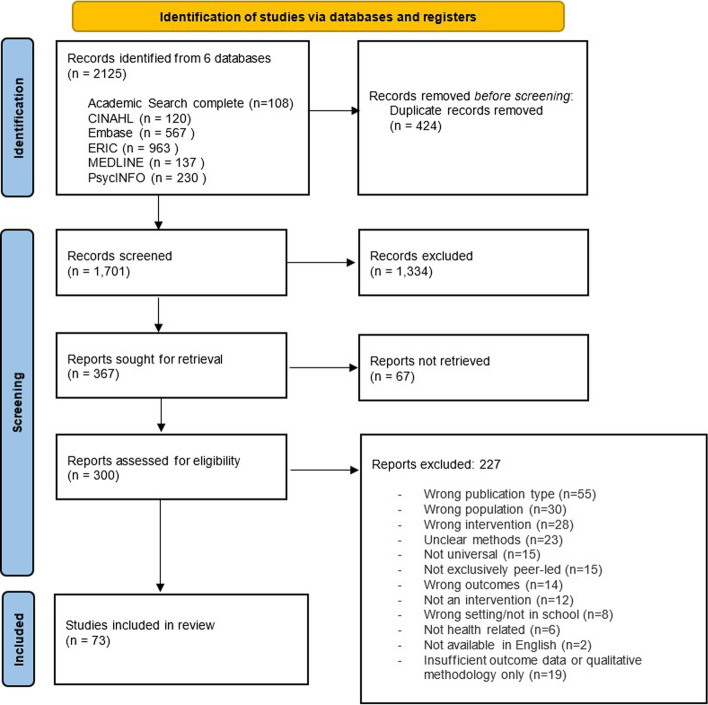
A total of 2125 studies were identified after the initial search and 73 articles were included in the review. The majority of papers evaluated interventions focused on sex education/HIV prevention (n = 23), promoting healthy lifestyles (n = 17) and alcohol, smoking and substance use (n = 16). Papers mainly reported peer learner outcomes (67/73, 91.8%), with only six papers (8.2%) focussing solely on peer educator outcomes and five papers (6.8%) examining both peer learner and peer educator outcomes. Of the 67 papers reporting peer learner outcomes, 35/67 (52.2%) showed evidence of effectiveness, 8/67 (11.9%) showed mixed findings and 24/67 (35.8%) found limited or no evidence of effectiveness. Of the 11 papers reporting peer educator outcomes, 4/11 (36.4%) showed evidence of effectiveness, 2/11 (18.2%) showed mixed findings and 5/11 (45.5%) showed limited or no evidence of effectiveness. Study quality varied greatly with many studies rated as poor quality, mainly due to unrepresentative samples and incomplete data.
School-based peer education interventions are implemented worldwide and span a wide range of health areas. A number of interventions appear to demonstrate evidence for effectiveness, suggesting peer education may be a promising strategy for health improvement in schools. Improvement in health-related knowledge was most common with less evidence for positive health behaviour change. In order to quantitatively synthesise the evidence and make more confident conclusions, there is a need for more robust, high-quality evaluations of peer-led interventions using standardised health knowledge and behaviour measures.
同伴教育是一种让同伴(“同伴教育者”)向其他同伴(“同伴学习者”)传授健康知识的方法,这种方法在学校环境中越来越受欢迎,可能是因为青少年更愿意向同龄人而不是成年人或专业人士寻求健康问题的帮助。同伴教育干预涵盖了广泛的健康领域,但它们的整体效果仍不清楚。本综述旨在总结全球范围内在学校实施的以同伴为基础的健康干预措施的有效性。
2020 年 10 月,我们在五个电子数据库中搜索了符合条件的研究。为了被纳入,研究必须评估一项以学生为基础的同伴教育干预措施,旨在解决 11-18 岁学生的健康问题,并纳入定量结果数据以检验效果。我们总结了干预措施的数量,并分别调查了每个健康领域的健康知识提高和健康问题或风险行为减少的影响,使用混合方法评估工具来评估质量。
经过最初的搜索,共确定了 2125 项研究,73 篇文章被纳入综述。大多数论文评估的干预措施侧重于性教育/艾滋病毒预防(n=23)、促进健康生活方式(n=17)和酒精、吸烟和药物使用(n=16)。论文主要报告了同伴学习者的结果(67/73,91.8%),只有 6 篇论文(8.2%)专门报告了同伴教育者的结果,5 篇论文(6.8%)同时报告了同伴学习者和同伴教育者的结果。在报告同伴学习者结果的 67 篇论文中,35/67(52.2%)显示出有效性的证据,8/67(11.9%)显示出混合结果,24/67(35.8%)发现有限或没有有效性的证据。在报告同伴教育者结果的 11 篇论文中,4/11(36.4%)显示出有效性的证据,2/11(18.2%)显示出混合结果,5/11(45.5%)显示出有限或没有有效性的证据。研究质量差异很大,许多研究被评为质量差,主要原因是样本无代表性和数据不完整。
在全球范围内实施了以学校为基础的同伴教育干预措施,涵盖了广泛的健康领域。一些干预措施似乎显示出有效性的证据,这表明同伴教育可能是改善学校健康的一种有前途的策略。与健康行为改变的证据较少相比,与健康相关的知识的提高更为常见。为了定量综合证据并得出更有信心的结论,需要使用标准化的健康知识和行为措施对同伴主导的干预措施进行更有力、高质量的评估。