Piñuel Lucrecia, Boeri Patricia, Zubillaga Fanny, Barrio Daniel Alejandro, Torreta Joaquin, Cruz Andrea, Vásquez Grace, Pinto Adelita, Carrillo Wilman
CIT-RIO NEGRO Sede Atlántica, Universidad Nacional de Rio Negro (UNRN-CONICET), Don Bosco y Leloir s/n, Rio Negro Viedma CP 8500, Argentina.
Research Department, Faculty of Health Sciences, Technical University of Babahoyo. Av. Universitaria Km 21/2 Av. Montalvo. Babahoyo CP 120301, Ecuador.
Plants (Basel). 2019 Jul 30;8(8):257. doi: 10.3390/plants8080257.
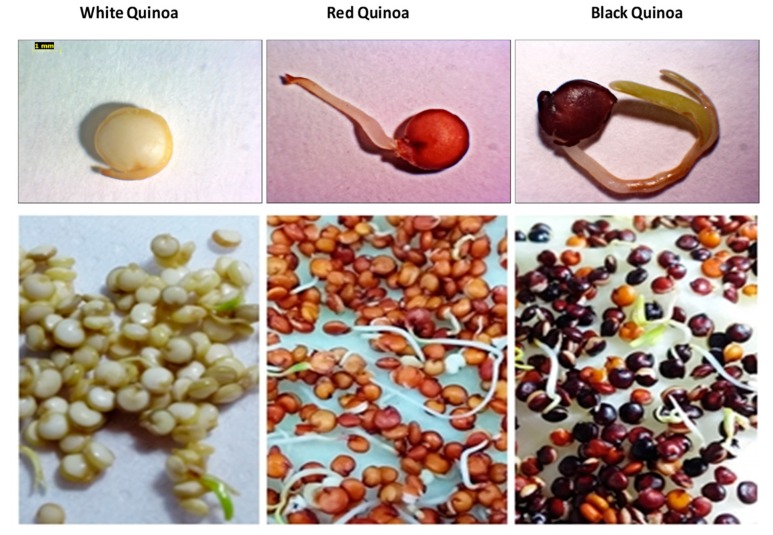
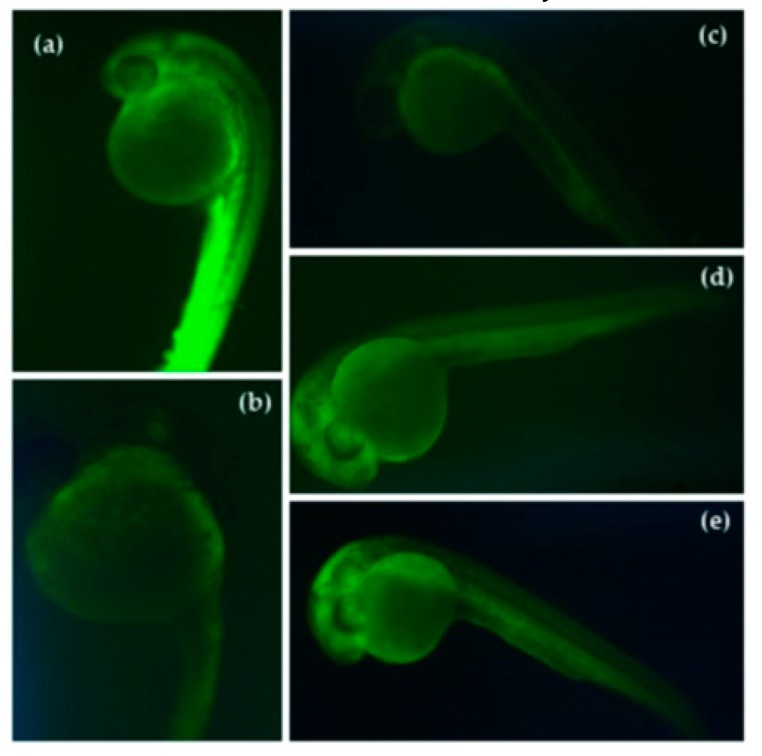
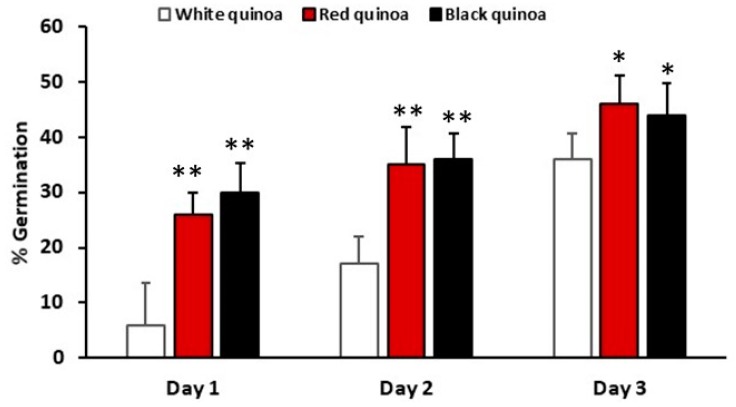
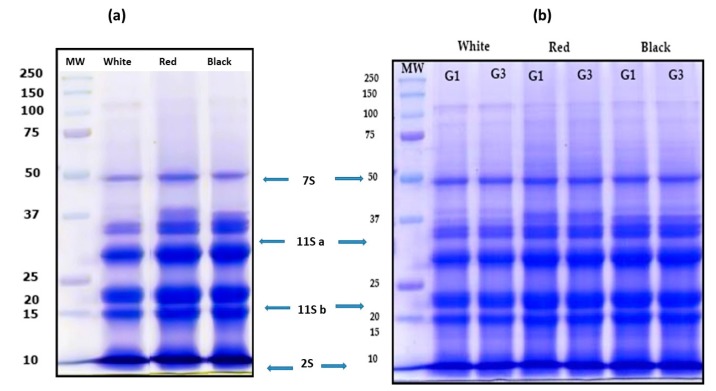
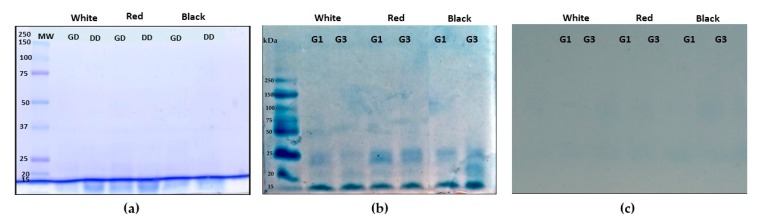
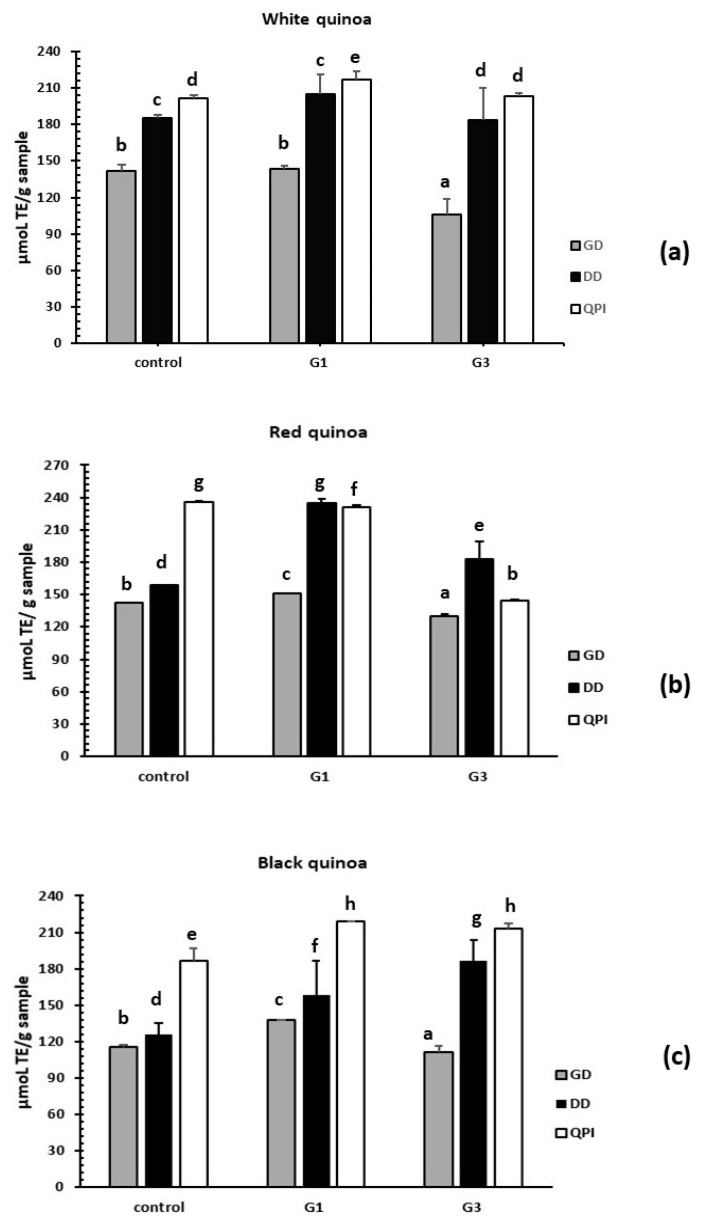
Red, black and white seeds quinoa were germinated at 28 °C during 24 (G1), 48 and 72 h (G3). Red quinoa presented a higher percentage of germination with a value of 46% of germination at 72 h. Quinoa protein isolate (QPI) was obtained by alkaline extraction (pH 8.0) followed by an isoelectric precipitation (pH 4.5) from white, red and black quinoa seeds, germinated QPI-G1 or QPI-G3 and non-germinated QPI-NG, Willd var. Real. QPI-G1, QPI-G3 and QPI-NG were subject to a simulated gastric digestion (DG) and in vitro duodenal digestion (DD). The antioxidant activity was evaluated using the 1, 1-diphenyl-2-picryl hydrazyl (DPPH), azino-bis-(3-ethylbenzothiazoline-6-sulfonic acid) (ABTS) and oxygen radical absorbance capacity (ORAC) methods. Gastric and duodenal digest of QPI-NG and QPI-G1 and QPI-G3 from white, red and black quinoa presented antioxidant activity. QPI-G1-DD of white quinoa presented the highest antioxidant activity with a DPPH value of 167.98 µmoL TE/g of digest, QPI-G1-DD of red quinoa with an ABTS value of 204.86 µmoL TE/g of digest and QPI-G1-DD of black quinoa with an ORAC value of 401.42 µmoL TE/g of digest. QPI-G3-DD of white quinoa presented higher antioxidant activity with a DPPH value of 186.28 µmoL TE/g of sample, QPI-G3-DD of red quinoa with an ABTS value of 144.06 µmoL TE/g of digest and QPI-G3-DD of black quinoa with an ORAC value of 395.14 µmoL TE/g of digest. The inhibition of reactive oxygen species (ROS) production in the zebrafish embryo model () was evaluated. Protein profiles of QPI from white, red and black from germinated quinoa and non-germinated quinoa were similar with proteins between 10 kDa to 100 kDa with the presence of globulins 11S and 7S and 2S albumins.
将红色、黑色和白色种子的藜麦在28°C下分别萌发24小时(G1)、48小时和72小时(G3)。红色藜麦的发芽率较高,在72小时时发芽率达到46%。通过碱性提取(pH 8.0),随后进行等电沉淀(pH 4.5),从白色、红色和黑色藜麦种子、萌发的QPI-G1或QPI-G3以及未萌发的QPI-NG(品种为Real)中获得藜麦蛋白分离物(QPI)。对QPI-G1、QPI-G3和QPI-NG进行模拟胃消化(DG)和体外十二指肠消化(DD)。使用1, 1-二苯基-2-苦基肼(DPPH)、2,2'-联氮-双-(3-乙基苯并噻唑啉-6-磺酸)(ABTS)和氧自由基吸收能力(ORAC)方法评估抗氧化活性。白色、红色和黑色藜麦的QPI-NG以及QPI-G1和QPI-G3的胃和十二指肠消化物均具有抗氧化活性。白色藜麦的QPI-G1-DD表现出最高的抗氧化活性,DPPH值为167.98 μmoL TE/g消化物;红色藜麦的QPI-G1-DD的ABTS值为204.86 μmoL TE/g消化物;黑色藜麦的QPI-G1-DD的ORAC值为401.42 μmoL TE/g消化物。白色藜麦的QPI-G3-DD表现出较高的抗氧化活性,DPPH值为186.28 μmoL TE/g样品;红色藜麦的QPI-G3-DD的ABTS值为144.06 μmoL TE/g消化物;黑色藜麦的QPI-G3-DD的ORAC值为395.14 μmoL TE/g消化物。评估了斑马鱼胚胎模型中活性氧(ROS)产生的抑制情况。萌发藜麦和未萌发藜麦的白色、红色和黑色QPI的蛋白质谱相似,蛋白质分子量在10 kDa至100 kDa之间,存在11S球蛋白、7S球蛋白和2S白蛋白。