Mfopit Youssouf Mouliom, Weber Judith Sophie, Chechet Gloria Dada, Ibrahim Mahamat Alhadj Moussa, Signaboubo Djoukzoumka, Achukwi Daniel Mbunkah, Mamman Mohammed, Balogun Emmanuel Oluwadare, Shuaibu Mohammed Nasir, Kabir Junaidu, Kelm Soerge
Institut de Recherche Agricole pour le Développement.
University of Bremen.
Res Sq. 2023 May 11:rs.3.rs-2902767. doi: 10.21203/rs.3.rs-2902767/v1.
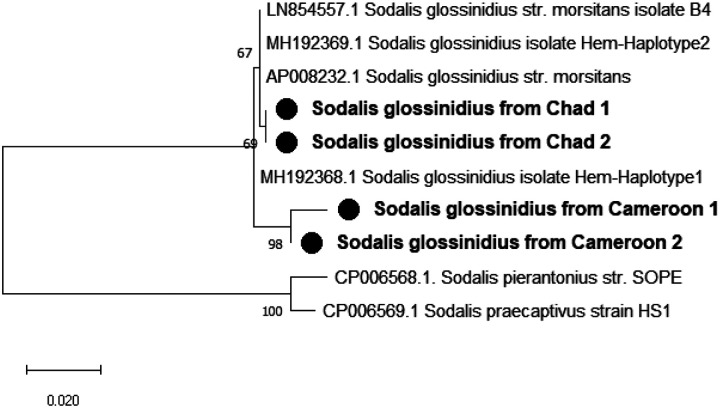
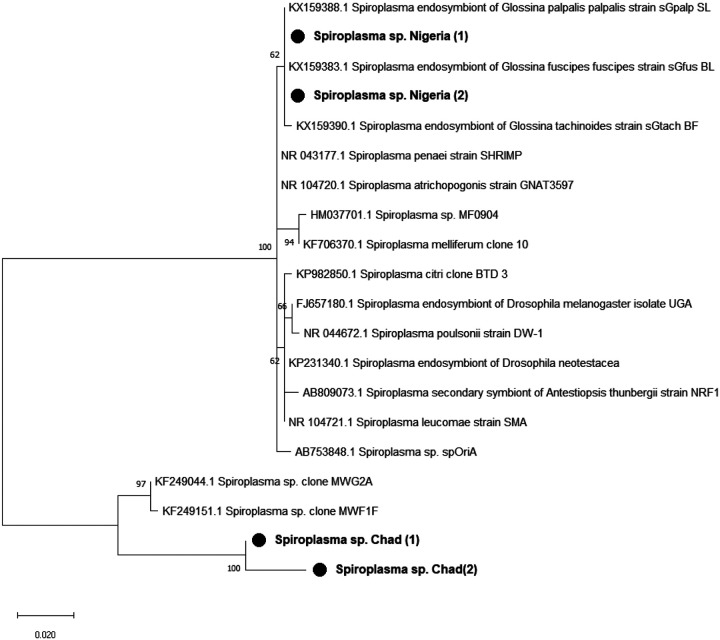
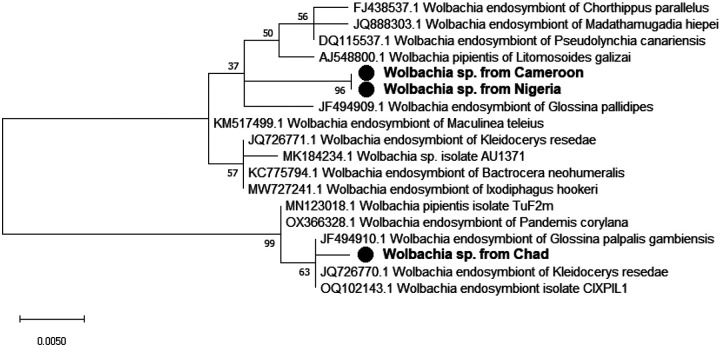
Tsetse flies are cyclical vectors of African trypanosomiasis. They have established symbiotic associations with different bacteria, which influence certain aspects of their physiology. The vector competence of tsetse flies for different trypanosome species is highly variable and is suggested to be affected by various factors, amongst which are bacterial endosymbionts. Symbiotic interactions may provide an avenue for the disease control. The current study provided the prevalence of 3 tsetse symbionts in species from Cameroon, Chad and Nigeria. Tsetse flies were collected from five different locations and dissected. DNA was extracted and polymerase chain reaction PCR was used to detect the presence of , sp and using specific primers. A total of 848 tsetse samples were analysed: (47.52%), (37.26%), (9.08%) and (6.13%). Only 95 (11.20%) were infected with at least one of the 3 symbionts. Among the infected, 6 (6.31%) were carrying mixed infection ( and ). The overall symbiont prevalence was 0.88%, 3.66% and 11.00% respectively, for , and . Prevalence varied between countries and tsetse species. No was detected in samples from Cameroon and no was found in samples from Nigeria. The present study revealed for the first time, the presence of infection by in tsetse in Chad and Nigeria. These findings provide useful information to the repertoire of bacterial flora of tsetse flies and incite to more investigations to understand their implication in the vector competence of tsetse flies.
采采蝇是非洲锥虫病的周期性传播媒介。它们与不同细菌建立了共生关系,这些细菌会影响其生理的某些方面。采采蝇对不同锥虫物种的传播能力差异很大,据推测受多种因素影响,其中包括细菌内共生体。共生相互作用可能为疾病控制提供一条途径。当前研究提供了喀麦隆、乍得和尼日利亚的采采蝇物种中3种采采蝇共生体的流行情况。从五个不同地点采集采采蝇并进行解剖。提取DNA,使用聚合酶链反应(PCR),通过特异性引物检测 、 菌属和 的存在情况。总共分析了848份采采蝇样本: (47.52%)、 (37.26%)、 (9.08%)和 (6.13%)。只有95份(11.20%)感染了至少一种这3种共生体。在受感染的样本中,6份(6.31%)携带混合感染( 和 )。 、 和 的总体共生体流行率分别为0.88%、3.66%和11.00%。流行率在不同国家和采采蝇物种之间有所不同。在喀麦隆的样本中未检测到 ,在尼日利亚的样本中未发现 。本研究首次揭示了乍得和尼日利亚的采采蝇中存在 感染。这些发现为采采蝇细菌菌群库提供了有用信息,并促使开展更多调查以了解它们在采采蝇传播能力中的作用。