Department of Behavioural Science and Health, University College London, London, United Kingdom.
PLoS One. 2019 Aug 1;14(8):e0220195. doi: 10.1371/journal.pone.0220195. eCollection 2019.
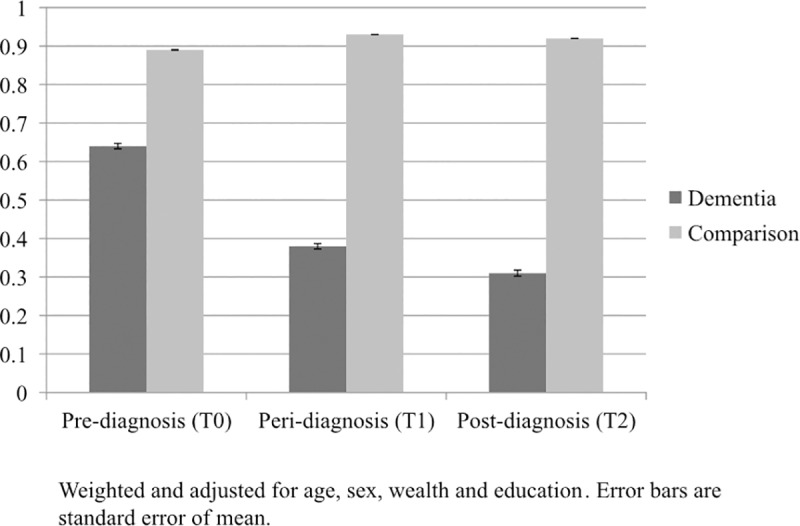
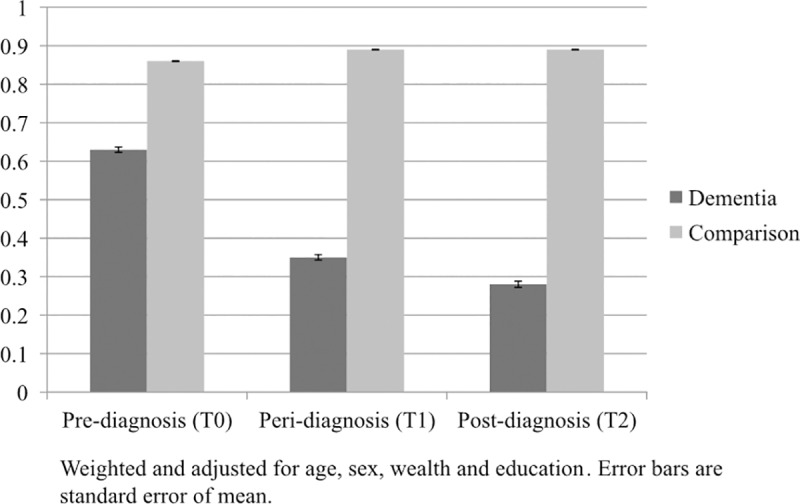
Social engagement protects against dementia onset. Less is known about patterns of social engagement around the time of dementia diagnosis. We investigated face-to-face and telephone contact at three times (pre-diagnosis, at report of diagnosis, 2 years post-diagnosis) in individuals who developed dementia and a comparison group.
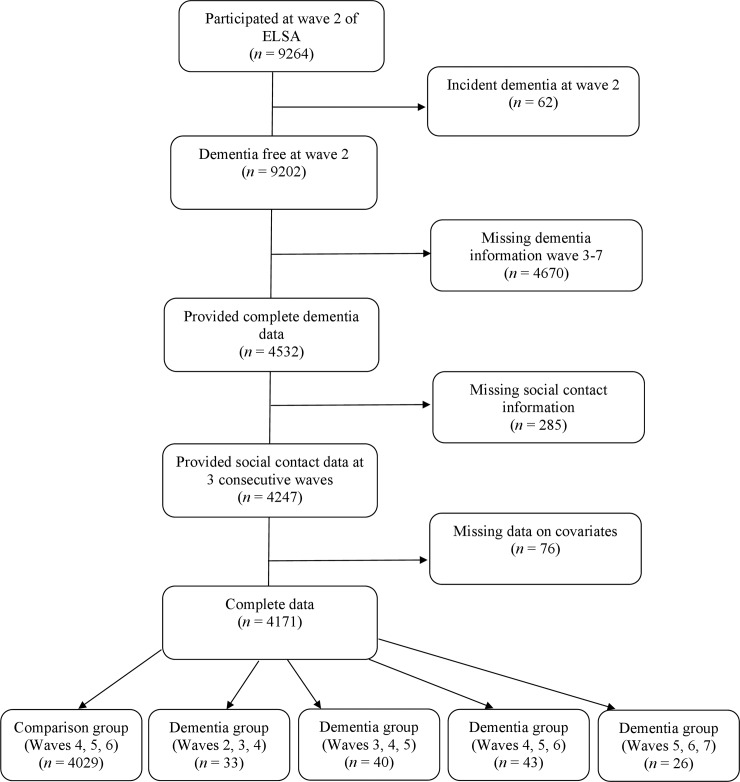
Social engagement was assessed at waves 2-7 of the English Longitudinal Study of Ageing in 4171 individuals aged 50 and older. Dementia was ascertained by either self-reported physician diagnosis or through an informant evaluation of a participant's functional and cognitive performance compared with a few years earlier. Generalized estimating equations were used to examine differences by group, time, and group-by-time interactions.
The dementia group reported less face-to-face (p < 0.001) and telephone contact (p < 0.001) than the dementia-free group pre-diagnosis. The dementia group experienced greater reductions in social engagement leading up to dementia diagnosis and in the 2 years following diagnosis (p's < 0.001).
Given that social engagement reduces dementia risk and supports the lived experience of people with dementia, it is important to find ways of promoting social interaction in older adults.
社交参与可以预防痴呆症的发生。关于痴呆症诊断前后社交参与模式的了解较少。我们研究了在被诊断患有痴呆症的个体和对照组中,三个时间点(诊断前、诊断报告时、诊断后 2 年)的面对面和电话接触情况。
在年龄较大的 50 岁及以上的人群中,通过英国纵向老龄化研究的第 2-7 波评估社交参与情况。通过自我报告的医生诊断或通过对参与者的功能和认知表现与几年前的比较,由知情人评估来确定痴呆症。使用广义估计方程来检查组间、时间和组间时间交互作用的差异。
痴呆症组报告的面对面(p < 0.001)和电话接触(p < 0.001)均少于痴呆症组。在诊断为痴呆症之前,以及在诊断后 2 年内,痴呆症组的社交参与度下降幅度更大(p 值均<0.001)。
鉴于社交参与可以降低痴呆症的风险并支持痴呆症患者的生活体验,因此找到促进老年人社交互动的方法很重要。