Department of Biochemistry and Molecular Biology, Bio21 Molecular Science and Biotechnology Institute, The University of Melbourne, Parkville, 3010, Australia.
School of BioSciences, The University of Melbourne, Parkville, 3010, Australia.
Genome Biol. 2019 Aug 1;20(1):151. doi: 10.1186/s13059-019-1756-6.
In multicellular organisms, alternative splicing is central to tissue differentiation and identity. Unicellular protists lack multicellular tissue but differentiate into variable cell types during their life cycles. The role of alternative splicing in transitions between cell types and establishing cellular identity is currently unknown in any unicellular organism.
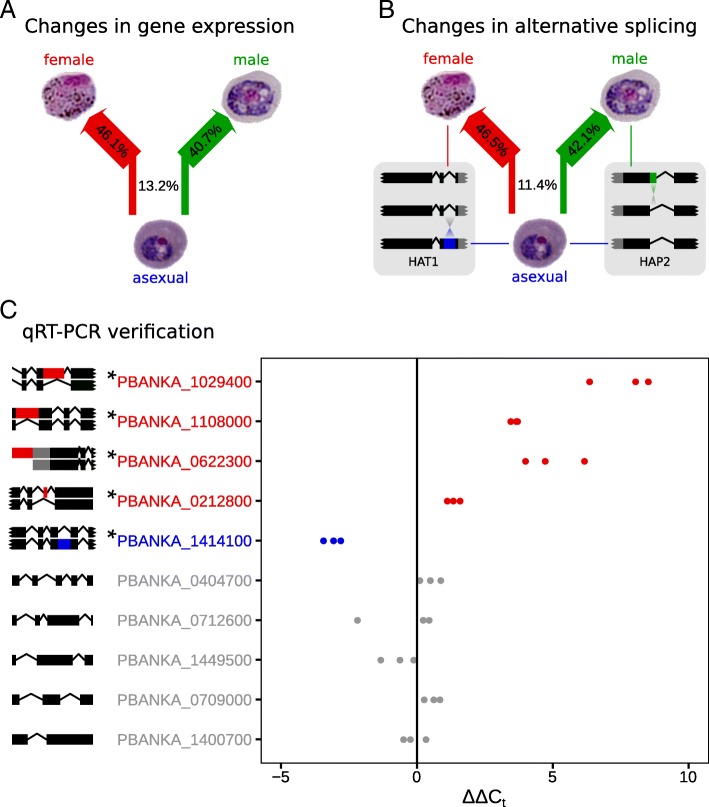
To test whether alternative splicing in unicellular protists plays a role in cellular differentiation, we conduct RNA-seq to compare splicing in female and male sexual stages to asexual intraerythrocytic stages in the rodent malaria parasite Plasmodium berghei. We find extensive changes in alternative splicing between stages and a role for alternative splicing in sexual differentiation. Previously, general gametocyte differentiation was shown to be modulated by specific transcription factors. Here, we show that alternative splicing establishes a subsequent layer of regulation, controlling genes relating to consequent sex-specific differentiation of gametocytes.
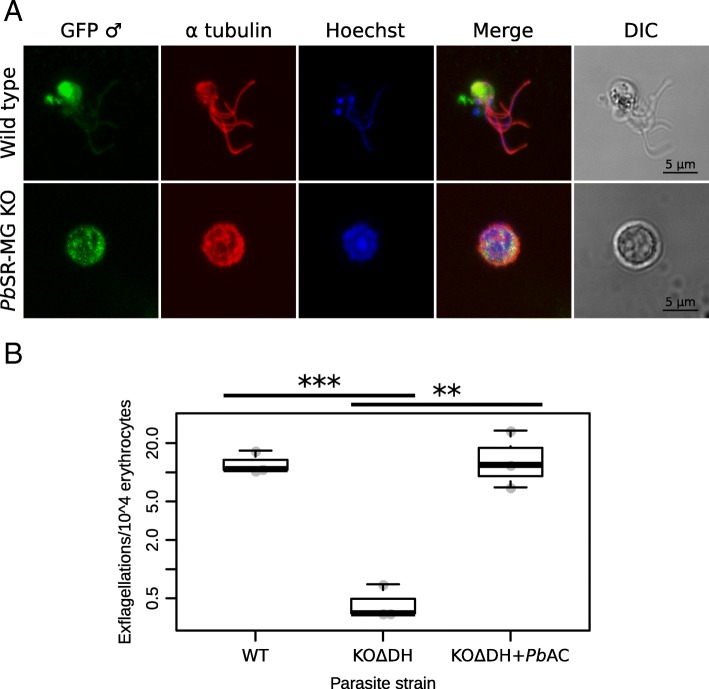
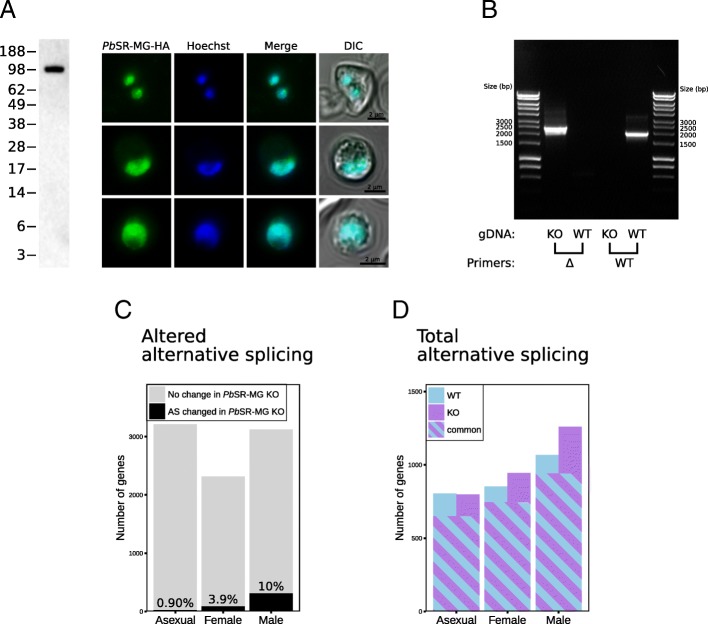
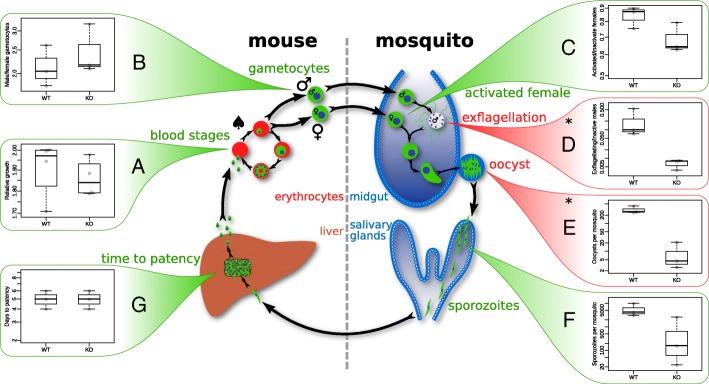
We demonstrate that alternative splicing is reprogrammed during cellular differentiation of a unicellular protist. Disruption of an alternative splicing factor, PbSR-MG, perturbs sex-specific alternative splicing and decreases the ability of the parasites to differentiate into male gametes and oocysts, thereby reducing transmission between vertebrate and insect hosts. Our results reveal alternative splicing as an integral, stage-specific phenomenon in these protists and as a regulator of cellular differentiation that arose early in eukaryotic evolution.
在多细胞生物中,可变剪接是组织分化和身份的核心。单细胞原生动物缺乏多细胞组织,但在其生命周期中会分化为不同的细胞类型。目前,在任何单细胞生物中,可变剪接在细胞类型之间的转变和建立细胞身份方面的作用尚不清楚。
为了测试单细胞原生动物中的可变剪接是否在细胞分化中起作用,我们进行了 RNA-seq 分析,比较了啮齿动物疟原虫 Plasmodium berghei 中的雌性和雄性性阶段与无性红细胞内阶段的剪接情况。我们发现阶段之间的可变剪接发生了广泛变化,并且可变剪接在性分化中起作用。以前,普遍的配子体分化被证明是由特定的转录因子调节的。在这里,我们表明可变剪接建立了随后的调控层,控制与配子体随后的性别特异性分化相关的基因。
我们证明了可变剪接在单细胞原生动物的细胞分化过程中被重新编程。一种替代剪接因子 PbSR-MG 的破坏扰乱了性别特异性的替代剪接,降低了寄生虫分化为雄性配子和卵囊的能力,从而减少了脊椎动物和昆虫宿主之间的传播。我们的研究结果表明,可变剪接是这些原生动物中一个完整的、特定阶段的现象,也是细胞分化的一个调节因子,它在真核生物进化的早期就出现了。