Pennartz Cyriel M A, Farisco Michele, Evers Kathinka
Department of Cognitive and Systems Neuroscience, Swammerdam Institute for Life Sciences, University of Amsterdam, Amsterdam, Netherlands.
Research Priority Area, Brain and Cognition, University of Amsterdam, Amsterdam, Netherlands.
Front Syst Neurosci. 2019 Jul 16;13:25. doi: 10.3389/fnsys.2019.00025. eCollection 2019.
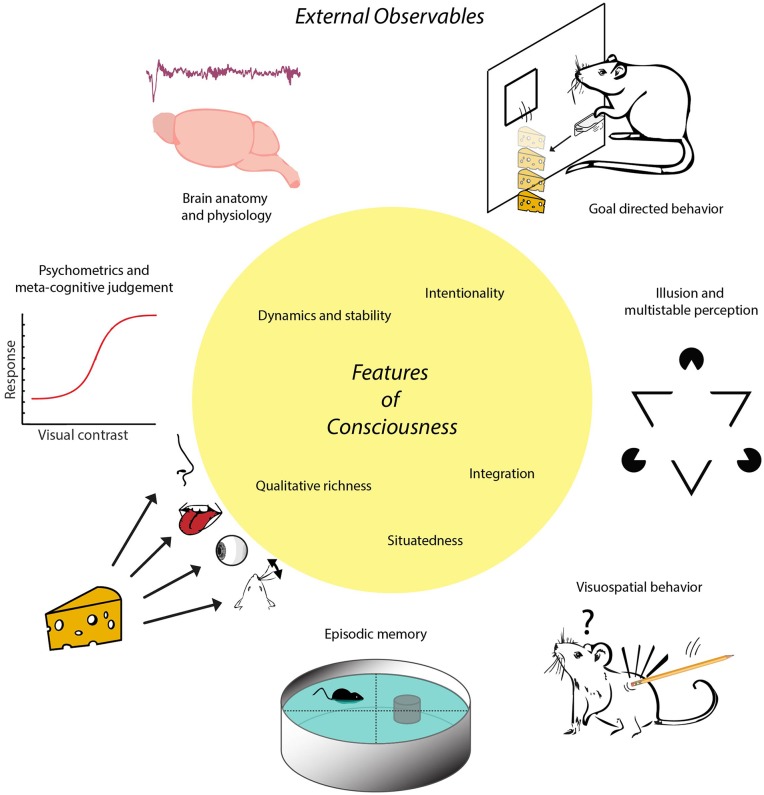
In today's society, it becomes increasingly important to assess which non-human and non-verbal beings possess consciousness. This review article aims to delineate criteria for consciousness especially in animals, while also taking into account intelligent artifacts. First, we circumscribe what we mean with "consciousness" and describe key features of subjective experience: qualitative richness, situatedness, intentionality and interpretation, integration and the combination of dynamic and stabilizing properties. We argue that consciousness has a biological function, which is to present the subject with a multimodal, situational survey of the surrounding world and body, subserving complex decision-making and goal-directed behavior. This survey reflects the brain's capacity for internal modeling of external events underlying changes in sensory state. Next, we follow an inside-out approach: how can the features of conscious experience, correlating to mechanisms inside the brain, be logically coupled to externally observable ("outside") properties? Instead of proposing criteria that would each define a "hard" threshold for consciousness, we outline six indicators: (i) goal-directed behavior and model-based learning; (ii) anatomic and physiological substrates for generating integrative multimodal representations; (iii) psychometrics and meta-cognition; (iv) episodic memory; (v) susceptibility to illusions and multistable perception; and (vi) specific visuospatial behaviors. Rather than emphasizing a particular indicator as being decisive, we propose that the consistency amongst these indicators can serve to assess consciousness in particular species. The integration of scores on the various indicators yields an overall, graded criterion for consciousness, somewhat comparable to the Glasgow Coma Scale for unresponsive patients. When considering theoretically derived measures of consciousness, it is argued that their validity should not be assessed on the basis of a single quantifiable measure, but requires cross-examination across multiple pieces of evidence, including the indicators proposed here. Current intelligent machines, including deep learning neural networks (DLNNs) and agile robots, are not indicated to be conscious yet. Instead of assessing machine consciousness by a brief Turing-type of test, evidence for it may gradually accumulate when we study machines ethologically and across time, considering multiple behaviors that require flexibility, improvisation, spontaneous problem-solving and the situational conspectus typically associated with conscious experience.
在当今社会,评估哪些非人类和非语言生物具有意识变得越来越重要。这篇综述文章旨在阐述意识的标准,特别是针对动物的标准,同时也考虑智能人工制品。首先,我们界定“意识”的含义,并描述主观体验的关键特征:质的丰富性、情境性、意向性与解释、整合以及动态与稳定特性的结合。我们认为意识具有生物学功能,即向主体呈现对周围世界和身体的多模态情境性概览,以辅助复杂的决策制定和目标导向行为。这种概览反映了大脑对感觉状态变化背后外部事件进行内部建模的能力。接下来,我们采用由内而外的方法:与大脑内部机制相关的意识体验特征如何能在逻辑上与外部可观察到的(“外部”)属性相联系?我们不是提出各自定义意识“硬”阈值的标准,而是概述六个指标:(i)目标导向行为和基于模型的学习;(ii)生成整合多模态表征的解剖学和生理学基础;(iii)心理测量学和元认知;(iv)情景记忆;(v)对错觉和多稳态感知的易感性;以及(vi)特定的视觉空间行为。我们不是强调某个特定指标具有决定性,而是提出这些指标之间的一致性可用于评估特定物种的意识。各种指标得分的整合产生一个整体的、分级的意识标准,有点类似于针对无反应患者的格拉斯哥昏迷量表。在考虑从理论推导的意识测量方法时,有人认为其有效性不应基于单一可量化的测量来评估,而是需要对包括此处提出指标在内的多条证据进行交叉检验。当前的智能机器,包括深度学习神经网络(DLNNs)和敏捷机器人,尚未被表明具有意识。与其通过简短的图灵式测试来评估机器意识,当我们从行为学角度并随着时间研究机器时,考虑到多种需要灵活性、即兴发挥、自发解决问题以及通常与意识体验相关的情境性概览的行为,支持机器意识的证据可能会逐渐积累。